- You are here:
- Home »
- Blog
5 Marketing Trends That Might Not Survive in 2024 [HubSpot Research + Expert Insights]

Few marketing trends last forever. In reality, they come and go at rapid speed — and marketers must adapt.
Few marketing trends last forever. In reality, they come and go at rapid speed — and marketers must adapt.
Because marketing is always evolving, your marketing playbook should, too. But if your strategy looks the same as years prior, it’s time to do some housekeeping.
Here, we’ll cover five marketing trends that are losing steam and how marketers can respond.
![Download Now: Free State of Marketing Report [Updated for 2024]](https://no-cache.hubspot.com/cta/default/53/b0f73a5e-16e4-41fd-9511-8564efc560a7.png)
1. Account-based marketing.
In 2023, only 13% of marketers leveraged account-based marketing (ABM), according to HubSpot’s annual State of Marketing report.
To Dustin Brackett, CEO and Founder of HIVE Strategy, this makes sense. As he told me, “While I strongly believe in ABM and the power it has for organizations trying to sell into a targeted list of other organizations, I can see why it will never be at the top of the marketing trends lists. ABM is really only valuable for organizations that have high-value customers. There isn’t a ton of ROI to be had by investing in ABM for a B2C organization, or any organization that has a lower customer lifetime value because ABM is a large investment in time, resources, and dollars.
Matt Freestone, Managing Director at Unmatched, sees many of his clients investing in ABM. However, he believes the resistance to ABM comes from sales and marketing alignment issues.
As he puts it, “We’ve found that the reason ABM tends to not be utilized by marketers is that many businesses still have sales and marketing alignment issues. I think ABM will see a resurgence in 2024, as long as Sales and Marketing teams can come together, build effective campaigns, and share common goals.”
Finally, Katherine Forbes, Senior VP of Marketing at Creative Circle, believes ABM isn‘t topping the ’marketing trends of 2024‘ list because it’s become status quo for most sales reps. As she puts it, “The ABM approach has become so mainstream for B2B businesses that it can no longer be considered a differentiating tactic or a trend. In fact, it likely is the foundation of a typical seller’s sales methodology, rather than an approach employed solely by marketing teams.”
She adds, “ABM is still a productive tactic, but marketing teams (such as ours) may be better off focusing on delivering a white-glove and personalized experience through their e-commerce and self-service options. According to a Gartner, Inc. survey of 771 B2B buyers, 75% of B2B buyers now prefer a rep-free experience, but those who purchase through digital channels alone are more likely to regret their purchase.”
2. The metaverse.
Marketing is all about experimentation, and the metaverse became a new playground for marketers to explore. However, this initial excitement seems to be fizzling out.
In 2024, 14% of marketers plan to stop marketing in the metaverse (e.g. Horizon Worlds and Roblox). In addition, 13% plan to stop leveraging VR and AR.
Although the metaverse is intriguing, it’s proving difficult to execute. The equipment is expensive, the hardware is uncomfortable, and adoption is slow.
Adrian Alexandrescu, CEO of Mediapost Martech, says, “I wasn‘t a big believer in the whole Metaverse concept, as it seemed too much like something inspired by movies such as ’Ready Player One.‘ Fast forward to today: most of our clients haven’t invested a dime in Metaverse Marketing, Roblox, or similar platforms and have absolutely no plans for the near future to do so.”
That said, the metaverse is still in its infancy. As it continues to evolve, things could turn around.
3. Podcasts and other audio content.
This one surprised me. As a consumer, I listen to podcasts daily. And I’m not alone – around one in four internet users listen to podcasts, and in 2024, there are over 500 million podcast listeners.
So why wouldn’t podcasts be appealing to marketers?
As Blend’s Marketing Manager Dan Stillgoe told me, “Businesses are often quick to shutdown podcasts because they don’t see direct ROI from them. It’s true that you can’t directly attribute leads or revenue from a podcast, but that’s not its purpose. Podcasts are a long-term brand-building channel that can improve affinity and connection for your brand like no other channel. When you realize the long-term and surrounding benefits, podcasting becomes a clear and obvious investment.”
He adds, “Podcasting is the perfect way to craft content that’s engaging and authentic — something buyers are beginning to crave in this AI era.”
Additionally, I’m assuming some marketers feel the barrier-to-entry is a little high. Creating a full, high-quality podcast episode requires time and resources. It takes more effort than, say, posting an Instagram Reel, and it‘s harder to track ROI. But while it’s not easy, it’s worth considering if most of your consumers are podcast-listeners.
4. Audio chat rooms.
If you’ve been keeping up with tech news and tech publishers like TechAcute, you probably have come across an audio chat room at some point. Audio chat rooms — like Clubhouse and Twitter Spaces — surged in popularity during the start of the pandemic, when many people were seeking opportunities to connect with others.
Fast forward to today, and more than a quarter (14%) of marketers are planning to stop investing in audio chat rooms in 2024.
Additionally, only 13% of marketers invested in audio chat rooms in 2023.
From a marketing perspective, the biggest problem with audio chat rooms is that users prefer to speak with people — not brands.
Stephen Lackey, VP of Marketing at SmartBug Media, says, “The transient nature of audio content in these rooms makes it challenging for marketers to create lasting impressions. Unlike visual or written content, which can be revisited and shared easily with direct attribution, spoken words dissipate into the digital ether, making it harder for brands to maintain a sustained presence in users’ minds.”
He continues, “Moreover, the lack of visual elements restricts marketers from leveraging the power of visuals and multimedia content, a cornerstone in digital marketing in the upcoming year. Without the ability to showcase products or services, marketers struggle to engage their audience effectively, potentially losing valuable opportunities to convert interest into action (especially considering the significant time investment required for these platforms).”
Rather than leaning into audio chat rooms, Lackey suggests marketers focus on platforms that allow for a more controlled, visually engaging, and scalable approach.
5. User-generated content.
In 2024, 13% of marketers plan to decrease their investment in user-generated content (UGC).
There could be several reasons for this, including:
- Quality concerns: It can be difficult to maintain a consistent brand image when you‘re relying on content created by users, and that content might not always be as high-quality as you’d like.
- Limited control: Marketers have limited control over messaging when they’re reposting user-generated content. Additionally, it can be much harder to monitor comments and engagement on those posts.
- Difficulty in tracking ROI: It is difficult for marketers to track ROI on user-generated content.
During this tumultuous time where consumer preferences and behaviors are changing rapidly as a result of AI and shifting algorithms, marketers might prefer to keep full control over the content they produce – particularly since it’s easier to track impact on their own content.
However, when I spoke with Emplifi’s Chief Strategy Officer Kyle Wong earlier last year, he highlighted the importance of UGC, telling me, “When investing in a strategy around user-generated content, it’s important to understand the basics, which is this: We are investing in a strategy to essentially help capture more positive word-of-mouth marketing from our customers.”
I don’t think UGC is going away, but I could understand why marketers might be temporarily decreasing their investment as they consider how consumer preferences and behaviors are changing in 2024 — particularly with the current popularity of influencer marketing, instead.
Back to You
Marketing is always evolving, so your marketing playbook should, too. As we inch closer to 2023, it’s essential to take stock of which trends you want to leverage, and which ones are better left behind.


7 Email Banner Examples I Love (For Your Inspiration)

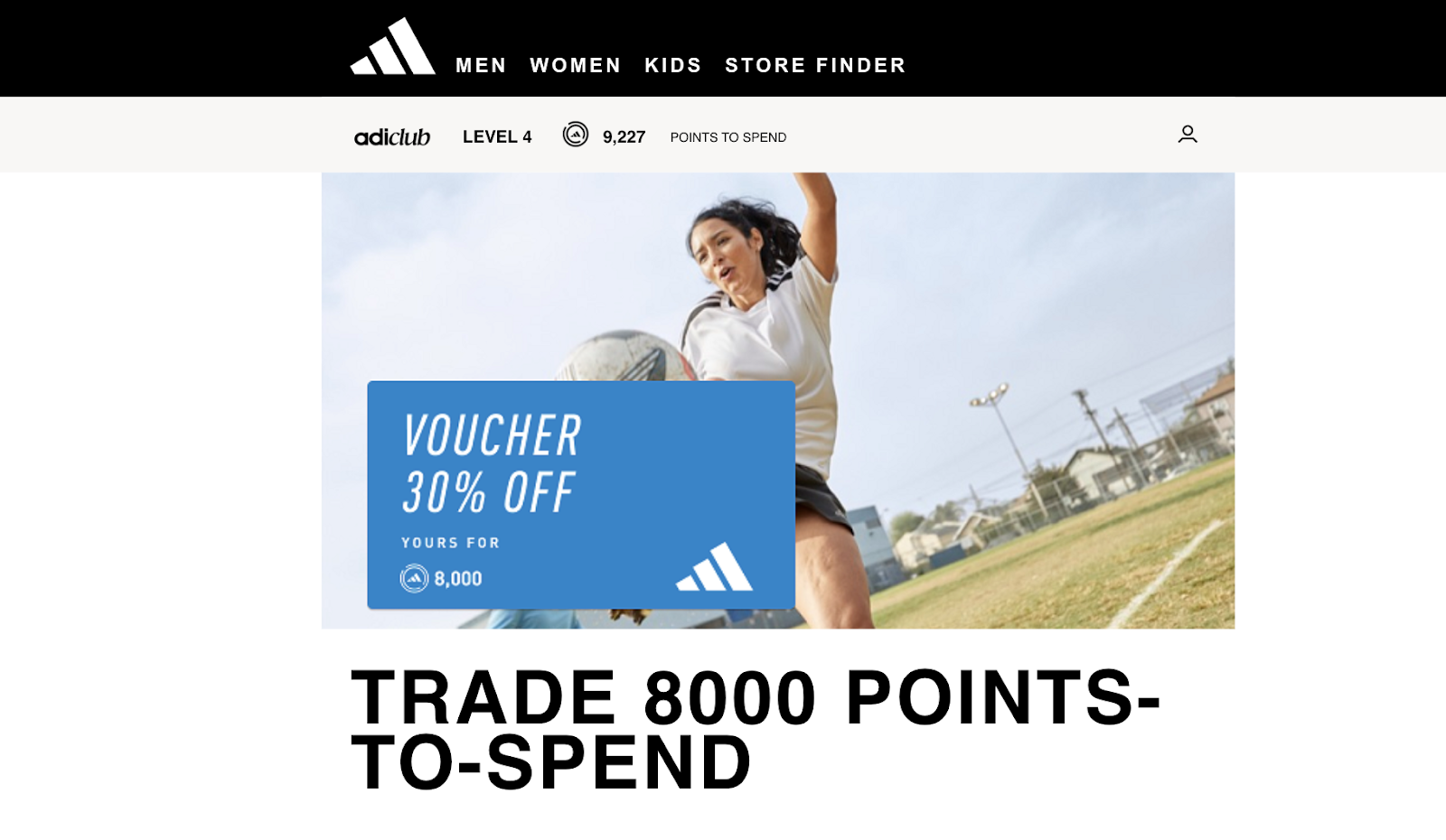
Last week, I was drinking coffee when an email from Adidas popped up.
At the top, I could see my 9,000+ loyalty points displayed prominently in the banner, along with an offer that immediately caught my attention: a 30% discount on my next purchase if I redeemed those points.
Last week, I was drinking coffee when an email from Adidas popped up.
At the top, I could see my 9,000+ loyalty points displayed prominently in the banner, along with an offer that immediately caught my attention: a 30% discount on my next purchase if I redeemed those points.
I quickly forgot my initial plan for a quiet coffee and was intrigued and excited by the potential savings. Points I’d accumulated from previous purchases, which I hadn’t thought much about, now seemed like gold.
That’s precisely what an impactful email banner does. It tempts you and turns a routine email check into an exciting shopping spree.
Here, I’ll share what an email banner needs to include to have that effect and highlight seven of my favorite email banners that haven’t only caught my eye and compelled me to take action.
![→ Download Now: The Beginner's Guide to Email Marketing [Free Ebook]](https://no-cache.hubspot.com/cta/default/53/53e8428a-29a5-4225-a6ea-bca8ef991c19.png)
What is an email banner?
A banner is a visual element at the top of an email that complements the marketing copy.
A banner is a great way to immediately set the tone for the message’s content and to create a lasting visual impression in the recipient’s mind.
Here’s what that exciting email banner from Adidas looked like:
Brand banners can range from simple designs featuring the brand’s name and logo to elaborate promotions.
These banners differ from signature banners, which you can find at the bottom of an email.
Banners are designed to capture your attention right from the start, while signature banners typically contain contact information, a professional sign-off, or links to social media handles.
What to Include in an Email Banner
While email banners have plenty of room for creativity, a few standard elements are a no-brainer. Include these elements for an impactful banner:
Brand Logo or Name
A brand logo and name in your header is the first thing people see. It sets the tone for the rest of your email content, reinforces your brand identity immediately, and lends credibility to your message.
For example, here’s a banner from PayPal featuring its logo:
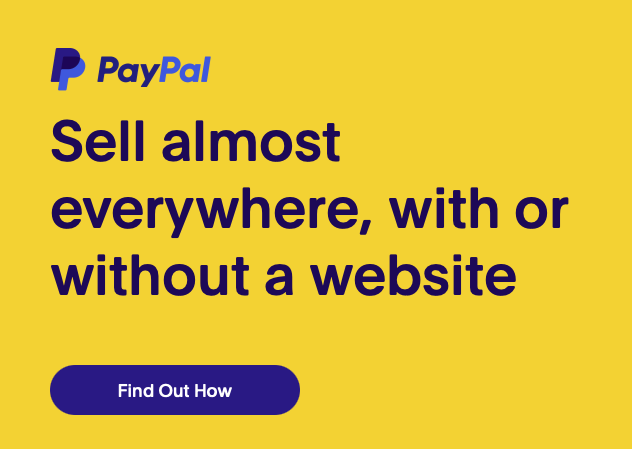
See how the design is simple and the logo visually apparent? Follow the same guidelines to incorporate your brand name and logo. PayPal’s background colors also complement each other and don’t clash.
Lastly, consider the size of your logo and name — PayPal’s logo is large enough to be easily recognizable but not so large that it overpowers the rest of the banner’s content.
Brand Colors
Using your brand colors in your email banner reinforces brand identity and ensures visual consistency. It’s much easier for recipients to recognize your email as a visual signature.
The key is not to play with too many colors. Keep your brand look professional and cohesive by using a limited color palette. Also, ensure the contrast between the background and text colors is enough to make your content readable.
Link to Your Website
Adding a link to your website in your email banner is a strategic move and is especially relevant for e-commerce emails. It provides a direct pathway for recipients to shop or explore your offerings.
For an e-commerce clothing store like H&M, links to specific categories guide customers to what interests them and make the shopping experience smoother.
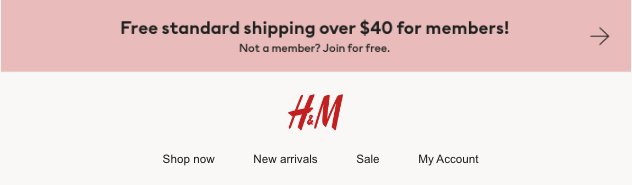
Pro tip: Make these links visually distinct and easy to find. Use clear, concise text or icons that represent each category.
Apart from this, ensure these links are mobile-friendly, too, since 56% of marketers use mobile-friendly emails in their email marketing strategy — and you don’t want to fall behind.
Current Promotions or Announcements
Highlighting current promotions or offers can reduce bounce rates and put your best deal front and center so nobody misses it.
A banner featuring a special sale, event announcement, discount code, or limited-time offer adds a sense of urgency to your message, encouraging subscribers to act quickly and not miss out.
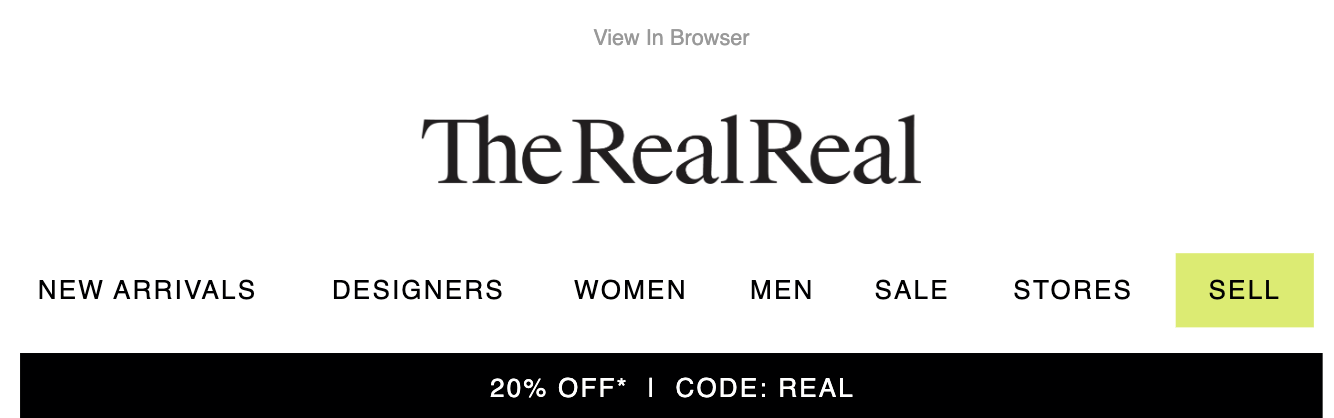
Make the promotion clear and straightforward with bold, legible fonts and colors that make a statement but still fit your brand’s look. It’s also essential to keep the timing in mind.
Keep your audience engaged by updating your banner with the most relevant offers.
Personalization Elements
Personalization elements, whether email or SMS, make any message feel more tailored and engaging to each recipient.
Litmus’ research shows that 80% of customers are more likely to purchase a personalized experience. And why not?
Customized emails are like greeting someone by name when they walk into your store — it makes the interaction feel more personal and welcoming.
Personalization can be as simple as including the recipient’s name in the banner or as complex as showcasing products based on browsing history.
Start with the basics. Use your email platform’s personalization tokens to insert names or relevant details into your banner. But keep it relevant, too. Make sure personalized content aligns with the recipient’s interests.
You increase your chances of making a meaningful impact with this approach.
The Best Email Banners
I’ve shared some examples and fundamental elements of email banners earlier, but how do you bring these together?
In this section, I’ll share seven of my favorite email banners that are unique in their way and will get your creative juices flowing:
1. Hootsuite
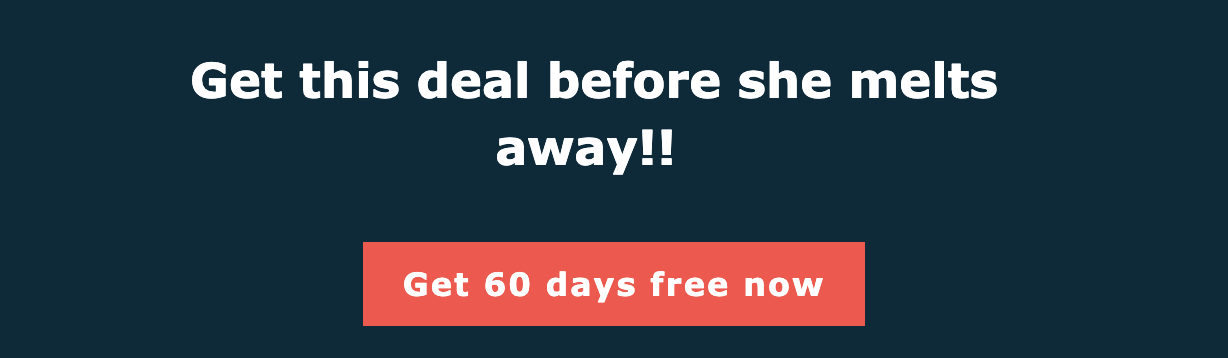
I love Hootsuite’s email banner. The tagline, “Get this deal before she melts away!!” adds personality and character to the email. This creative touch made the email memorable; I remember it even days later.
The brand also stuck to its brand guidelines with consistent colors and fonts. While the message is fun, it’s still unmistakably Hootsuite. This consistency reinforces brand identity in my head and cements these colors’ association with Hootsuite.
What I like: An orange-ish red for the CTA button was strategic. Research shows that red tones convey urgency and importance, encouraging me to click through. The color choice also fits within Hootsuite’s brand guidelines.
2. Old Navy
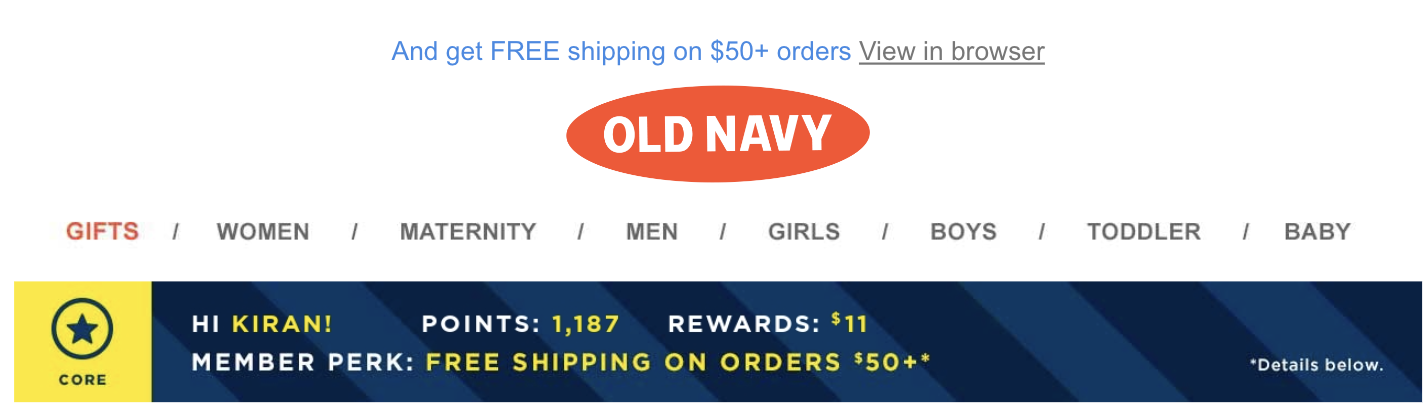
Old Navy’s email banner did a great job of making me feel like a loyal customer. I learned about an offer with the tagline “get FREE shipping on $50+ orders” and how it integrates personalized elements to improve my shopping experience.
Links to categories such as women, men, and gifts also make it easy for me to shift my focus to the website.
What caught my eye was how the banner summarized my rewards and points and even included my name. This personalization makes the shopping experience convenient and relevant by giving me a snapshot of where I stand.
What I like: The banner creatively uses space to combine several elements (offers, navigation, and personalization) without overwhelming me. It’s this balance between information and design that gets the message across.
3. Amazon Business
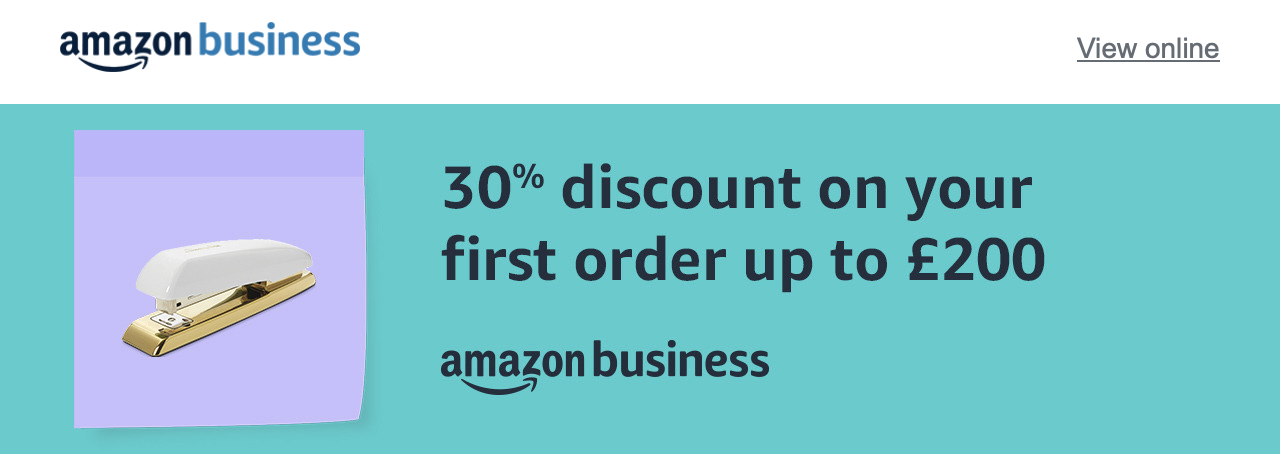
Amazon Business’s email banner caught my eye with its transparent, straightforward approach. It highlights a 30% discount on my first order up to £200 (around $252.64 USD), an offer that was hard to ignore for me.
What’s smart about their design is the clean, simple background they chose. There aren’t too many distractions, making the discount offer the show’s star.
The picture of the stapler in the banner is also quite cute. This fun and relevant element speaks directly to me and my needs and makes the entire message feel personalized and thoughtful.
What I like: Including a common office item, like a stapler, cleverly emphasizes the relevance of Amazon Business’s offerings to the everyday operational needs of small businesses.
It’s a subtle yet effective way to connect with the audience on a practical level.
4. Shopify
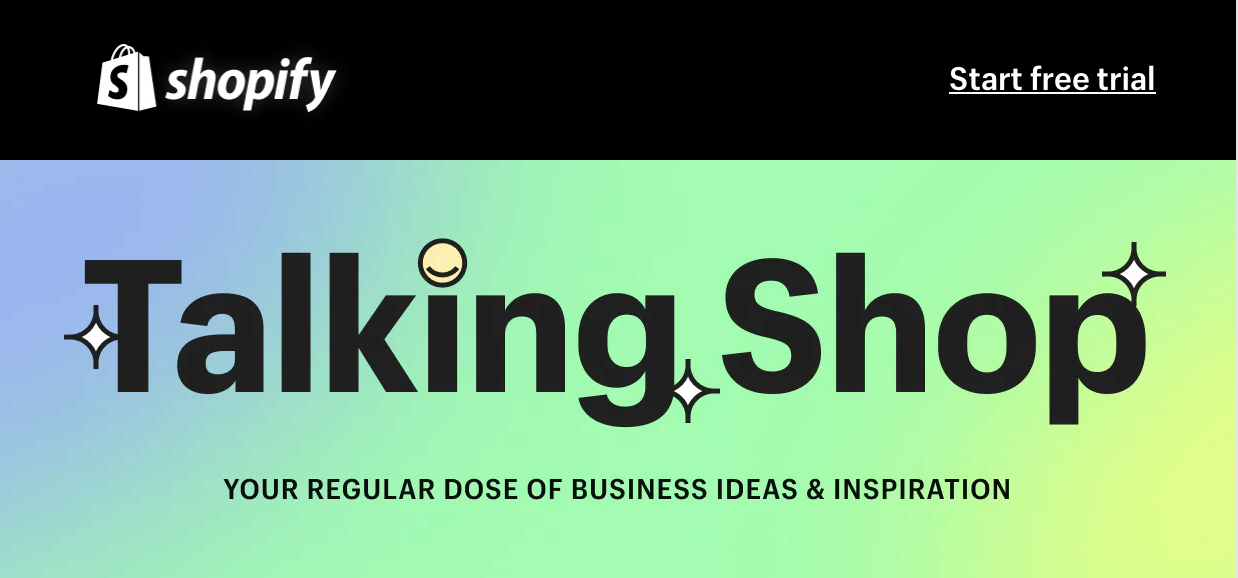
This headline and tagline combo from Shopify immediately resonates with me as a business owner. It promises constant ideas to help me keep my business competitive and creative.
The playful visual elements like stars and a smiley in place of the “i” dot also added a lighthearted, approachable feel to the banner.
These graphic elements and the gradient background make the banner attractive and reinforce that Shopify makes business fun and easy.
What I like: The inclusion of the Shopify logo and a subtle “Start free trial” text at the top right corner offers a clear next step without being too pushy.
I like how it’s a reminder that behind the engaging content and the vibrant community lies an opportunity to directly experience what Shopify offers.
5. Outreach
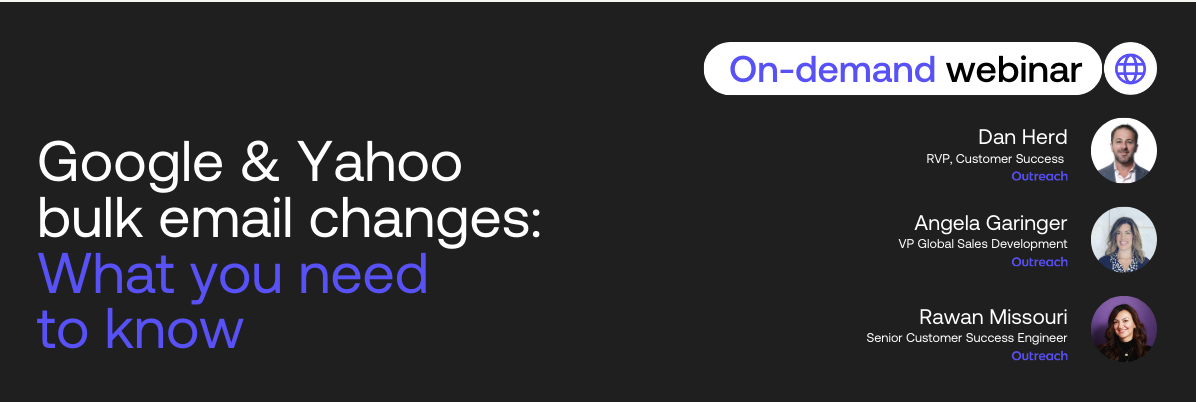
Outreach’s clear and informative email banner is extremely value-packed. The brand is promoting a webinar against a clean black background to ensure the focus stays on the webinar title and the presenters.
My favorite part is how Outreach included the three experts’ names, roles, and pictures. The design is simple and elegant. Bringing it all together, the email is an introduction to these experts.
What I like: There’s no logo on the banner. It focuses my attention entirely on the webinar’s content and the experts presenting it.
This decision might seem unconventional initially, but it allows the message about the webinar and its relevance to take center stage without distractions.
6. Holt Renfrew
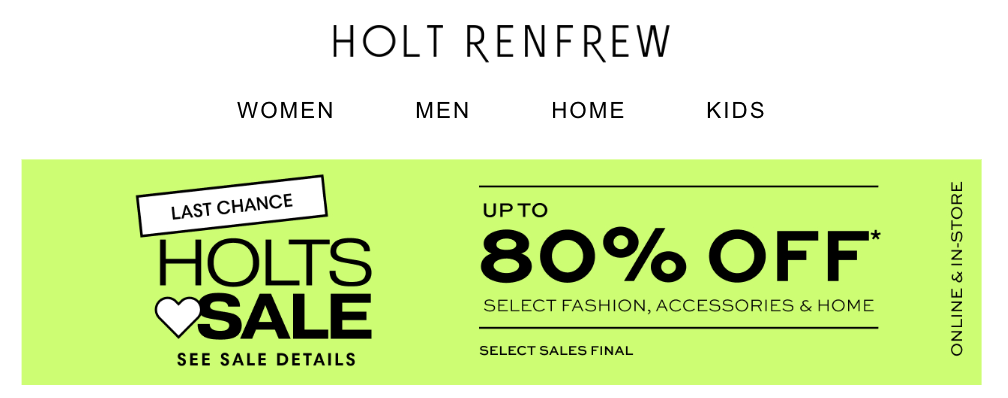
Holt Renfrew’s banner starts basic. The logo at the top and direct links to categories like women, men, home, and kids help me navigate the email more quickly if I want to explore their products.
The email shines in its vibrant promotion of the sale that boasts “UP TO 80% OFF” on a neon green background. This choice of color is bold and eye-catching and makes it impossible to miss the sale announcement.
Despite the potential for visual overload with such a bright background and including details like “select sales final,” the banner conveys all these elements without being overwhelming.
What I like: A neon green background is unconventional for a luxury brand, usually using more subdued, elegant color schemes.
Neon green grabs my attention and infuses excitement and freshness into the promotion to show that it’s worth checking out.
7. Uber Eats
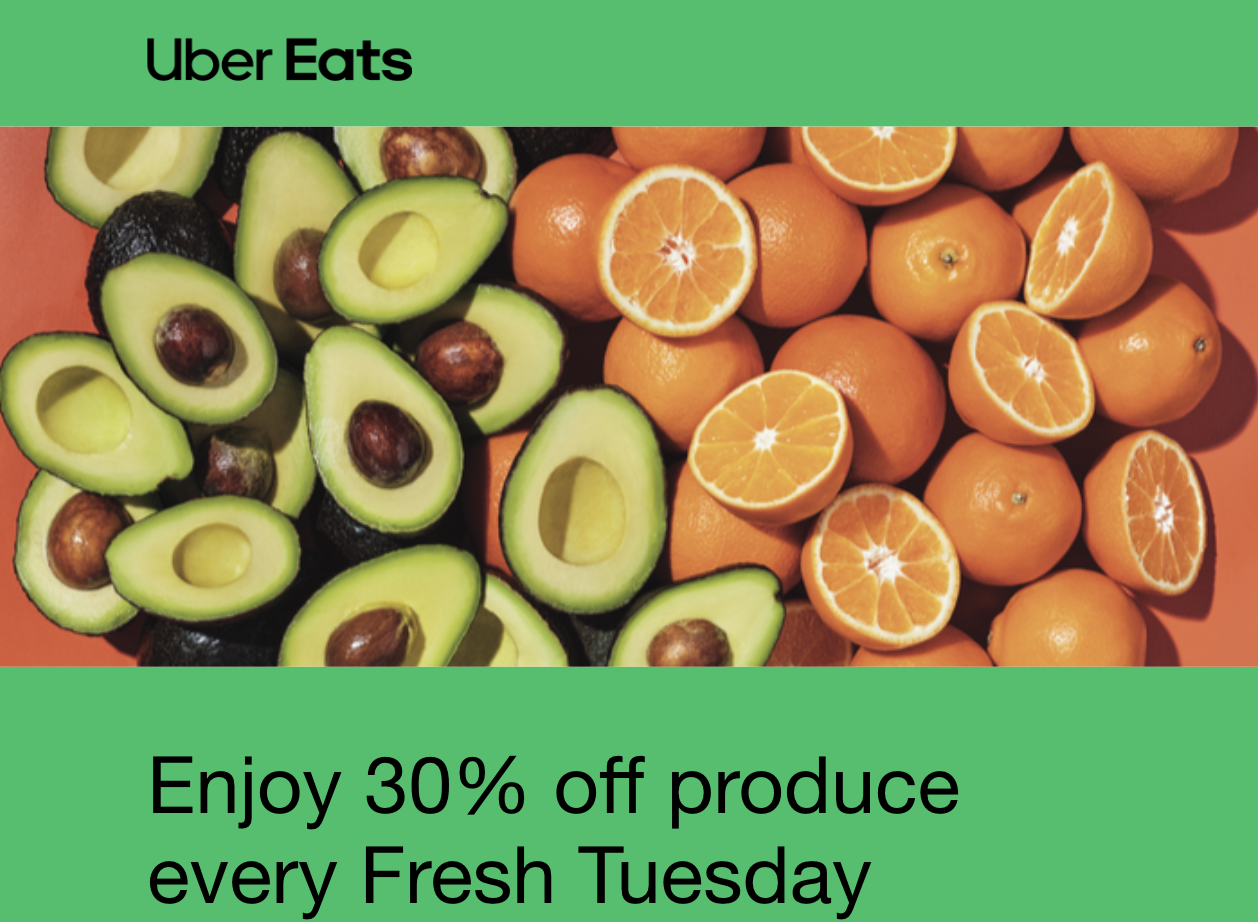
Uber Eats’ email banner stood out because of its colorful oranges and avocados. This shade of green in the background matches its brand colors and makes the fruits and vegetables look fresh.
The offer (“Enjoy 30% off produce every Fresh Tuesday”) is clear and builds excitement for weekly savings. It creates a sense of anticipation for weekly deals and encourages me to return and save on my fruits and veggies.
What I like: The banner is very straightforward. It communicates the deal without overloading me with details since the entire focus is on fresh produce.
Taking advantage of the weekly deal is tempting, and using brand colors and new imagery reinforces Uber Eats’ value to me.
Creating Email Banners that Work
Email banners require a lot of thought — and a lot of tact, too. They vary from industry to industry and audience to audience, so what works for one brand may not work for another.
So, how do you know what works? Simple: Test it out. Remember these fundamentals (and inspirations) to create a batch of email banners and see what works for your audience.
Monitor metrics like click-through and bounce rates to measure what engages your audience. A little trial-and-error pinpoints you to elements that click with your audience and make them take the actions you want.

How to Get Verified on TikTok: A Step-by-Step Guide

As a content creator and marketer, I often see creators and brands clamoring for verification checkmarks on TikTok — and I understand the excitement. To be verified on TikTok is like getting a golden ticket to the chocolate factory.
As a content creator and marketer, I often see creators and brands clamoring for verification checkmarks on TikTok — and I understand the excitement. To be verified on TikTok is like getting a golden ticket to the chocolate factory.
It feels exclusive and rare, meaning you stand out from the crowd. And with TikTok predicted to be among the video-centric apps to see the most growth in 2024, standing out will be crucial.
A blue checkmark on TikTok doesn‘t mean you’ll automatically step into the celebrity world and get the red carpet treatment. However, I can guarantee it’s a good look for your brand and a great step in growing your platform.
But how do you get verified on TikTok? It‘s actually a bit easier than you might think. Here’s how to get verified on TikTok and some tips I’ve gathered from being an endless scroller on the app.
And from being an experienced marketer, of course.
What does TikTok verification mean?
How many followers do you need to get verified on TikTok?
How to Grow Your TikTok and Boost Your Chances of Verification
![Free Ebook: The Marketer's Guide to TikTok for Business [Download Now]](https://no-cache.hubspot.com/cta/default/53/2c7242e4-ad54-4f63-8627-a15aa6a2ea50.png)
What does TikTok verification mean?
At its core, TikTok verification means that the account is verified to belong to the person or brand it represents.
You’ve probably noticed that your favorite brands, musicians, creators, and public figures sport a blue checkmark next to their username. The checkmark means it’s their actual account, and you are following the right person.
Why is TikTok verification important?
Let‘s be honest: It’s a bit of a status symbol. Being verified on TikTok lets your followers know you‘re not some imposter — but it also lets others know you’re worth following.
Think about it: TikTok users will see your verified profile and think, “This person is so important that people want extra assurance that it’s them and not a bot or a faker.” It adds legitimacy to your platform and a slight sense of exclusivity.
Even I can admit my interest in some creators has been piqued by the appearance of a blue checkmark.
Status aside, a verification badge also builds trust with your followers and establishes authority in specific topics or industries on the platform.
For example, entertainment journalist Mona Kosar Abdi is verified on TikTok, so her followers know the news they‘re receiving comes from a legitimate and reliable source.
So, how do you get verified on TikTok? Let’s dive in.
How to Get Verified on TikTok
In 2022, TikTok made it possible for users to apply for verification. Until then, it was up to a secret society behind the scenes to find creators and verify them as a reward for creating popular, high-quality content.
OK, it wasn’t a secret society — just TikTok staff. Still, the process seemed really shrouded in secrecy, and it was always a delightful surprise for creators to log in and see that shiny blue checkmark.
Nowadays, creators can fill out a simple application to be verified, though the app still reserves the right to choose or decline someone for verification.
Here’s how to apply:
- Open the TikTok App and click Profile in the bottom right corner.
- Click the menu in the top right corner (the three horizontal lines).
- Click Settings and Privacy.
- Tap Account.
- Tap Verification.
You’ll need to meet three basic requirements to be eligible for verification:
- Have a username, bio, and profile photo
- Have verified your email and phone number
- Have turned off private account
You‘ll then need to select your verification type, which would be personal or institution. Personal means you’re a notable person, such as a celebrity, influencer, or journalist.
Institution means you’re a nonprofit institution, such as an organization or university.
If you‘re a brand or company, you must register as a business account on TikTok and then follow the steps above. Not sure how to register a business account? Don’t worry, I got you covered. Just click here.
Pro Tip: If you‘re registering as a person and not an institution or brand, make sure to have proof of ID on hand, such as a driver’s license or passport. You will be asked for proof of identity as you fill out your application.
Don’t be like me and scramble for your wallet at the last minute.
Once you submit your application, you just have to play the waiting game for about 30 days — which is the time it takes for TikTok to read your submission.
During that time, you can binge-watch your favorite shows, go on a hiking trip, backpack across Europe, or watch paint dry. But, whatever you do, do not submit another application before the 30 days are up.
Doing so will only slow down the verification process.
However, if you’re still not verified after 30 days, you can submit another request.
How many followers do you need to get verified on TikTok?
Contrary to popular belief, TikTok doesn‘t consider follower count or likes on a page when verifying users. I’ve seen pages with hundreds of thousand of followers not be verified, despite having gone viral or gained traction.
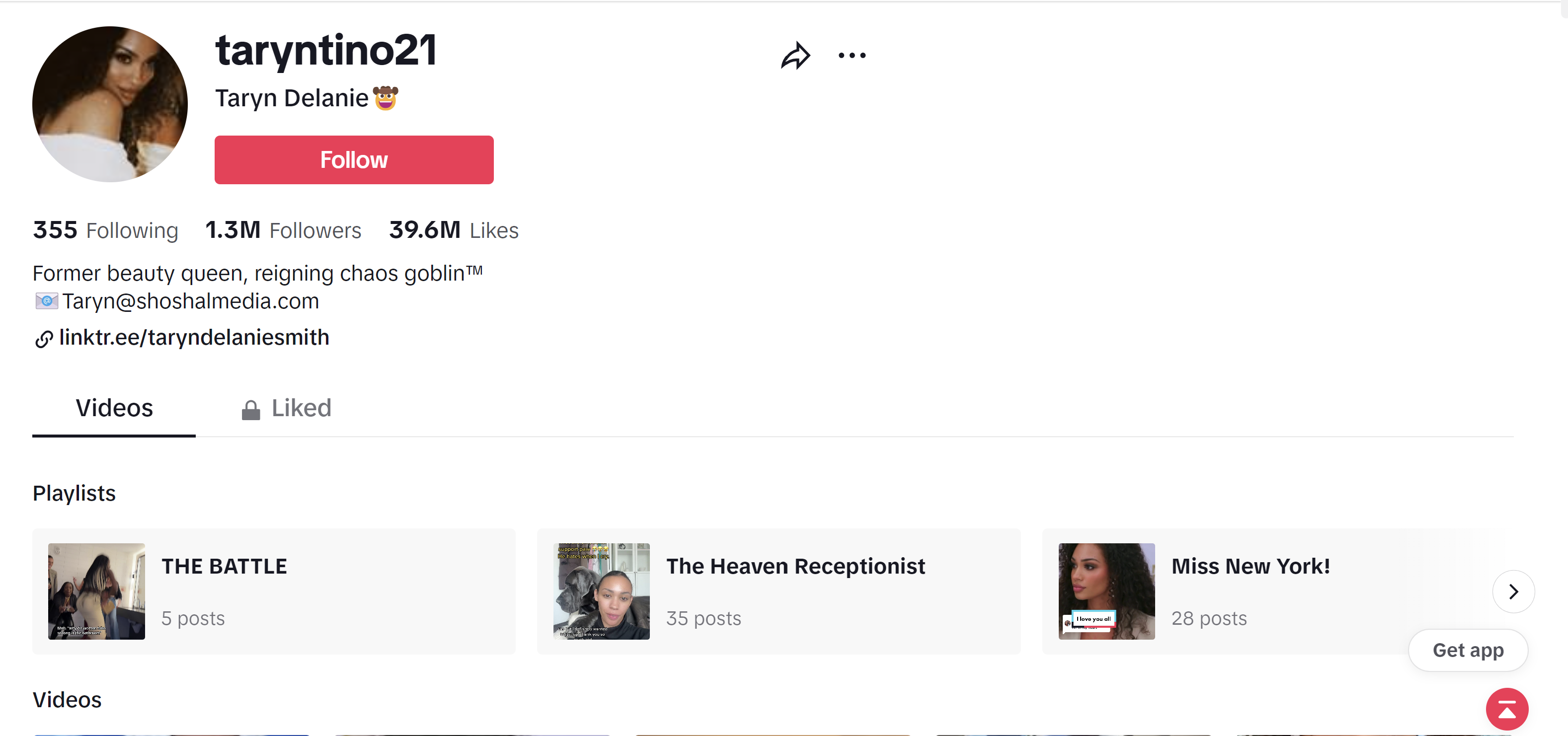
For example, one of my favorite creators, former beauty queen Taryn Delanie Smith, has over 1 million followers on TikTok and has gone viral several times. Yet, to my surprise, she’s not verified!
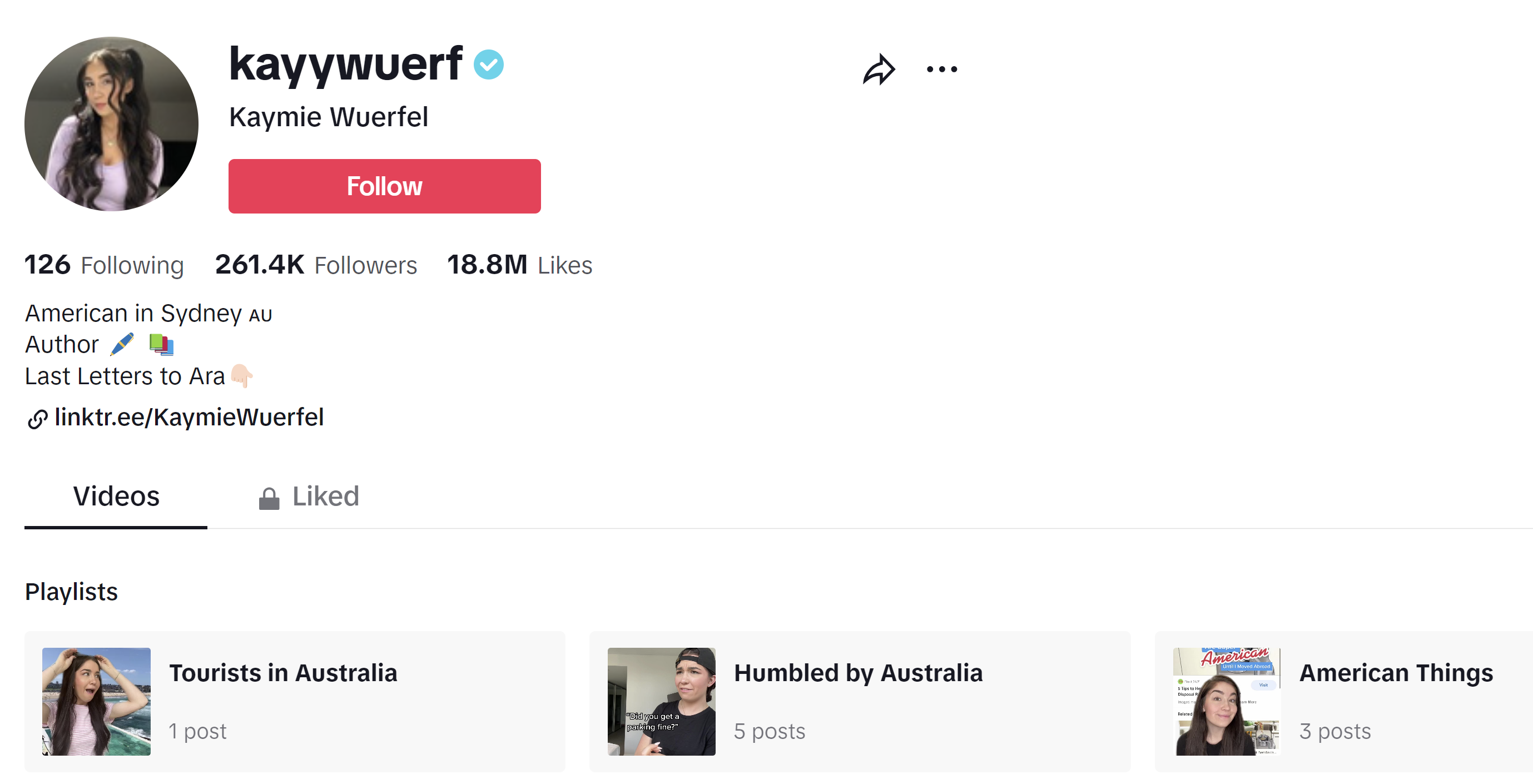
Author Kaymie Wuerfel has over 260K followers and sports a blue checkmark on TikTok. So, don’t worry too much about your follower count.
Instead of focusing on follower count, think about the quality of your content.
How to Grow Your TikTok and Boost Your Chances of Verification
If you want to give yourself the best chance at being verified on TikTok, follow these tips I’ve gathered based on the verified accounts I follow:
1. Be consistent.
According to TikTok, you must have logged into your account in the last six months to be eligible for verification. However, simply logging in isn’t enough to give yourself the best odds.
You want to post frequently and consistently, like artist Kaarin Joy. Joy is an interior decorator who posts 1-2 TikToks a day detailing the different art and design projects she completes around her house.
I started following this creator when she had less than 1 million followers, so trust me when I say I definitely noticed her following dramatically increase when she went from posting every few days to once or twice per day.
So, I’m not surprised that she’s amassed 2.4 million followers and the coveted blue checkmark on TikTok after years of consistent content.
You should also try posting at the most optimal time for your audience. Our research shows the best time to post on TikTok is between 6-9 PM, followed by 3-6 PM and 12-3 PM. But feel free to experiment to see what your audience prefers.
2. Keep track of media coverage.
This is less of a tip and more of a must-have, but I worry it’s not something many creators or brands think about when applying for verification — media coverage!
According to TikTok, applicants must have been featured in multiple news sources to be considered for verification.
Press releases and sponsored or paid media do not count.
I’ve followed content creator and influencer Bretman Rock’s career for almost 10 years. The entertainer has been featured in outlets such as Vogue, Insider, and Elite Daily — and, of course, is verified on TikTok.
So, if you have a video that’s gone viral, take a minute to search yourself or your brand on Google or other search engines to see if your content was featured in any news outlets.
Make sure to bookmark or save whatever posts you find so you can submit them in your application.
Though press releases or sponsored media will not be considered in the application process, you can still use them to form relationships with journalists and news outlets, leading to genuine media coverage of your brand.
3. Be authentic.
I always shine a light on Keith Lee‘s platform when it’s time to discuss authenticity. The family man and food critic has made a name for himself on TikTok for simply being himself.
His commitment to providing genuine reactions to the food he tries and his transparency with his audience have made him stand out on TikTok and helped him earn his verification checkmark.
Pro Tip: Speaking of authenticity, make sure your username is similar to your business name. Notice Keith Lee’s username is the same as his real name. Doing so makes it easier for TikTok to verify the account belongs to a real person.
4. Get creative.
Adventures in Arcadia is a TikTok account that blends food with role-play games like Dungeons & Dragons. Its most popular series on TikTok is Roll for Sandwich, where the host uses D&D dice and character sheets to craft a sandwich.
The TikTok trend of using D&D dice to randomly curate a meal started with Adventure in Arcadia, but it was soon picked up by other creators to make pizza, nachos, burritos, and more.
However, while all are entertaining in their own way, Adventures in Arcadia’s Roll for Sandwich remains the most popular in the “Roll For Universe,” and the account is the only one of its kind to be verified.
While trying new TikTok trends doesn‘t always hurt, it’s best to be creative and craft your own lane in your niche. Doing so will help your platform grow, cultivate a dedicated audience, and give you a better shot at being verified on TikTok.
Getting verified on TikTok is a huge milestone for creators, marketers, and brands alike. It lends legitimacy to your platform, builds trust with your audience, and lets people know you’re an important person in your niche/industry.
Now that you know how to apply and boost your chances of getting that shiny blue checkmark, you have all the information you need to start your verification process. Good luck! Don‘t forget this post when you’re famous.

Bluesky is Now Open to the Public. Should your business be there? [Expert Interview]

Like dozens of other “Twitter killers,” Bluesky has sat in limbo since its launch– thanks mostly to an invite-only policy.
Like dozens of other “Twitter killers,” Bluesky has sat in limbo since its launch– thanks mostly to an invite-only policy.
But when the micro-blogging site went public last month, it skyrocketed to an estimated 4 Million users almost overnight.
That kind of growth can be chum in the water for marketers. But is the social media startup worth your time?

I sat down with HubSpot’s Manager of Brand Social Strategy and Analytics to find out.
But first, let’s jump back a bit for those who don’t know what Bluesky is.
What is Bluesky?
Bluesky is one of dozens of social media apps that have popped up in the hopes of X (formerly Twitter) dying off.
It joins the ranks of micro-blogging sites like Mastodon, Threads, Plurk, Cohost, Compost, Sparklefyre, and Snuffleupagus. (Admit it. You have no idea which of those I just made up. That’s how many X-alternatives there are.)
So, what sets Bluesky apart from the others?
Bluesky was designed as an open-source social media app built on a decentralized infrastructure (called the AT Protocol) and funded by Twitter co-founder Jack Dorsey.
That’s a mouthful. But what exactly does it mean?
- Open source means the code is available for anyone to see (or even tinker with).
- Decentralized means that anyone can host a version of Bluesky on their own server.
That combo gives users a lot more transparency into how the platform works. It also gives them a lot more agency when something goes wrong.
For example, if you don’t like what the Facebook algorithm serves you, there’s not much you can do.
But if you don’t like the Bluesky algo? You can just launch your own Bluesky. (Blackjack optional.)
When Bluesky was invite-only, it had gathered an estimated 3 Million monthly active users. Compare that to the 130 Million users claimed by Threads.
But when Bluesky opened up to the public in early February, it jumped by 800,000 users in a single day.
It’s even attracted celebs like Chrissy Teigen and Neil Gaiman, as well as major media outlets like The New York Times and The Washington Post.
So, should your company be counted among those names?
Should your business be on Bluesky?
To get the scoop on all things social, I spoke with Erin McCool, HubSpot’s Manager of Strategy and Analytics, Brand Social.
Let’s start by putting our money where our mouse is…
Is HubSpot on Bluesky, or do we plan to be?
“Currently, we’re not on Bluesky, and there are no immediate plans to join,” McCool says. “When it began as invitation-only, it was less of a priority for us because, naturally, fewer individuals within our target audience will have access to join.”
But that may not be the case for every business. As a B2B SaaS, HubSpot may have a very different audience than yours.
It’s important to identify your audience and meet them where they are.
But don’t forget, the world of social media is always moving. Where your audience is today might change tomorrow.
“We are always monitoring emerging platforms because the social landscape moves quickly, so we’ve got to be ready to move with it,” she adds.
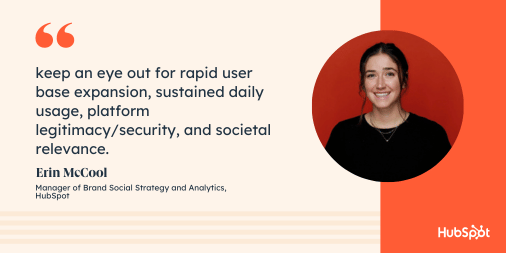
So, when should marketers pay attention to a new social channel?
“I’d keep an eye out for rapid user base expansion, sustained daily usage, platform legitimacy/security, and societal relevance,” McCool explains.
Remember those 130 Million Threads users I mentioned earlier?
“When Threads launched last summer, it hit all those factors- we joined the platform quickly,” she says. “We’ve since grown our following to 90k, organically!”
But that kind of growth won’t happen if you spread your time and talent across too many platforms.
How does HubSpot’s social team choose which platforms to focus on?
“We’re constantly auditing our target audience’s preferences and habits– alongside our own social performance– to refine our content strategy,” Erin says. “As well as how and where we show up in the social world.”
Pro tip: Not sure what to look for? You can learn more about what she means in our Social Media Analytics: The Ultimate Guide.
But it’s not just about numbers.
“We also want a combination of platforms that allow us to diversify our content formats,” McCool explains.
Think about the difference between LinkedIn, TikTok, and Instagram. Each platform works best with a different format, and each format will allow you to speak to a different segment of your audience.
If you only engage on micro-blogging platforms, you could be limiting your reach.
Just don’t go too far in the other direction, either.
“Entering a new platform is an investment of time and effort, so we align our decisions with what we feel will drive lifelong engagement and brand growth.”
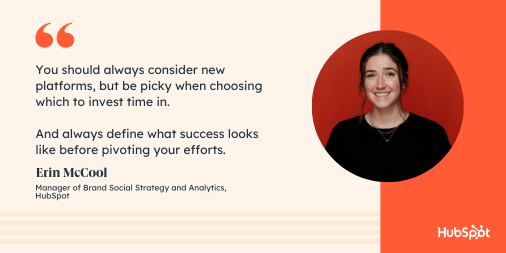
And that gets to the heart of the matter: There are so many social media platforms that even with a team of marketers, you still have to decide where to invest that time and effort.
So now, bottom line:
Should our readers consider Bluesky?
“You should always consider new platforms, but be picky when choosing which to invest time in,” she advises. “And always define what success looks like before pivoting your efforts to a new platform.”
In other words, don’t join a platform just to join. Remember that you’re there to promote your brand.
Instead of asking yourself, “Should we join this platform?” McCool suggests you prioritize questions like:
- “Is our audience here?”
- “Do the content features match our capabilities?”
- “Do we have the resources to sustain this presence?”
And, finally, remember that you don’t have to decide right away. McCool adds one more piece of wisdom:
“It never hurts to secure your brand’s handle while you experiment on the platform from your personal account.”

The Top 5 B2C Marketing Trends of 2024 [New HubSpot Blog Data + Expert Insights]

In 2024, 43% of B2C marketers plan to increase their marketing budget.
In 2024, 43% of B2C marketers plan to increase their marketing budget.
The question is: Where is that budget going? Will marketers reinvest in the same strategies or try new trends?
To understand what trends B2C marketers are leveraging in 2024, we surveyed 1,460 global marketing professionals working in B2B and B2C companies.
From influencer marketing to short-form video, there are so many efforts brands can focus on. Let’s see what our latest research says about what worked well for B2C marketers this year and where they plan to invest in 2024.
1. Short-form video content will be a top priority for B2C marketers.
Short-form video took off in early 2020 and shows no signs of slowing down.
Back then, TikTok was the number one place to go for short-form content. Today, Instagram Reels and YouTube Shorts are also competing for users’ attention.
This is good news for brands, as short-form video trend content resulted in the biggest ROI for marketers in 2023.
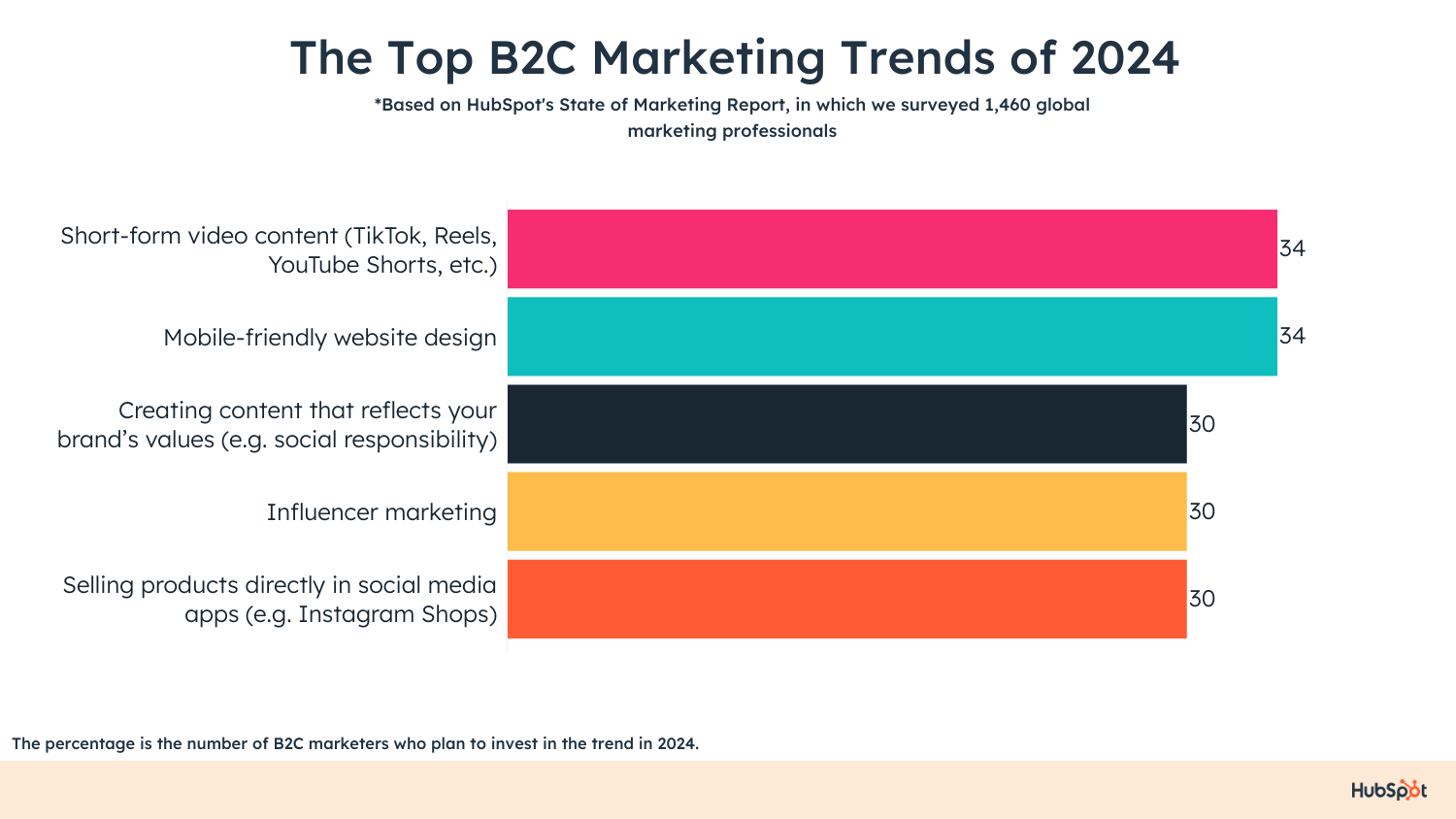
Additionally, 34% of B2C marketers said short-form video is the #1 trend they plan to invest in in 2024.
Why now? Well, short-form video is a key feature in social media today.
Last Crumb, an LA-based homemade cookie company, is a good example of a B2C brand dominating short-form video. They have over 200K followers and over 2 million likes on TikTok, and their videos are light-hearted and fun, with a healthy mix of user-generated videos and studio-produced clips:
Ultimately, short-form video is a powerful strategy for reaching new audiences.
As Director of Research & Training at Blue Frog, Jillian Streit, told me: “For the generations that prefer to listen and watch their content, short-form videos offer a unique opportunity to showcase your brand personality that is more difficult to do through imagery or text. With storytelling and a little humor, you can connect with your audience more personally and generate longer-lasting loyalty in your customers.”
Streit adds, “Organizations that sell tangible products should utilize short-form videos to quickly and efficiently showcase key features and uses of your products.”
Today, with so many platforms offering in-app shopping experiences and advanced ad formats, brands can meet more of their marketing goals.
2. B2C marketers will lean into mobile-friendly website design.
34% of B2C marketers say mobile-friendly website design is the top trend they’re focused on in 2024.
To understand why mobile-friendly web design matters so much for B2C brands, I spoke with Bill Lorimer, Associate VP, Ecommerce at SmartBug Media.
Lorimer told me, “Mobile-friendly design is more than just a buzzword – it’s a crucial strategy to stay ahead of the competition and ensure a positive digital experience for your brand. Prioritizing mobile optimization turns your e-commerce site into a magnet for on-the-go shoppers, offering them a seamless and enjoyable experience regardless of the device they’re using.”
He adds, “Mobile-friendliness isn’t just about the front-end experience, either: Search engines also prioritize mobile-friendly sites over ones that aren’t. Ultimately, investing in mobile optimization translates into increased traffic, higher conversion rates, and greater revenue generation, making it a fundamental strategy for the success of your brand in today’s digital landscape. If this isn’t a priority for your brand, be ready for challenging times ahead.”
Unsure where to begin? Take a look at our guide on optimizing your site for mobile users.
 3. B2C marketers will become obsessed with creating content that reflects their brand’s values (e.g. social responsibility).
Manuela Gaitan, Head of Marketing at Awtana, told me: “There has been a growing trend towards creating content that reflects a brand’s values, particularly those centered around social responsibility. While this approach may not be as popular as focusing solely on product features or lifestyle imagery, it’s proving to be a worthwhile investment for B2C companies.”
Gaitan believes there are three reasons creating content that reflects brand values is important for B2C marketers. As she puts it:
- Aligning marketing content with a brand’s values helps establish a deeper emotional connection with consumers. By showcasing a commitment to social responsibility through content, companies can resonate with their target audience on a more profound level, fostering loyalty and trust in the process.
- Communicating brand values in marketing content can set a company apart from its competitors in a crowded marketplace. By highlighting these values, B2C companies can carve out a distinct identity for themselves, attracting like-minded consumers who are drawn to their mission and purpose.
- Investing in content that reflects brand values can have long-term benefits for a company’s reputation and bottom line. By demonstrating a genuine commitment to social responsibility through their content, companies can enhance their reputation as ethical and socially conscious entities, which can translate into increased customer loyalty and positive word-of-mouth.
A whopping 46% of B2C marketers plan to increase their investment in creating content that reflects their brand’s values in 2024. As your competitors increase their investments, you’ll want to consider doing the same.
4. Influencer marketing will reign supreme.
For most B2C marketers, the power of influencers is clear.
In 2023, 54% of B2C marketers worked with creators or influencers — and 49% plan to increase their investments in influencer marketing in 2024.
This is because in 2023, influencer marketing offered businesses the best returns. When asked to select their top ROI driver from a list of 26 tactics and strategies, 12% of marketers chose influencer marketing — ahead of AI/automation and native advertising.
I can personally attest to the power of influencer marketing: Almost daily, I am purchasing B2C products from my latest favorite influencer. Most recently, I’ve bought skincare products, an Amazon head-scratcher, and a daily vitamin supplement — all thanks to influencer marketing.

5. B2C marketers will lean heavily into social selling.
Speaking of my aforementioned online shopping habits: Social selling will be huge in 2024.
In fact, 30% of B2C marketers predict it will be the top trend of the year.
As seen in our Consumer Trends survey, social media is the future of shopping. Within Gen Z, Millennials, and Gen X, social media is the preferred channel for product discovery. Among all consumers, there is a growing number of social media users who buy on social media.
That number is especially high among younger generations, with 27% of millennials and 22% of Gen Z purchasing products directly in-app.
When determining how to sell products on social media, it‘s critical you start with the platforms on which you already have a following. For instance, if your brand sees high engagement on Instagram, it makes sense to start selling your products to your Instagram audience, who’ve already demonstrated interest in your brand.

15 Email Preview Text Examples That Would Catch My Attention

I believe in the concept of inbox zero, so I have a sinking feeling every time we approach the holidays or big occasions (think Black Friday) when I know a mass of emails are heading my way.
All floodgates burst open — my inbox quickly becomes an overflowing chaos.
I believe in the concept of inbox zero, so I have a sinking feeling every time we approach the holidays or big occasions (think Black Friday) when I know a mass of emails are heading my way.
All floodgates burst open — my inbox quickly becomes an overflowing chaos.
I usually send all these unread promotional messages straight to spam. But, occasionally, a few brilliant emails catch my eye because of their intriguing, clever, or motivational preview text messages.
The bottom line: A good preview text in email can help you stand out even in the busiest inboxes.
So, I curated 15 of my favorite preview text email examples to inspire you.
I’ll break down why they work + how to write your own.
We’ll cover:
- What is preview text in an email?
- The Best Preview Text in Emails to Check Out
- Turning Preview Text into Opens
What is preview text in an email?
Preview text is a short snippet presenting a summary or the first few words in an unopened email. It appears next to the subject line and gives you a glimpse of what’s inside.
While subject lines greatly influence your email open rates, preview text messages can also amp up this number. An awesome preview text piques your curiosity, presents a compelling offer, and nudges you to open the email.
Let’s look at some of the best examples of email preview text and some actionable tips for writing them.
The Best Preview Text in Emails to Check Out
I scoured my inbox to find 15 awesome examples of preview text in emails. These are some of my favorite messages from over 700 emails I reviewed. Let’s explain why they work and what you can learn from each.
1. Hootsuite
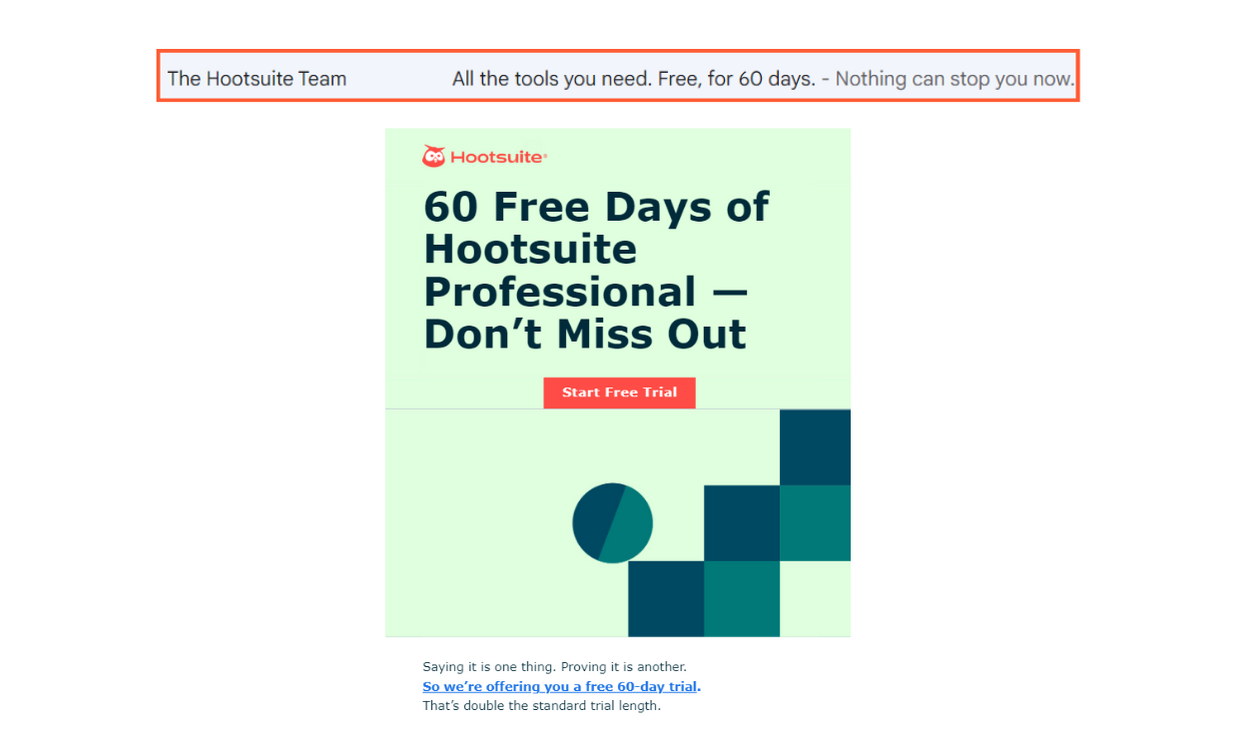
Hootsuite announced their 60-day free trial with this banger email. The subject line gives you a promise — all the tools for free.
The intriguing preview text elevates this promise and makes it look like there’s something really powerful inside this email.
What I like: I was curious about what Hootsuite had to offer — all because the preview text gave me confidence. It’s a crisp and clear message to inspire people. Instead of discussing their product, the subject line and preview text spotlight users.
Takeaway: Focus on your recipients. Keep yourself in their shoes to emphasize how they’ll benefit from each email.
2. Semrush
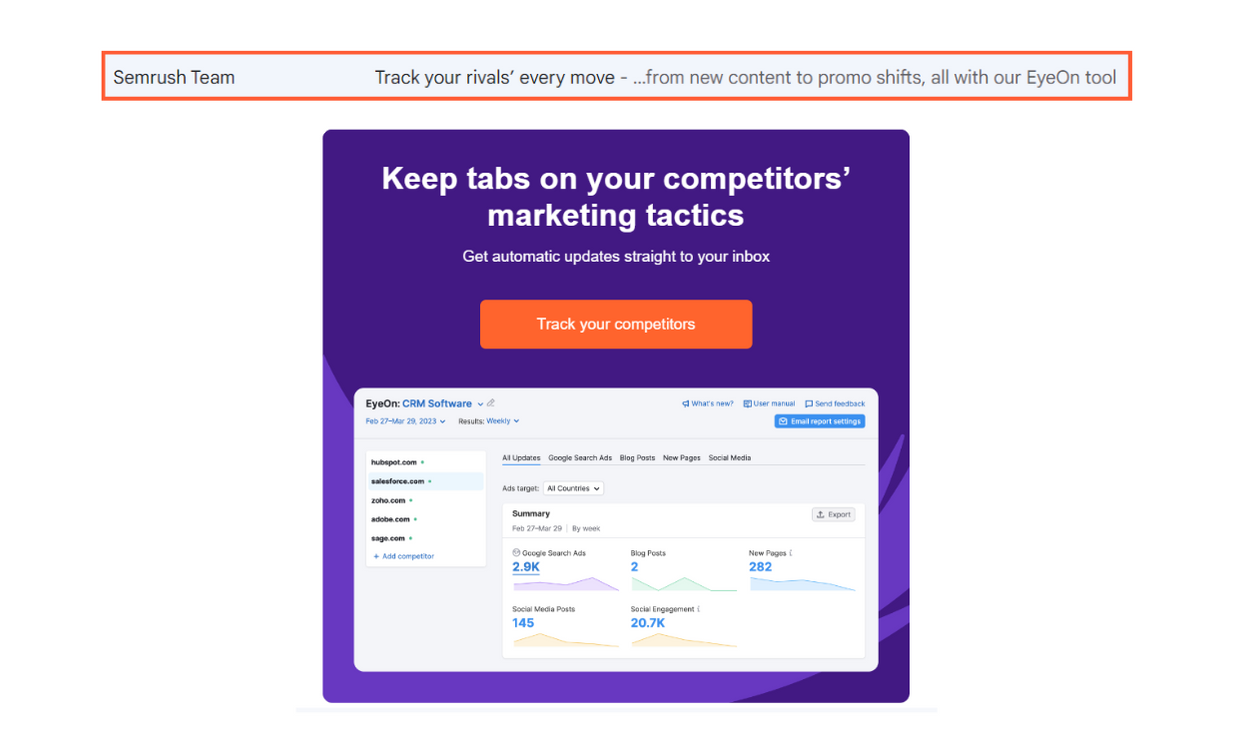
Semrush pulled off this masterstroke by making the preview text an extension of the subject line. The brand sent an email introducing a new feature to track competitors.
The subject line is a clever clickbait that can repel some people. However, the preview text adds more context and explains the “how” behind this subject line.
What I like: The preview text goes well with the subject line. This subject line + preview text combination also introduces the new tool in just under 10 words—neat!
It’s one of the few examples where the preview neatly fits into the subject and elaborates on the email’s core message.
Takeaway: Write a super short, one-line summary of what’s inside your email. Then, break this sentence into the subject line and the preview text.
3. Freelance Bold
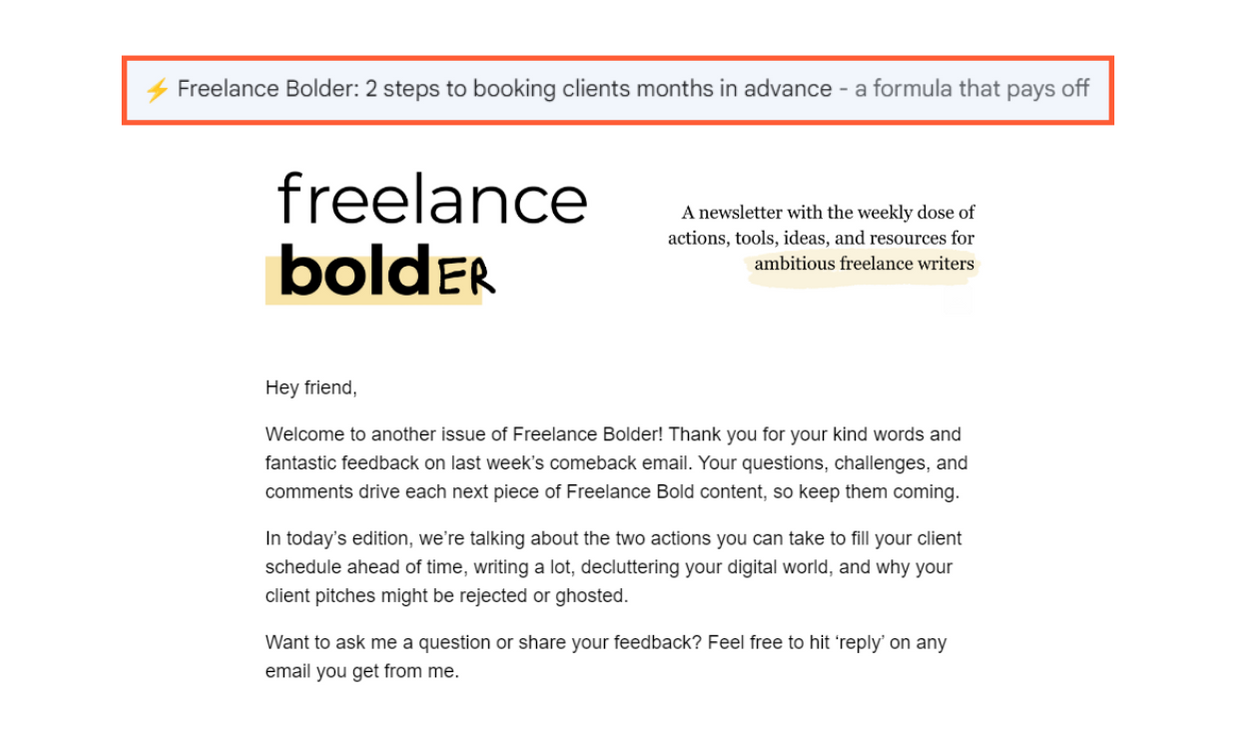
This preview text in one of Marijana Kay’s newsletters made me open the email quickly. Marijana is a freelance writer and content marketer for B2B SaaS brands.
This preview text is a classic — make an offer people can’t refuse. In the subject line, Marijana discusses the two main steps for taking bookings.
And the preview text promises her “formula” with tips to secure clients even when you’re fully booked.
What I like: This preview text has only 20 characters but still significantly impacts readers. Why? Because it gives you an irresistible promise.
Since Marijana is a leading expert, her subscribers (including me) would be more than curious to open this email and find her proven formula.
Takeaway: Make your offer sound unmissable and build credibility around it. Tell people what you share (formula, framework, template, etc.) and why they should get it.
4. Mutiny
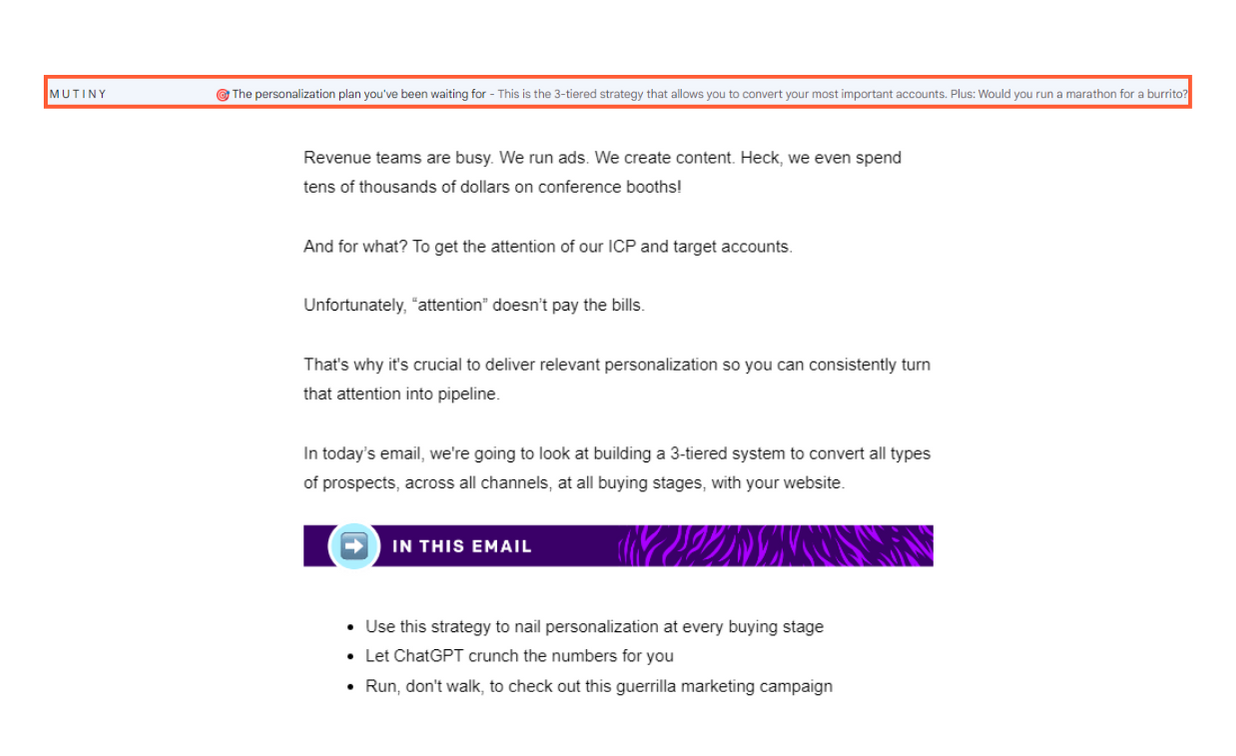
I found an excellent preview text from Mutiny, one of the most unique examples in this list. Even though this preview text is longer than usual, it piqued my curiosity with an out-of-context question — Would you run a marathon for a burrito?
What I like: This preview text cleverly makes people excited about what’s inside the email.
While the subject line will talk about the actual content of the email, the preview text can mention something irrelevant yet interesting to draw people’s attention.
Takeaway: Don’t stick to the topic; that’s boring. Go beyond your email’s central theme to discuss something unusual in the preview text.
5. Why We Buy
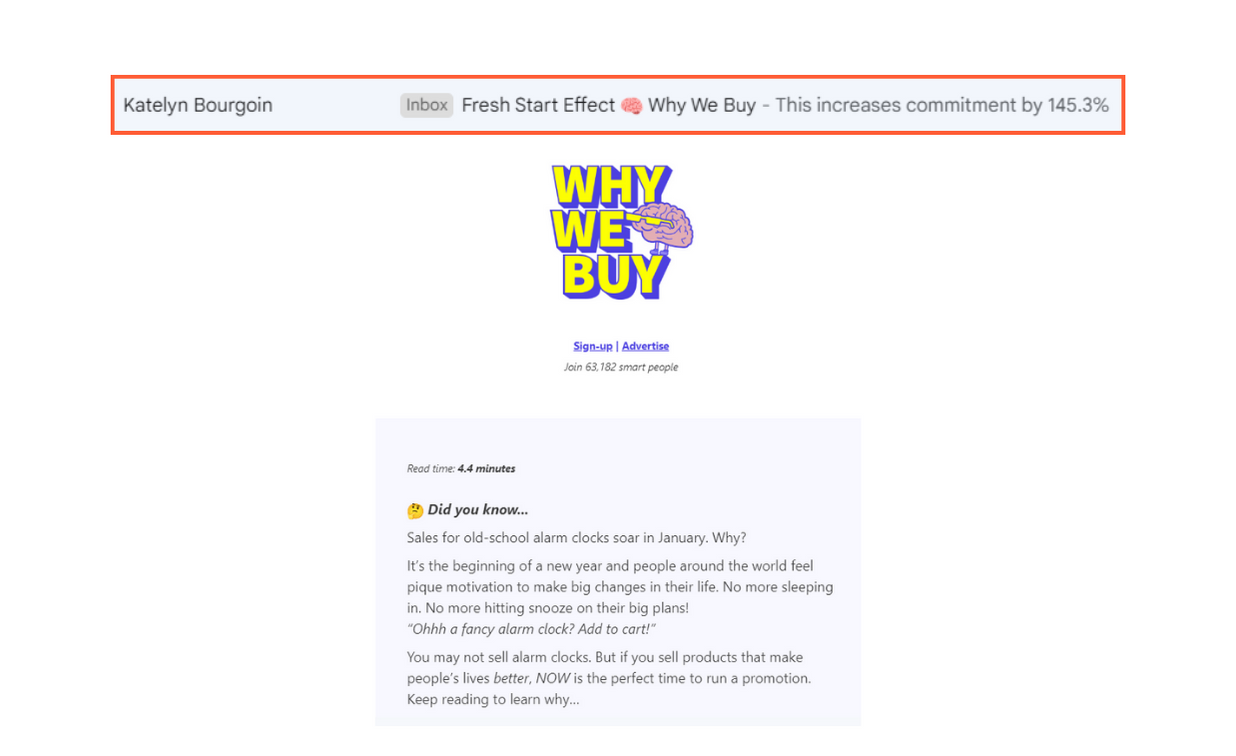
Image Source
Katelyn Bourgoin’s Why We Buy newsletter always has 2 or 3 letters to describe the theme of each email. I know Katelyn is a 4-time founder and customer-focused marketer with a personal branding agency.
That’s good enough for me to open and read the message, even if not instantly. But, this email was unique because the preview text immediately convinced me to check out the message.
It’s an aspirational message with a concrete number to show how I can achieve this goal.
What I like: This short preview text builds exciting proof around the subject line. It convinces me that the email talks about a proven method, and I can use it to increase commitment by over 100%.
Takeaway: Share some proof of concept in the preview text. Give readers a reason to view the message by hinting at the success they can achieve with the tips inside.
6. Notion
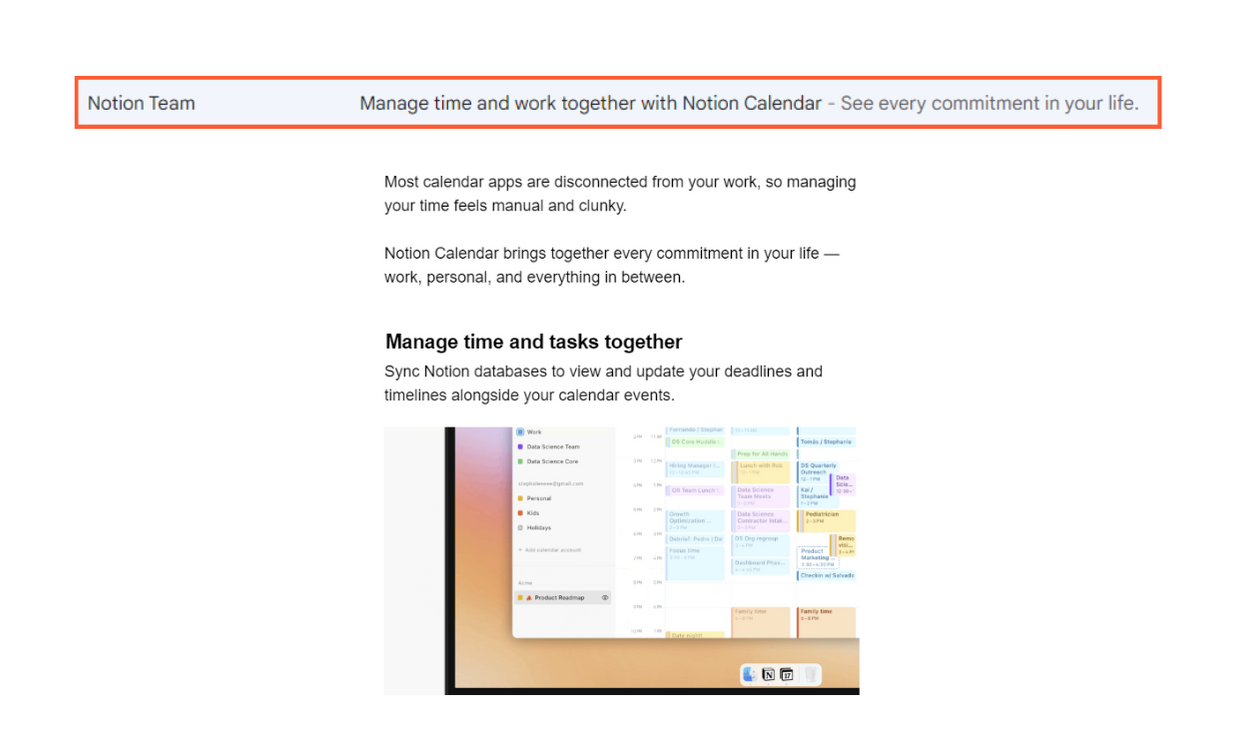
When Notion launched Calendar, they sent four emails introducing different capabilities and use cases. But this was the best because the preview text beautifully contextualizes this feature.
It directly pokes at the pain of managing multiple tasks, meetings, and timelines to propose a single solution — all in five words.
What I like: This message taps into a big emotion: motivation. It tells me that Notion Calendar will offer enough motivation to stay on top of all my commitments.
And the preview text increases open rates by evoking this powerful emotion.
Takeaway: Make your preview text personal. Speak directly to your readers and explain what they can do better with the insights inside the email.
7. Junia
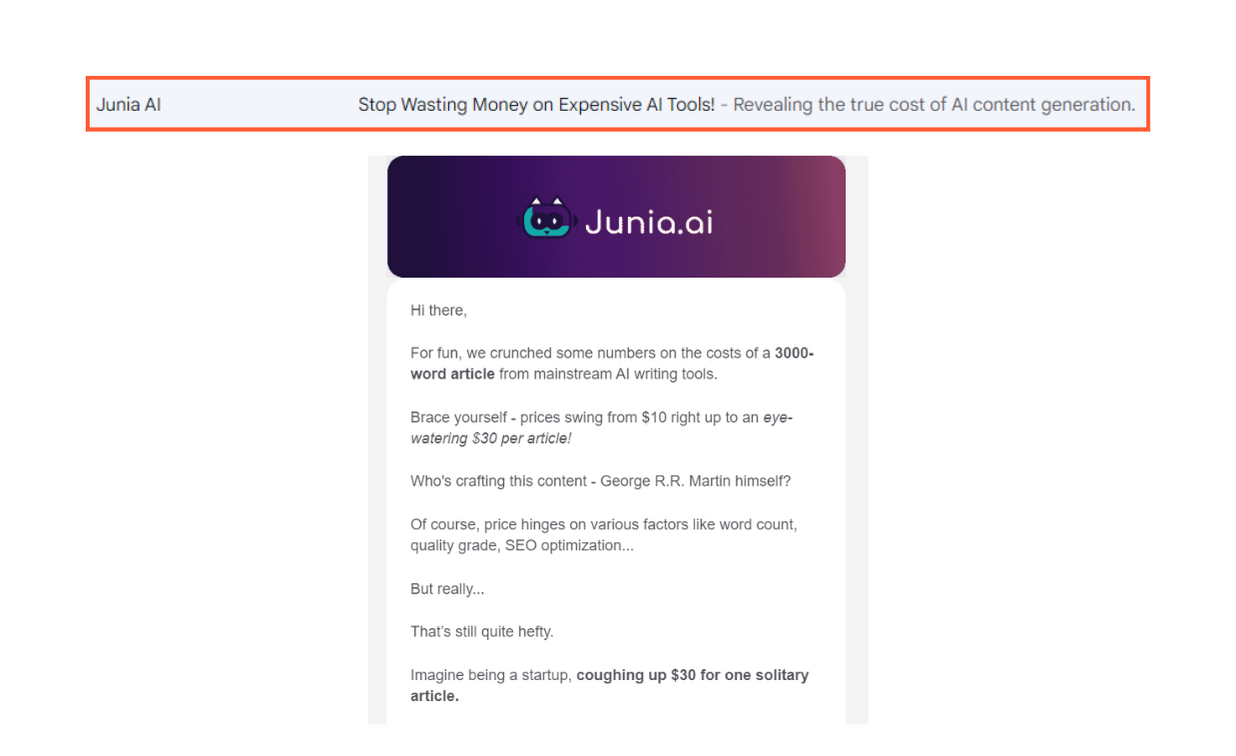
Junia ran a small experiment and shared their findings through an email. I wouldn’t usually have opened this message, but I felt compelled to click on the email because of the preview text.
It creates suspense and a sense of excitement, mentioning revelations inside.
What I like: The subject line + preview text combination gives you an action and a reason to work with. The subject line states a clear ask, and the preview text hints that there’s a reason behind this ask. It makes people curious to learn more.
Takeaway: Mention a simple action in the subject line and use the preview text to briefly explain why you’re asking people to take this action. Hint at these reasons instead of revealing everything.
8. Vidyard
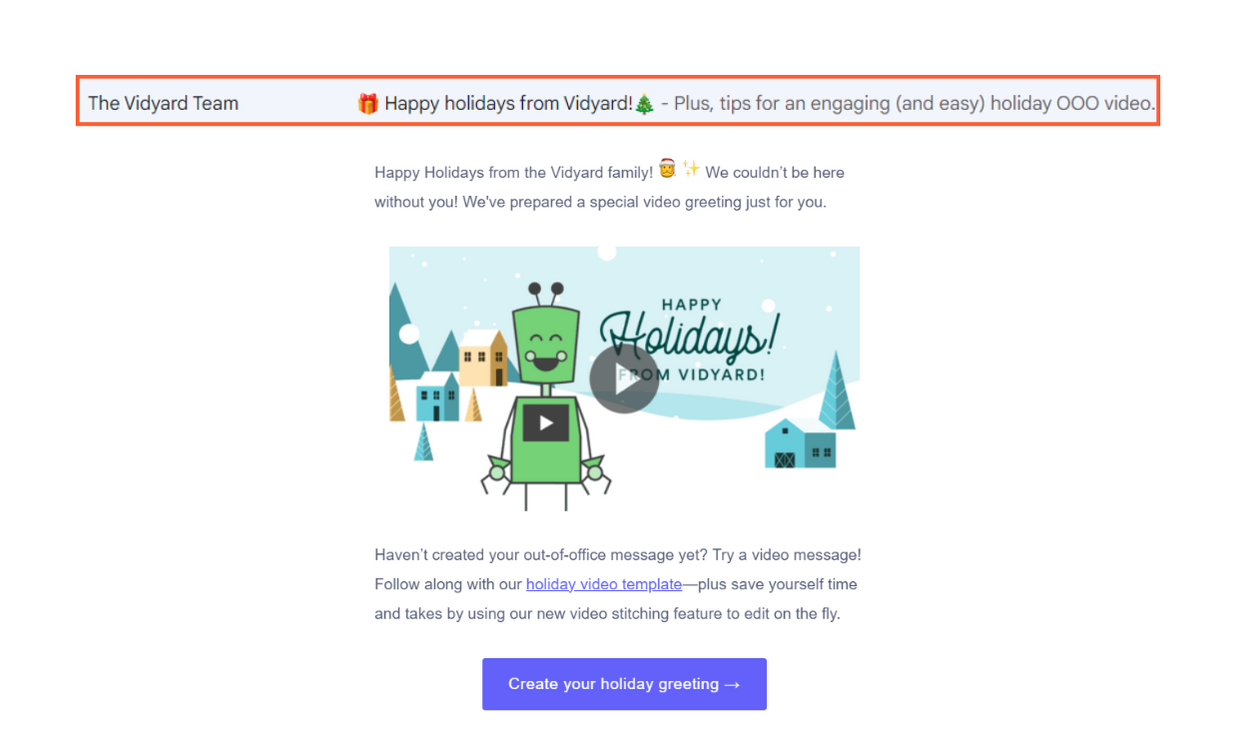
Holidays are the busiest of times for our inboxes. But Vidyard’s creative message was one of the few emails I opened right before signing off for my year-end vacation. Why?
Because it gave me something new to check out: tips to make an OOO video.
What I like: This isn’t one of those typical happy holiday emails. It promises something meaningful and topical.
At a time when everyone was setting out-of-office responders, Vidyard’s preview text instantly caught my attention because I wanted to do something fun.
Takeaway: Even when sending mainstream emails for holidays or occasions, make them more appealing with a unique take or creative tips.
9. Triple Whale
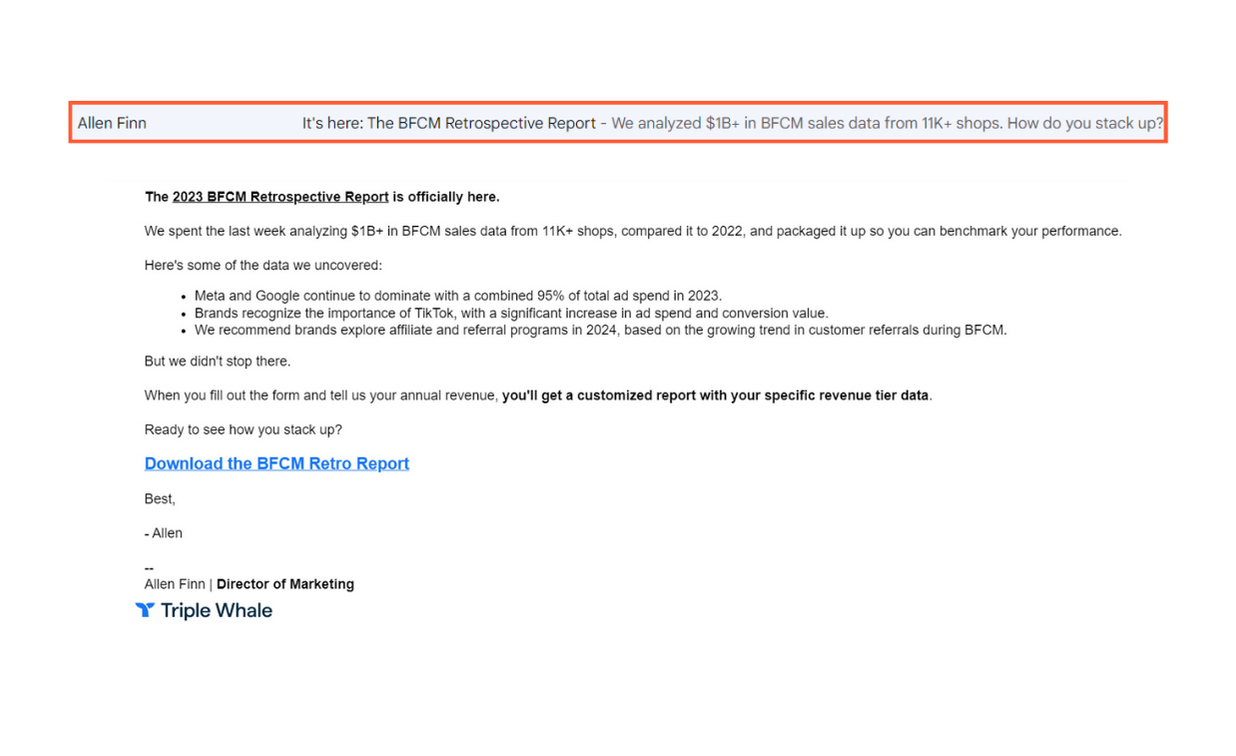
I’ve received dozens of eBooks and reports over email, but this one from Triple Whale was at a whole different level. The preview text neatly summarizes what their BFCM report analyzes and the data points it includes.
And the best part? It nudges me to open this email with a short question — how do you stack up?
What I like: I felt excited because this preview text gave me some context about what’s inside the report.
If I were an e-commerce business owner, I’d open the email faster than the speed of light because I’d want to evaluate my performance against this data.
Takeaway: When sharing a report or resource (like an ebook), briefly summarize the numbers or themes inside and end with a personal question.
10. Content Workshop
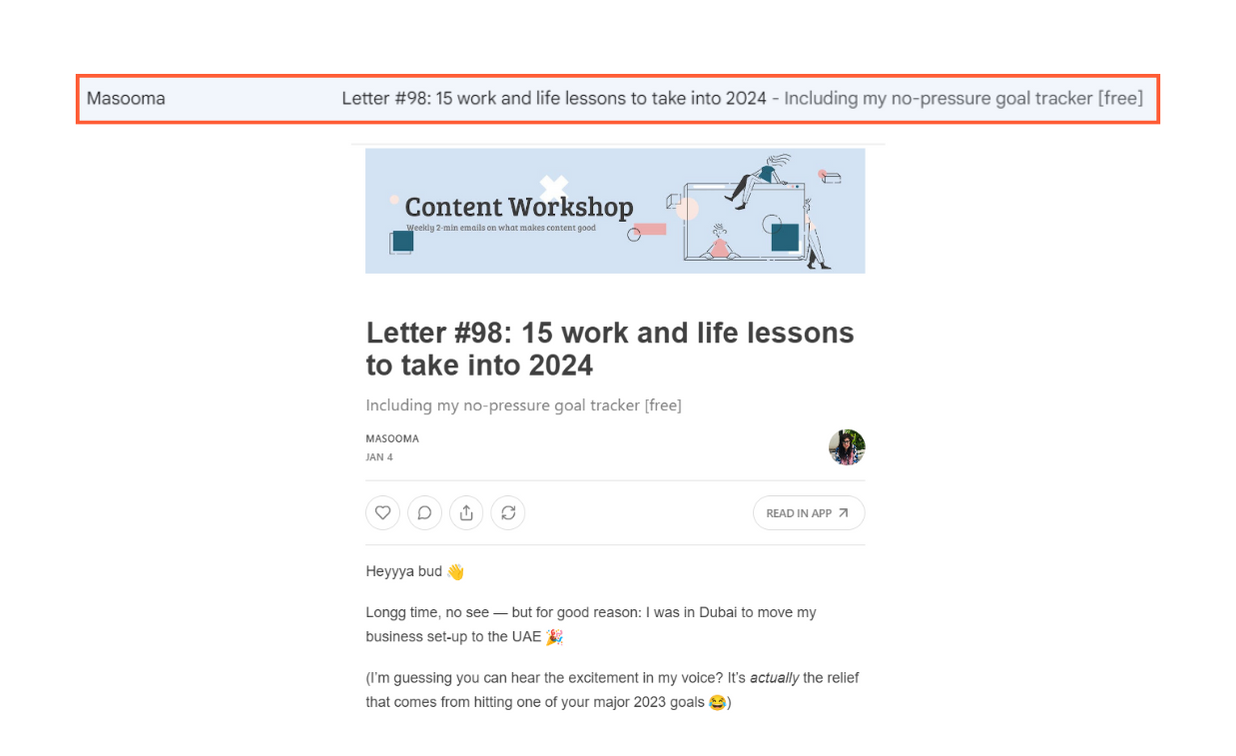
This edition of Masooma Memon’s Content Workshop is another of my favorite examples of email preview text because it promises a free resource.
Masooma is a freelance writer and content marketer for some of the biggest names in the B2B SaaS industry.
The subject line explains that she’ll talk about 15 lessons, and the preview text invites me to download her tried-and-tested goal tracker.
What I like: This preview text is a quick nudge to download the goal tracker. It’s an added motivation to open the email. And if some people aren’t intrigued by the subject line, they’d view the email looking at this offer.
Takeaway: If you offer a resource within your email, highlight it in the preview text. Position this resource as a tried-and-tested way to accomplish the goals discussed in the subject line + email.
11. Catalyst
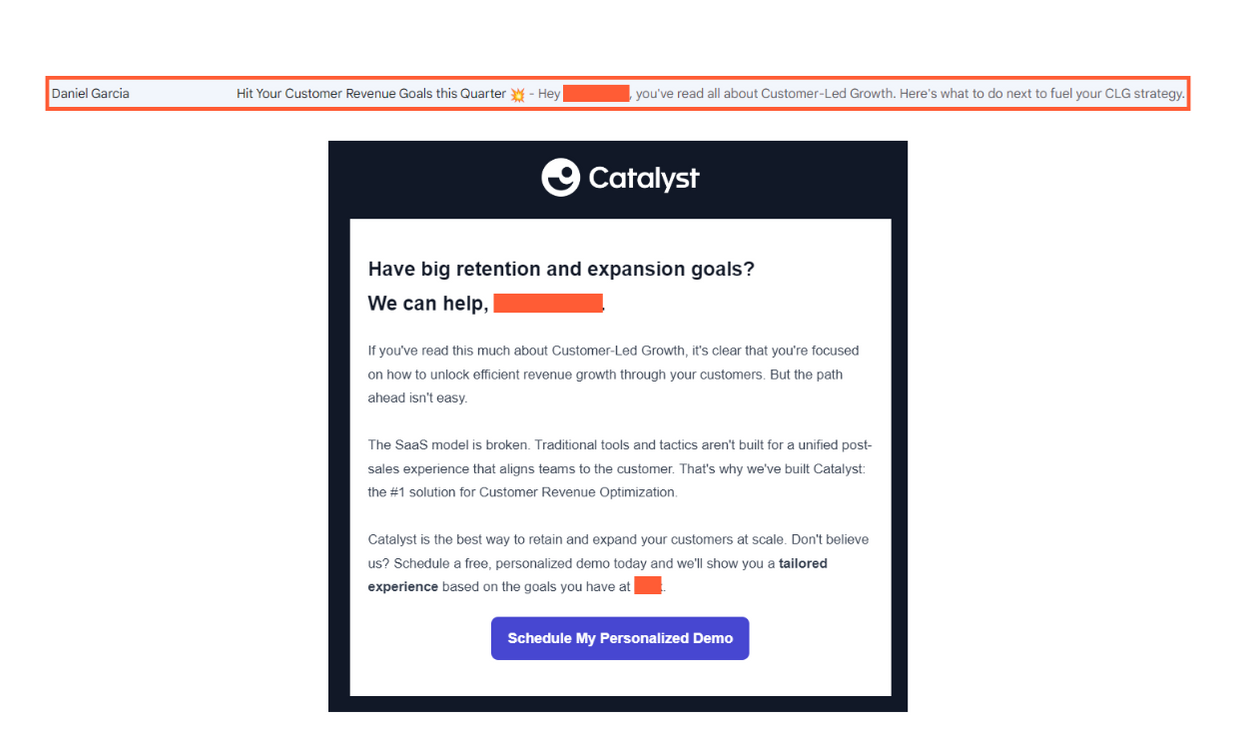
Catalyst uses preview text to guide users through the following steps after someone downloads their ebook on customer-led growth. Most companies throw people into their “lead nurturing sequence” and send random emails.
But Catalyst contextualized this nurture email for readers to instantly recognize why they’re receiving it and what’s inside.
What I like: This preview text immediately tells me why I’m receiving the email so that I don’t delete/spam it immediately. Plus, it sets the stage for me to open the message because the email contains the next steps.
And the personalization looks great, too!
Takeaway: Use the preview text snippet to create context around why you’re sending an email. You can significantly minimize unsubscribe rates by setting this context.
12. Atlan
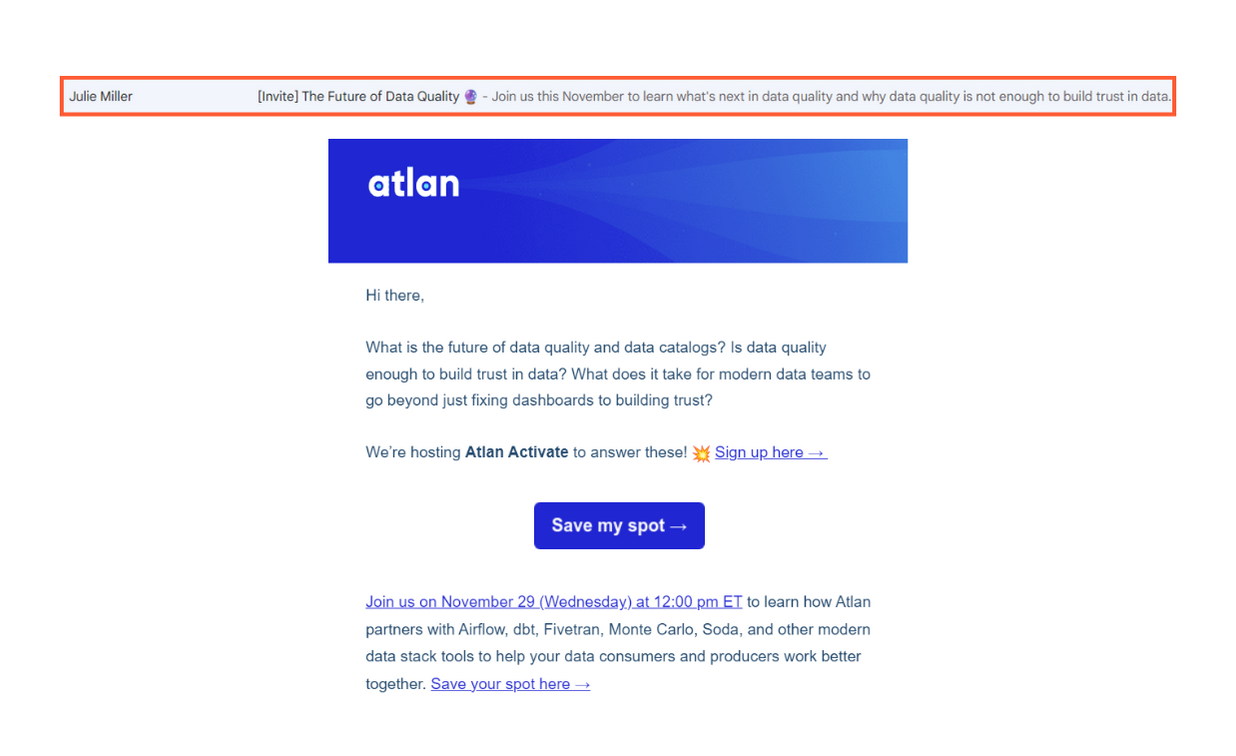
My inbox is filled with invites for webinars, events, fireside chats, and whatnot. This email by Atlan was one of the few such invites that stood out for me. It has three main elements:
- A recognizable [Invite] tag
- Event name + time
- Preview text with themes of discussion
What I like: This preview text is a one-line webinar summary. It’s clear and convincing for readers to explore more if the topics seem interesting.
Takeaway: Use the preview text to quickly summarize your event invites. It can save readers the time to jump through hoops.
13. Asana
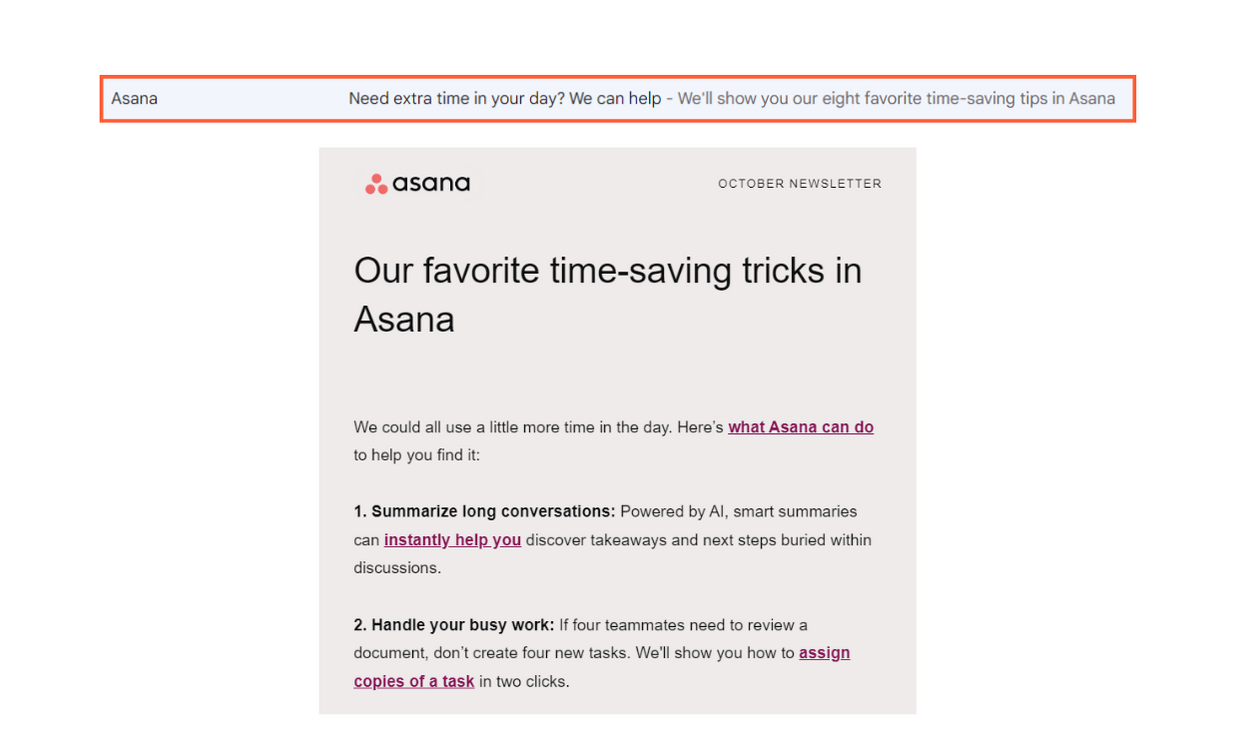
Asana is one of my go-to project management tools. And when your favorite brand wants to share their tips, you’ll open the email. This preview text draws on Asana’s brand strength and popularity to excite readers.
What I like: I consider Asana’s team project management experts. By hinting that this email includes their best time-saving tips, this preview text creates curiosity to open the email.
Takeaway: Leverage your brand image to write preview texts in first-person POV and share your first-hand experiences or expertise.
14. Coda
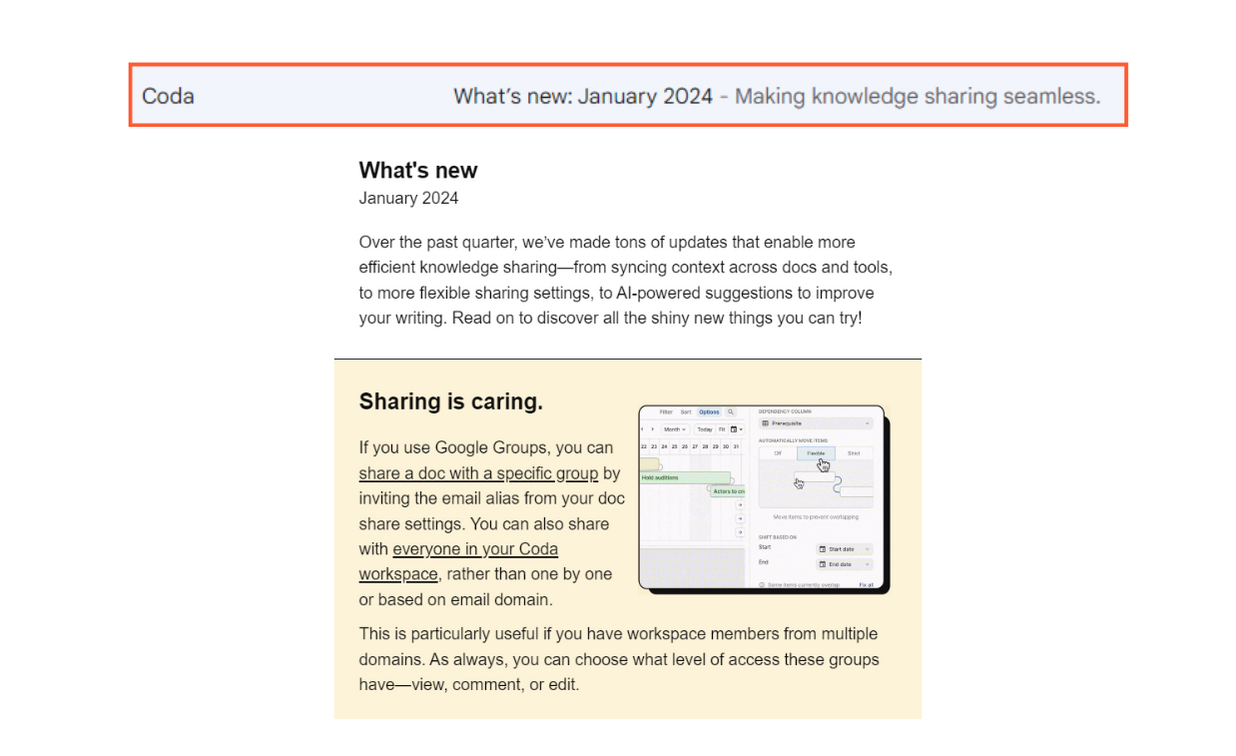
This product update email by Coda has a simple and powerful preview text message. It tells readers they can achieve something big using the new capabilities in the tool.
But, they must view the email first to learn about these new features.
What I like: The simplicity. This preview text doesn’t have anything extraordinary. Yet, for Coda users, it talks about a big goal and incentivizes them to achieve it by checking out the features inside the email.
Takeaway: Don’t be afraid to keep things simple. Test a few variations of such preview texts with your subscribers to choose the most optimized ones.
15. Vimeo
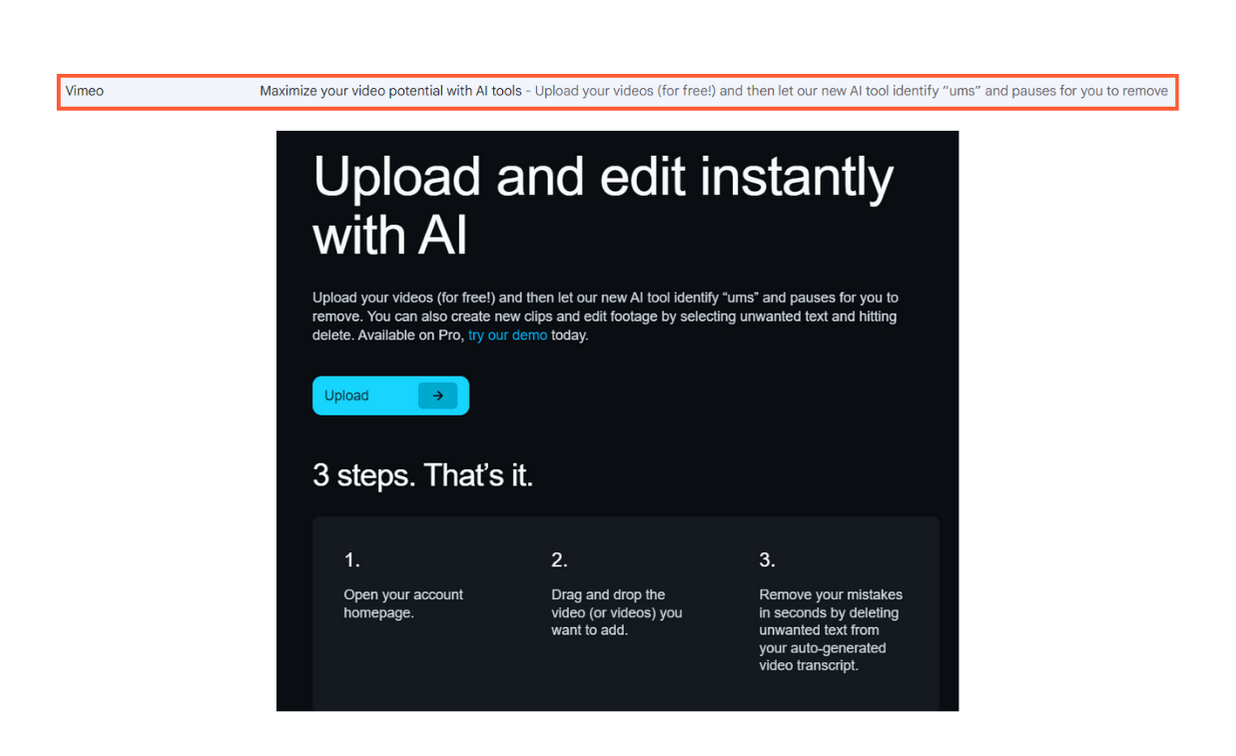
This preview text by Vimeo is one of my favorite examples because of its realistic message. While the email discusses a specific feature, the preview text zooms in on the pain points this feature can solve.
It also told me about the option to try this feature for free.
What I like: The preview text contextualizes Vimeo’s new AI feature. It explains how the tool removes phrases we don’t want to include in the video, making it an instant hit.
Takeaway: Speak directly to your users and lead with their pain points to craft a successful preview text.
Turning Preview Text Into Opens
That’s a wrap on my favorite preview text examples! Remember to spend extra time drafting the preview text the next time you create an email campaign.
You can make a checklist of these tips and takeaways to reel in more people and increase your open rates with an awesome preview text.

YouTube Competitor Analysis: How I Do It in 5 Easy Steps

YouTube competitor analysis is essential to your video content strategy this year. Take it from me — I lead HubSpot’s YouTube growth strategy, overseeing content strategy, trend monitoring, performance reporting, and competitor analysis.
YouTube competitor analysis is essential to your video content strategy this year. Take it from me — I lead HubSpot’s YouTube growth strategy, overseeing content strategy, trend monitoring, performance reporting, and competitor analysis.
As of 2024, YouTube is the biggest video-sharing platform and the second-biggest social media in the world, with over 2.70 billion users. And believe me, it’s not slowing down anytime soon, the number of YouTube’s global users is estimated to reach 2.85 billion by 2025.
![→ Free Templates: How to Use YouTube for Business [Download Now]](https://no-cache.hubspot.com/cta/default/53/b33cfd44-133a-49e3-a943-086c5679d485.png)
With this ongoing video growth on the horizon, it’s important to assess your competition.
Table of Contents
- What is a competitor analysis on YouTube?
- Why is a YouTube competitor analysis important?
- How to Do Competitor Analysis on YouTube
What is a competitor analysis on YouTube?
Competitor analysis on YouTube involves studying the content created by competitors in your desired niche or subject matter area. These insights help you understand your competitors’ strengths, weaknesses, and strategies.
This analysis can be conducted on a monthly, quarterly, or annual basis. Your goal is to learn what competitors are doing well and to emulate it in your own style.
You’ll also want to figure out what they aren’t doing so you can do it and stand out in the competitive YouTube landscape.
Why is a YouTube competitor analysis important?
Competitor analysis helps you understand the competitive landscape for your target market.
This is crucial in my role because it allows me to gain valuable insights into what other brands are doing on the platform.
By understanding competitors’ strategies, content performance, audience engagement tactics, and overall presence on YouTube, I can identify industry trends and pinpoint areas where content gaps exist.
I can also discover opportunities for improvement, and make informed decisions to stay ahead.
This analysis will help you better understand your audience and create a comprehensive YouTube content strategy.
How to Do Competitor Analysis on YouTube
Step 1: Create a list of your top competitors.
You should start your competitor analysis by identifying five to ten YouTube channels that are competitors.
These competitors can be based on your specific industry (e.g., cosmetics), niche (e.g., clean, cruelty-free cosmetics), and/or target audience (e.g., environmentally conscious cosmetics consumers).
In my experience here at HubSpot, I’ve learned the art of selecting a diverse range of competitors.
This thoughtful approach acknowledges the presence of niche competitors within topics we cover while aligning seamlessly with our channels that may explore broader subjects.
I find these competitors by searching for specific topics I want to cover on YouTube and by finding the top-ranking videos for each search result on YouTube.
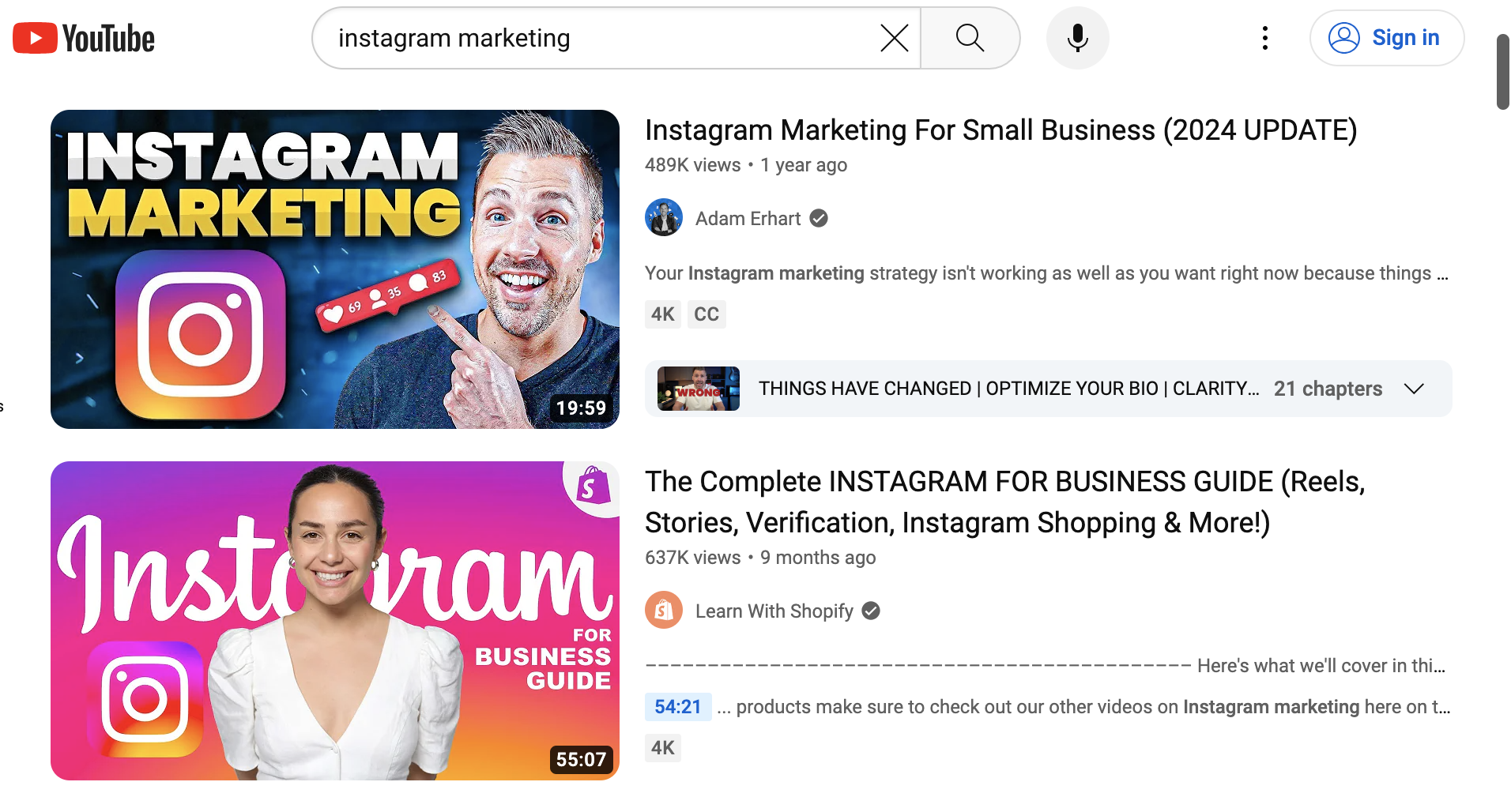
In the example below, you can see the top-ranking results for the topic “Instagram marketing,” based on the results, Adam Erhart and Learn With Shopify may be the current key competitors for this topic.
You can also use YouTube Shorts to identify key competitors.
Start by searching for the focus keyword and clicking the “Shorts” tab.
For example, the current top-ranking Shorts competitors for the keyword “Instagram marketing” are Vanessa Lau and Adam Erhart.
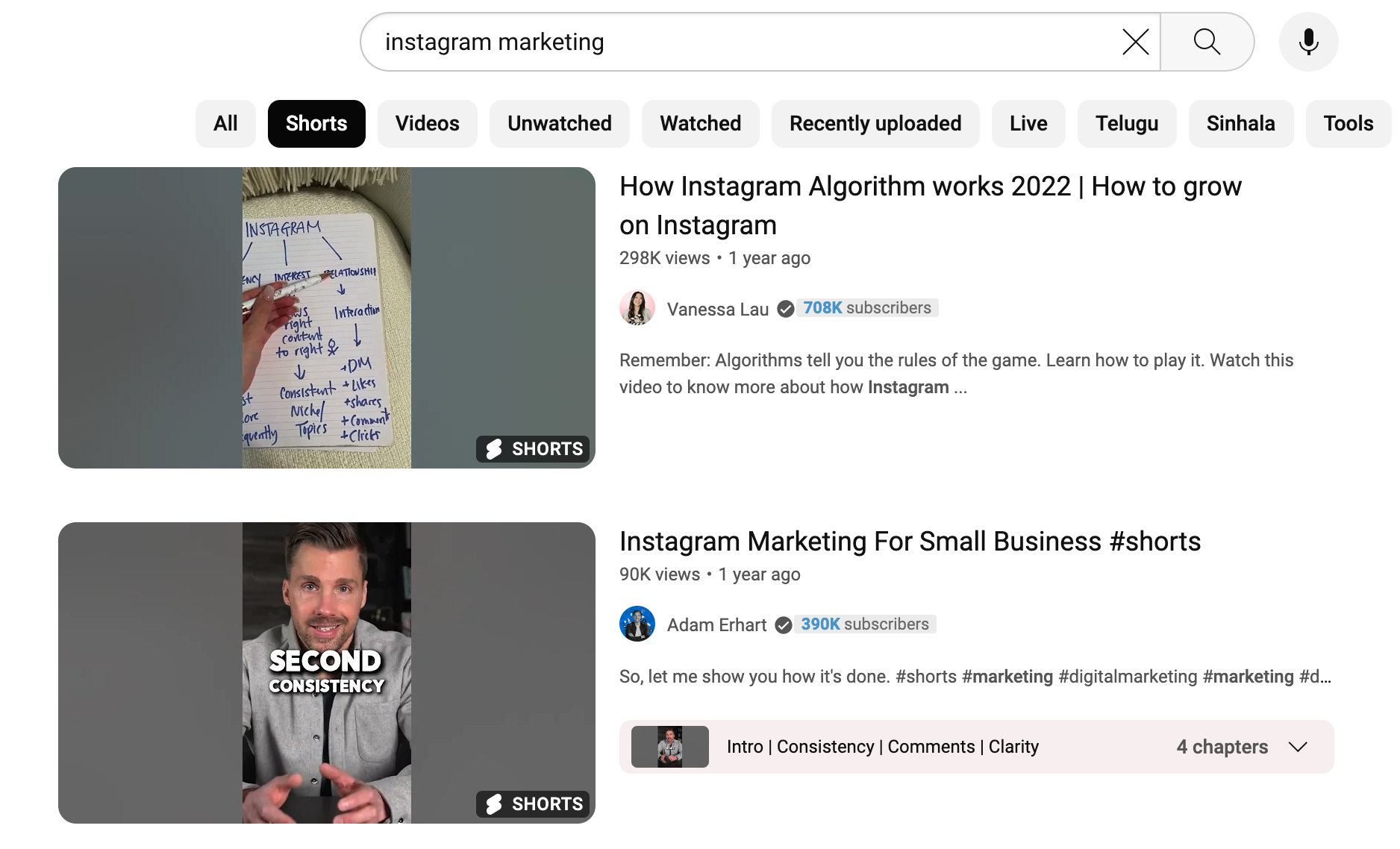
Be sure to go to the YouTube creator’s account to review the videos they’ve posted in the past year to ensure that the topics they cover align with the overall content pillars or topics that you intend to cover on your channel.
Step 2: Analyze competitor YouTube videos.
Once you’ve identified 5-10 competitors, it’s time to analyze the content your competitors have published for the year.
For example, I just conducted a 2024 competitor analysis for HubSpot analyzing all the videos created by our competitors in 2023.
I recommend considering the following things when completing a competitor analysis:
- What topics are your competitors discussing?
- What type of videos are they making (tutorials, vlogs, reviews, etc.)?
- How often are they publishing content?
- How long are their videos?
- What are their most popular videos from the past year?
- Do competitors have a video series or recurring theme?
- Are competitors using interactive elements such as polls, clickable links, or end-screen features?
Let’s continue with the Instagram marketing example from Step 1.
Below are examples of data and information you may find from your analysis of top-ranking Instagram marketing competitors:
- Topics discussed: General Instagram marketing, Instagram updates/trends, Instagram marketing tools, Instagram marketing strategy
- Type of videos: Tips, how-to tutorials, explainers
- Publishing cadence: Once per week
- Length of videos: 10-20 minutes
- Popular videos: “Instagram Marketing for Business” / “How to Create a Instagram Content Planner Calendar”
Pro Tip: I like to explore how competitors organize their playlists and video series. I assess the strategy behind grouping certain videos and creating a seamless viewing experience.
And don’t skip out on thumbnail research. I pay attention to the visual style of our competitors’ popular video thumbnails. I also identify trends in design, color schemes, and elements that grab attention.
Once you’ve aggregated this data, you can use it to identify and make note of any recurring themes.
These insights will be instrumental in crafting your content strategy because it will allow you to create content that resonates with your target audience and ensures your channel is competitive with other creators in a similar landscape.
Step 3: Identify SEO keywords and strategies.
Next, it’s time to examine your competitor’s video titles, descriptions, and tags.
This will allow you to understand how your competitors are optimizing their videos for YouTube search.
You can use competitor research in combination with SEO tools like TubeBuddy and VidIQ to review the monthly search volume of the keywords your competitors are using.
Video Titles
For video titles, examine how each competing video is structured and identify any common keywords/phrases. These titles communicate what keywords resonate with your audience and inform their searches on YouTube.
This analysis will inform how you shape your titles to include keywords or phrases that your target audience wants to see.
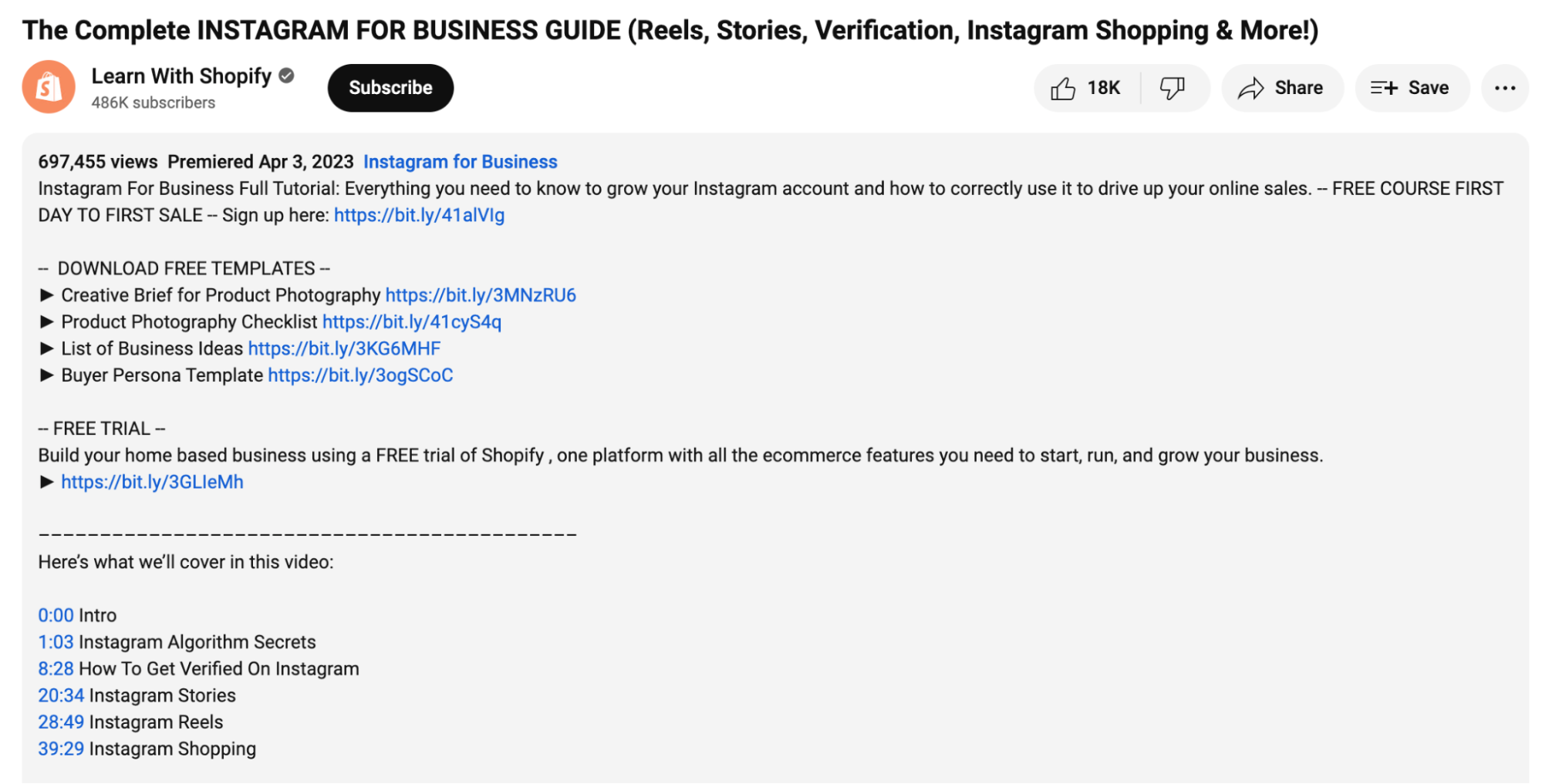
In our Instagram marketing example, the title in the top-ranking video says: “The Complete INSTAGRAM FOR BUSINESS GUIDE (Reels, Stories, Verification, Instagram Shopping & More!)”.
This title includes the focus keyword “Instagram for business” in all caps, it indicates that it is the complete guide, and gives a preview of what will be discussed in the video.
Video Descriptions
For video descriptions, analyze your competitor’s video description based on structure, if/where they include relevant keywords, links, and additional context. This will help develop the framework for your video descriptions.
In our Instagram marketing example, a description from a top-ranking social media marketing competitor may say: “Instagram For Business Tutorial: Grow your Instagram and use it to drive your online sales.”
This indicates that the competitor is using the primary focus word (“Instagram for business”) within the first sentence and tells the viewer exactly what to expect in the video.
Video Tags
For video tags, make note of any tags competitors use to enhance discoverability.
Video tags help categorize your content and indicate to your viewers what your videos are about.
Using the appropriate video tags for your video will best allow YouTube to share your content with viewers who are interested in that content.
In our Instagram marketing example, video tags from a top-ranking Instagram competitor may be: #instagramtutorials #instagramforbusiness.
This communicates to YouTube and the viewer that they will receive information about Instagram, a tutorial, and specifically for businesses.
Pro Tip: Beyond content analysis, I dive into competitors’ audience interactions. I identify recurring keywords in comments and observe how competitors engage. Pinned comments offer valuable insights into favored terms. I then leverage these findings to tailor my engagement strategy.
Step 4: Observe community engagement and audience feedback.
In this step, I like to observe how competitors engage with their YouTube community and how the audience responds to their content.
Community Engagement
Community engagement can help a creator connect with their audience.
You’ll want to look into how your competitors are using community features on YouTube to engage with their viewers.
I look for patterns in how competitors respond to comments, run polls, and address feedback.
Further, you’ll want to keep a close eye on whether your competitors are partnering with other creators to create their content. This will allow you to refine and adapt your community engagement strategy.
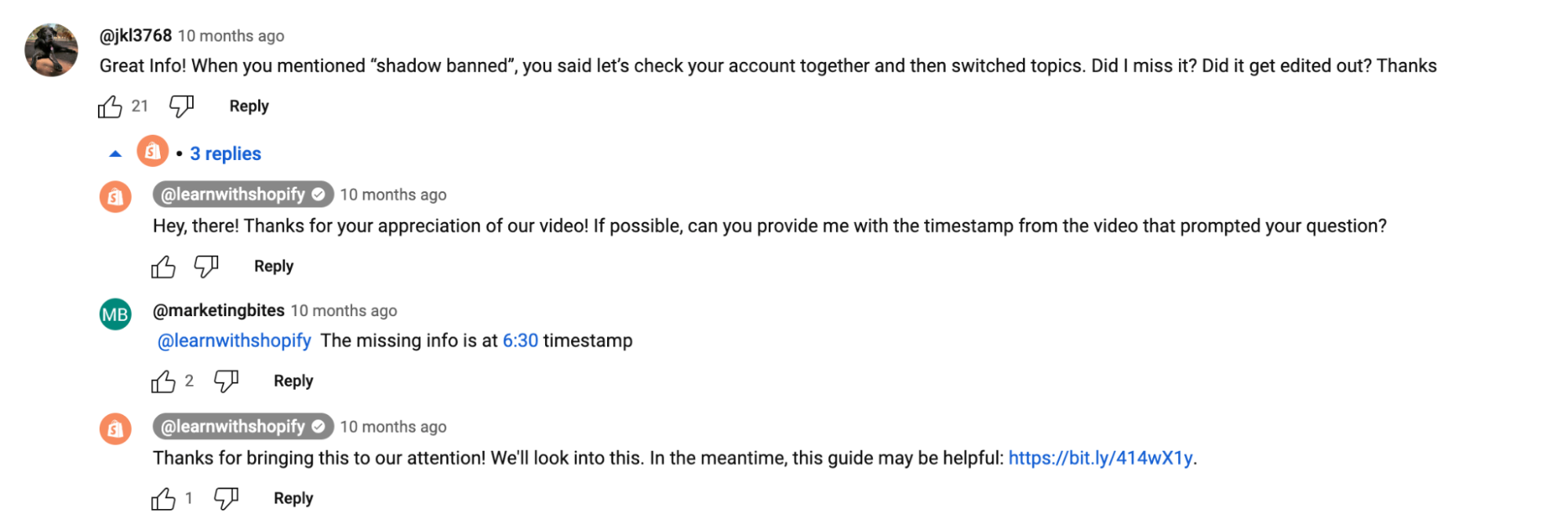
For example, under the “Instagram for business” video a viewer left a comment asking for clarity about a part of the video. Learn with Shopify responded and provided additional resources for the viewer.
This indicates to the Channel’s audience that Learn with Shopify is actively reviewing comments and looking to answer questions and provide educational resources for their audience.
This is something you’ll want to make note of and incorporate into your strategy.
Conversely, if your competitor has several questions under their videos that are left unanswered, that may serve as a point of differentiation for your videos.
You may want to create videos about those unanswered questions, and/or create an engaging presence in your comments to harbor a greater sense of community with your audience.
Audience Feedback
Analyzing the audience interaction on competitor videos such as likes will also allow you to understand how the audience received the video.
For example, if I notice that a video has a lot of views and ranks #1 for the topic, but it has limited likes, this may suggest that the viewers did not enjoy the content that was delivered.
Reviewing comments on competitor videos can give you a lot of helpful insight too. Viewer comments may tell you exactly what they liked or disliked about the video, what they want to see next, and what they wished was included.
These comments can set the stage for what you should include or avoid in your videos.
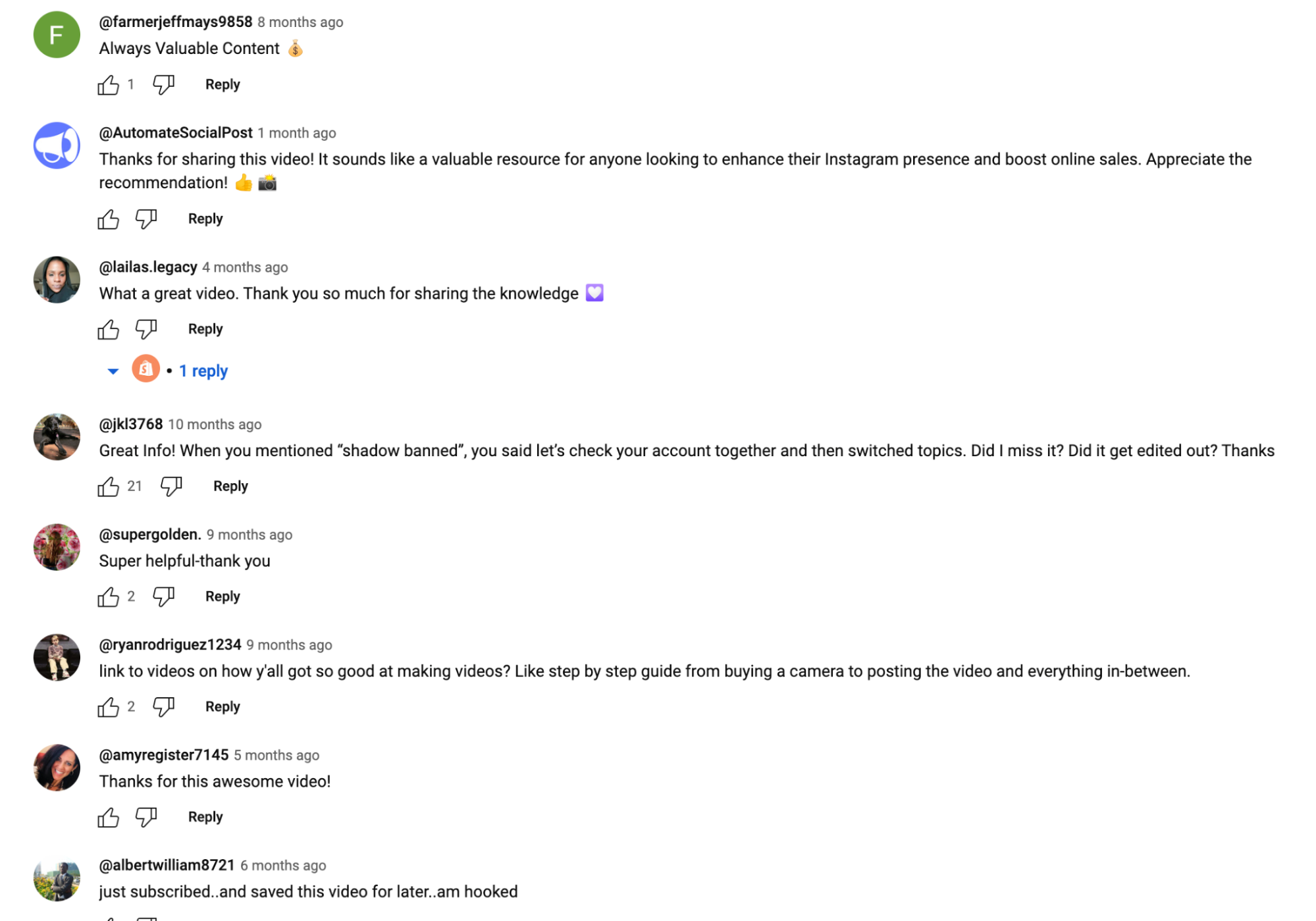
In the example below, under the “Instagram for business” video, viewers left several positive comments about how much they enjoyed the video. This is a great indicator that the video successfully delivered value to viewers.
You can take inspiration from this video by analyzing how the video is structured, how information is presented, the length of the video, along with other insights.
Remember, taking inspiration from a competitor does not mean copying. You want to create original content that delivers value to your audience independently and originally.
Viewers don’t need another video like this, they need something unique.
Further, there is a comment requesting a step-by-step guide on how to create videos. This comment indicates that there is a desire for this type of video.
If it fits your content strategy, this may be a video that you can create for your audience.
Step 5: Identify content gaps and use them to stand out.
It’s time to take all of the competitor insights you’ve found and turn them into content strategies for your YouTube channel.
You’ve evaluated and made note of what your competitors are doing well and where they are falling short. You will try to use what they’re using well as inspiration.
The areas where your competitors are falling short are called content gaps.
To round out our Instagram marketing example, let’s say I noticed that competitors are making long videos without outlined chapters.
This would be a great chance to not only adopt their successful elements but to also enhance the viewer experience by incorporating clear chapter markers.
This strategic differentiation is your key to standing out amidst competitors and delivering more refined and engaging video content.
Pro Tip: I like to explore how competitors use captions and transcriptions. I also assess whether they provide engaging supplementary content. For example, HubSpot provides its viewers with free content offers on the HubSpot Marketing Channel as supplementary educational content.
Level up your content strategy with a competitor analysis.
YouTube competitor research can help take your content strategy to the next level.
Competitor research and analysis serve as a compass for guiding your content strategy, offering insights into trends, audience engagement, and content gaps for opportunity.
These insights lay the foundation for a strong well-informed content strategy.
The digital landscape is continuously evolving and with that it requires us to both remain vigilant and flexible. These competitor insights lay the groundwork for your content strategy, but they are meant to evolve with emerging trends, audience preferences, and platform changes.
While adhering to the framework you’ve outlined from competitor research, you should continue to experiment and test new strategies.
With the combination of competitor insights, experimentation, and monitoring trends, you’ll know how to create content that your audience wants to see.
That’s all from me for now — good luck with your research.

TikTok Creativity Program: Is it better than the Creator Fund?

Just before the start of 2024, TikTok made a massive change in how the platform pays its creators by replacing the controversial Creator Fund with the new TikTok Creativity Program Beta.
Just before the start of 2024, TikTok made a massive change in how the platform pays its creators by replacing the controversial Creator Fund with the new TikTok Creativity Program Beta.
I wasn‘t surprised the fund was put to rest, considering how many creators expressed frustration over the fund’s payouts. However, I was skeptical of this new pay model, and if you‘re a creator on TikTok, you’re probably side-eyeing it as well.
Well, in case you don‘t know, I’m pretty much HubSpot‘s resident creator economy expert, so it’s my job to keep up with the latest creator trends and happenings.
That said, I‘ve researched and scoured TikTok for reviews of the new program straight from the creators who joined, so I’m prepared to give you a rundown and help you decide if you want to give TikTok Creativity Program Beta a shot.
Let’s dive in.
What is the TikTok Creativity Program?
How to Join TikTok Creative Program Beta
What happened to the Creator Fund?
TikTok Creativity Program Beta Payout
Is the TikTok Creativity Program Better than the Creator Fund?
What is the TikTok Creativity Program?
According to the platform, TikTok Creativity Program Beta is an initiative to reward creators for creating high-quality, original content, and it serves as a monetary incentive for creators who make longer content (over a minute).
TikTok’s website explains, “With Creativity Program Beta, you have the potential to collect rewards as you create and publish longer video content.”
As the name suggests, the program is still in beta mode and is only available in limited regions — the U.S., France, Brazil, Germany, Japan, Korea, and the U.K.
How to Join TikTok Creative Program Beta
To be eligible for the program, you must have an account based in one of the above regions, be at least 18 years old, have no less than 10,000 followers, and have at least 100,000 video views in the last 30 days.
How you enroll in the program depends on whether you‘re already registered in the defunct TikTok Creator Fund. If you’re enrolled in the Creator Fund, you can switch to TikTok Creative Program Beta via the following steps:
- Open the TikTok app and go to your profile.
- Tap the menu button (the three horizontal bars), then tap Settings.
- Tap Creator Tools, then Creator Fund.
- Finally, tap Switch at the bottom of the page.
Pro Tip: Once you join TikTok Creative Program Beta, you cannot switch back to the Creator Fund. But, also … why would you want to? The Creator Fund is dead.
If you‘re not enrolled in the Creator Fund, you’ll follow steps 1-3 but tap Creator Program instead of Creator Fund. You‘ll be notified three days later whether you’ve been accepted into the program.
What happened to the Creator Fund?
Okay, why did the Creator Fund go the way of the dinosaurs? The $2 billion fund was launched in 2020 and was discontinued in December 2023 after many creators criticized the program for low payouts.
In a 2022 interview with Business Insider, wellness influencer Mandana Zarghami said her biggest payout from TikTok was just $24 from a video that garnered 1.1 million views. Her lowest earning day at the time was 5 cents.
Most shocking was when I found out how much (or little) viral content creator John Eringman made from the Creator Fund. When he spoke to Business Insider,
Eringman had 1.3 million views, and at least one of his videos would reach a million-plus views each week.
The most he earned in a single day was $189.13 for a video with 13 million views. However, Eringman reported getting payouts ranging from 67-84 cents and averaging just a few dollars in one month.
In other words, even viral creators like Eringman were getting inconsistent payouts and were not receiving enough to make a living — prompting TikTok to sunset the Creator Fund.
TikTok Creativity Program Beta Payout
So, how much are creators making via the TikTok Creativity Program Beta? While the platform’s website is being hush-hush about exactly how much the new program is rewarding creators, some users are already sharing their experience.
Finance content creator Miki Rai shared that her experience with the program was off to an underwhelming start but improved significantly over time.
“Immediately after I joined (in November 2023), my video views tanked so bad,” Rai explains in a TikTok. Rai believes the tank occurred because her audience was used to her posting short-form videos rather than videos longer than a minute.
Remember that the program only generates revenue if the videos are longer than 60 seconds.
Rai reports only making $146 her first month into the program, even after posting multiple times a day.
“Which makes that less than $5 per video that I made,” she says. Rai’s earnings jumped to $436.76 the following December and about the same in January. But, in February, Rai saw a major difference.
“We’re only halfway through, and so far, I’ve made $1,273.48,” she says in her TikTok. The app projected she’d earn $2288.66 by the end of the month.
Rai says the boost in earnings is likely connected to a couple of her videos going viral that month, one of which earned 3.8 million views. Both videos were over a minute long.
Creator Kait Alayna says she made $629 in one week. That week, daily income ranged from $4.90 to $193.24.
However, it’s important to note some creators, like Rai, have reported a tank in views shortly after joining the program, prompting some users to discourage others from joining the program or dropping out themselves.
That said, the drop in viewers seems temporary as they get used to creators posting longer content.
Is the TikTok Creativity Program Better than the Creator Fund?
In short, I say it‘s definitely better. The program is still fairly new, so there aren’t many reliable statistics comparing the program to the fund.
But, based on videos I’ve seen of creators discussing their payouts, the program seems to be facing less criticism than the Creator Fund.
If you’re a creator used to generating short-form videos under a minute long, then exceeding 60 seconds can pose a challenge. You may also notice at least a temporary drop in views as your audience adjusts to the new direction.
All that aside, I think the program is worth applying if you want to generate income on TikTok. Now, do I think you’ll generate enough income to survive solely off the TikTok Creativity Program — no.
The fact is only 12% of creators make over $50,000 a year, regardless of the platform. The real money comes from brand partnerships, deals, sponsorships, ad revenue, and commissions.
Regarding TikTok, you can generate additional income via TikTok Live and TikTok Shop, as well as the above methods.
My advice, you‘ll stand to benefit in the long run from switching to the new creativity program. Plus, there really isn’t much of a point in sticking to an old fund that was so widely criticized it was discontinued.
Just make sure you have other streams of income, too.

40 of the Best SEO Tools for Auditing & Monitoring Your Website in 2024
For many years, Google algorithm updates have left marketers, SEOs, and business owners confused and concerned. I wonder if search engines like Google wait for you to get all of your ducks in a row, only to unleash an update that can make your efforts obsolete.For many years, Google algorithm updates have left marketers, SEOs, and business owners confused and concerned. I wonder if search engines like Google wait for you to get all of your ducks in a row, only to unleash an update that can make your efforts obsolete. Plus, some secrecy behind how Google determines websites and their order of appearance on the search engine results page (SERPs) for different queries doesn’t help. The good news is that there are several free and paid search engine optimization (SEO) tools for monitoring and auditing your site. Not only can these tools help you improve your ranking, they can help you reduce or eliminate the impacts of Google updates that may sweep through your industry. Note: Some of the free tools below also offer paid plans, while some of the paid tools also offer free plans. We recommend you check the pricing pages for the tools that interest you to determine the ideal plan for your needs and goals. For universal SEO tips, you can use today to grow your business, check out our video guide below. Free SEO Tools These tools are free to use, but you might find a paid option that has more features. We’ve shared some of the best features in each tool, as well as how you can get the most out of them for your SEO strategy. 1. HubSpot Website Grader Image Source The goal of marketing is to generate traffic and qualified leads via the company’s website. That’s why, as marketers, we need to understand what we can do to improve the SEO of websites we manage. I like that with HubSpot’s Website Grader, you enter your website URL and receive a report with actionable SEO insights. Here’s the result of the HubSpot website from the grader: If you check your website and your report is not looking good, you can sign up for the HubSpot Academy SEO course to learn how to improve your website’s SEO, user experience (UX), and more. With the HubSpot Website Grader, you can: Website performance: Learn about your website’s performance in seconds, identify specific performance issues, and receive actionable feedback on how to fix them. On-demand support: Receive how-to education on improving your website. Improve specific website issues: Gain access to a five-lesson HubSpot Academy course on Website Optimization to understand how to improve challenges with your website. Optimize for mobile: Discover how to optimize your website for mobile. Boost web security: Learn how you can implement website security best practices. Enhance the user experience: Personalize your website’s UX to create a delightful experience for users. 2. Google Search Console Image Source Google Search Console has several tools available to help you appear in the SERPs for the search terms and phrases your target audience is looking for. If you’re the owner of a business or an SEO on your marketing team, Search Console can help you conduct an initial SEO analysis from scratch or update your existing SEO strategy with fresh keywords. I like that Google Search Console monitors, debugs, and optimizes your website — and you don’t need to know how to code to benefit from this tool. Here are some website elements Google Search Console will teach you about and help you optimize: Keywords: Learn about the keywords your web pages are currently ranking for. Crawl Errors: Identify any crawl errors that exist on your website. Mobile Responsiveness: Understand how mobile-friendly your website is and discover opportunities to improve the mobile experience for users. Google Index: See how many of your web pages are in Google’s Index (if they aren’t in Google’s index, you can use the tool’s URL Inspection Tool to submit a page for indexing). Analytics and Metrics: The website-related metrics that matter most to you, like clicks, impressions, average click-through rate (CTR), and average position. 3. Google Analytics Image Source Although Google Analytics has a paid version, the free version of the product can help you manage your website’s SEO — this is especially true if you pair Google Analytics with Google Search Console (which I recommend). In doing so, all of your website’s SEO data will be centrally located and compiled, and you can use queries to identify areas for improvement with the keywords and phrases you want your website and web pages to rank for. Other ways that you can use the free version of Google Analytics are: Filtering your referral traffic: Get rid of the traffic that has the potential of ruining SEO reports, such as fake traffic. Comparing organic versus non-organic website traffic: Understand where your visitors are coming from and optimize those channels to increase traffic. Determining engagement metrics: Use Site Content Reports to determine engagement metrics on each web page, engagement for the directories and pages on your website, page exit metrics, and acquisition, behavior, and conversion of landing pages. Reviewing the Multi-Channel Report’s Assisted Conversions feature: Identify which of your channels led to the most conversions and the value they bring to your business. 4. SEO PowerSuite Image Source SEO PowerSuite is a one-stop software for all your SEO needs, and is also one of the most budget-friendly options. I like this toolkit because it allows you to check as many websites as you need without limitations. It works with 550+ search engines and can track geo-specific positions, even down to the exact street address. The suite is highly customizable, with easy automation and white-label reporting. Here is what you can do with four tools of SEO PowerSuite: Rank tracker — Keep a close eye on how your website is ranking across various search engines. It’s super handy for monitoring keywords and fine-tuning your strategy. Website Auditor — Get a list of issues and tips on how to fix them. Analyze any page of your website and see how well it is optimized for your target keyword. See what needs to be improved in your content to increase the optimization rate, and make all those changes right in the app. SEO Spyglass — Unveil your competitors’ backlink strategies and get insights to boost your site’s authority. Make sure to check out the Backlinks history module to see the newly found and lost links of any domain and page. Link Assistant — Build a network of high-quality backlinks and make outreach and campaign management efficient. 5.The Free SEO Report Card by Singularity Digital Image Source The Free SEO Report Card by Singularity Digital lets you analyze your website to determine how it stacks up against the competition. In exchange for your email address and a few data points, the SEO Report Card will cover: A website score — a score from A+ to F ranking your site’s overall SEO strength and a breakdown of it per category. Rank analysis — a snapshot of your website ranking across the world. Link building — a breakdown of the websites that link to your site and your domain link strength. On-site analysis — a look at how successful you were in implementing on-page SEO elements like headings and alt tags. Website accessibility — information about your site’s mobile usability and how it displays on different devices. 6. Internet Marketing Ninjas Image Source Internet Marketing Ninjas is an SEO-focused company with a variety of free tools for comparing your website against the competition, optimizing web pages for certain keywords, generating meta tags, and increasing organic traffic to your website. Here are some examples of the free Internet Marketing Ninja SEO tools you can take advantage of: Broken link tool. Identify broken links and redirects and use the site crawl feature to generate an XML sitemap of your website. Image metadata. See all of your page links (external, internal, etc.) on your web pages to review what’s working well and what’s broken or needs an update. On-page optimization tool. Use this to evaluate your web page content, meta information, and internal links. Side-by-side comparison. Compare the SEO of your web pages versus a competitor’s web pages. Page speed tool. Analyze page-load time and how long each component of a web page takes to fully display. 7. Bing Webmaster Image Source Microsoft Bing Webmaster gives you access to many tools that offer insight into your website, such as reporting, diagnostic, and SEO tools. The SEO tools you can use for free can help you analyze your website, manage backlinks, and review keywords to ensure your site is well-optimized for organic search. Here are other things you can do with the Bing Webmaster SEO tools: Seeing backlink profiles. Learn about your backlink profile to understand referring pages, domains, and anchor links. Performing keyword research. Determine which keywords and phrases your audience is searching for, as well as the search volumes of those keywords and phrases. Using the site scanning feature. Crawl your website and identify technical SEO errors. Getting SEO reports. Review any errors on your website and individual site pages. 8. Google Trends Image Source Traditional SEO tools are great for conducting research and audits when your business is already established. But what if you’re starting a new business venture and want to know what popular industries, topics, and ideas people are exploring? Google Trends is a great place to explore the untapped potential that can yield a large keyword landscape for your website. Note that Google Trends isn’t where you’ll get granular data. I think this tool performs best when you use it as a compass to set a direction for your SEO strategy and then pair those insights with a more robust software like HubSpot’s SEO Marketing Tool. Here’s what you should look for in Google Trends: Trends: Look for trends in specific countries or regions of the world. Popular topics: Find popular people and long-tail keywords related to them. Comparisons: Compare and contrast trends over time. 9. Seolyzer Image Source Seolyzer is a free SEO tool for site crawling, log analysis, and determining how search engines like Google view your website. Seolyzer pulls information that crawling bots leave in your server’s log files while browsing your site. The tool also identifies error codes, redirects, and page speed performance. Additionally, Seolyzer can help you: Monitor SEO issues: Identify poor response time, error messages, and crawl volume so you can resolve them before serious damage is done. Manage your unique KPIs: Analyze page performance, crawl volume, HTTP status codes, active and new pages, and desktop versus mobile responsiveness. Segment web pages: Determine what your most crawled pages are. Compare web pages: See what Google deems as the most important to the pages that are crucial to your business’s bottom line. Measure SEO impact: Understand the impact of your SEO efforts on a page-by-page basis or by the category of the page. 10. SEOquake Image Source SEOquake is a Google Chrome extension that automatically checks a web page’s SEO parameters quickly for free. This includes on-page SEO audits, internal and external link reviews, real-time URL and domain comparison, and data file export. Other things you can use SEOquake for are: Link Analysis: Get a detailed description of your link performance — including URLs, anchor text, and other link types — with the tools Link Examiner feature. Focus on metrics that matter: Adjust your SEOquake reports to display only the parameters and metrics that you care about. Audit your website’s SEO: Identify any SEO-related issues that search engines can find. Share your findings with stakeholders: Export the results of your SEO analysis into a customizable and shareable report. 11. Seobility Image Source Seobility is a free SEO-checker tool. With it, you can test your website’s level of compliance with today’s SEO guidelines. I like this tool because when you enter your URL, Seobility will analyze your site and provide some custom website optimization tips. Besides the detailed SEO audit of your website, you’ll gain access to 1,000 subpage audits, email reporting and alerts, and keyword monitoring. Here are some more features you can leverage when using Seobility: Finding technical errors: Resolve on-page SEO issues quickly to recover lost traffic and prevent future traffic dips. Accurate SEO scoring: Receive an SEO score that accounts for various website factors, including meta-information, page quality, link structure, and more. Meta information analysis. Understand the specific SEO issues with your meta information, such as meta titles/descriptions, meta tags, and invalid or incorrect domain names or page URLs. Optimization opportunities. Identify areas for improvement regarding your page speed and quality (related to text, duplicate content, responsive design, and alt attributes for content). Link structure suggestions. Understand how your page and link structure can be improved by getting data about your headers, internal links, and incorrect anchor text. Server error fixes. Identify specific server errors related to any redirects, HTTP headers, or CSS and Javascript files. 12. Check My Links Image Source Check My Links is a Google Chrome extension that ensures your links on both internal and external web pages work. For instance, if you were to search for a term on Wikipedia, Check My Links could tell you how many links that Wikipedia page has and how many of those links are broken. I find it helpful because I can make corrections to broken links immediately (or, hopefully, before a page goes live). Check My Links is ideal for developers, content editors, and web designers, according to its creators. Here are some more examples of what Check My Links can do: Identifying broken links: Check each link on your web pages and identify all invalid links. Auto-highlight issues: Quickly see the good links in green and the broken links in red. Export broken links for further analysis: Copy all of your bad links to your clipboard in one click. 13. BROWSEO Image Source BROWSEO is an SEO browser for reviewing your website in a limited format to analyze its UX, content, and SEO. Once you input the URL, the output will hone in on your HTML so you’re able to understand the page’s structure, optimized search terms, and other SEO-related factors. Here’s the snapshot of what we got by entering this article about SEO tips into BROWSEO: Examples of what you can do with BROWSEO include: Seeing the number of words on the page: Find the sweet spot for copy length on your web pages. Determining the number of internal and external links on your page: This allows you to see how your linking strategy is working on each page. Seeing all of your meta information: Review title tags, alt text, and meta descriptions. 14. CWVIQ Alerts CWVIQ is a free email notification service for website owners to monitor site speed and get notified when pages load slowly. Page speed and Core Web Vitals are essential SEO components that can impact your rankings and user experience. With CWVIQ, you can monitor these. CWVIQ also sends subscribers a weekly summary of the monitored speed through the week, along with CWV metrics. Examples of what you can do with CWVIQ include: Monitoring website performance: Obtain weekly reports and analytics on page speed and web performance Optimize backend performance: Identify underperforming website elements to improve load times and user experience 15. PageSpeed Insights Image Source This free SEO tool measures and reports the user experience of your website on mobile and desktop using Google’s Core Web Vitals. It also identifies problems and suggests changes you can implement to improve the page’s speed. Here are some things PageSpeed Insights allows you to do: Monitoring page load speed. See how quickly the elements of your web pages load on mobile and desktop. Improving site navigation. Find opportunities to improve your website’s accessibility and navigation. Bettering UX improvement. Identify problems slowing down your website and performance. Find suggestions to create a better user experience. Performing UX analysis. Discover an in-depth analysis of your site’s user experience with essential metrics like: First contentful paint — how long it takes for a user to see content on the screen. First input delay — the time before a page becomes interactive and responds to the user’s first interaction, like clicking a link. Cumulative layout shift — how stable the page elements are as it loads. Largest contentful paint — How quickly the user can see the largest page element. 16. Schema.org Image Source Search bots scrape structured and unstructured data from web pages. But the bots are not always accurate. Schema or structured data is a semantic vocabulary of tags that you can add to a page’s HTML to help crawlers understand the page’s content. Search engine companies created it as a unified language for structured website data. This code helps search engines display your content in rich format (search results other than the traditional blue link text). For example, the recipes displayed below are rich results: Schema data helps search engines show your pages for the right search query, increasing your website’s CTR and site visits. Note that Google only uses 35 of the schema types. However, they don’t penalize you for including structured data they don’t use. Check out their rich results page to learn more about the schema types you can implement on your website. Schema.org helps you to: Explore several ranking opportunities, including rich results like knowledge panels, FAQs, carousels, images, videos, etc. Add schema to any website page. Structure page data to help search engines easily find and categorize your website. Enhance your website’s appearance. This gives you a competitive edge in the SERPs. Paid SEO Tools Next, let’s look at some paid SEO tools. (Note that some of these tools have free trial periods. Some also offer entirely free plans but with restrictions in terms of flexibility and customization). 1. HubSpot SEO Marketing Software Image Source Price: $45/ mo for the Starter plan, $800 for professional, and $3,200 for enterprise. HubSpot’s Marketing Hub includes an SEO marketing software tool that’s perfect for helping you build authority across your website. Since this software is integrated with HubSpot landing pages, web pages, and blog posts, you’ll never miss an opportunity to optimize your content for traffic and conversions. Whether you’re creating your first content strategy or you’re an expert in all things SEO, HubSpot’s SEO Marketing Software gives you the tools and the confidence to rank in the SERP and report on your performance. HubSpot’s marketing software doesn’t keep SEO in a silo. This tool works in conjunction with: Email: Send professional emails using your own branded designs. Marketing Automation: Create dynamic campaigns for segmented audiences. Lead Management: Track leads through each stage in your sales process. Analytics: Review your campaign to identify success and opportunities for improvement. 2. Ahrefs Image Source Price: Limited free features available. Plans cost $99/mo for lite, $179/mo for standard, $399/mo for advanced, and $999/mo for enterprise. Ahrefs is an advanced SEO resource that examines your website property and produces keyword, link, and ranking profiles to help you make better content decisions. Some of Ahrefs’ main features are: A site explorer, which shows you the performance of specific web pages on your website. A content explorer. This allows you to search high-performing web pages under specific keywords and topics. A keywords explorer, which generates the monthly search volume and click-through rates of specific keywords. Site audits, which crawl specified verticals within your domain and reveal technical issues at the page level. 3. SEMrush Image Source Price: $129.95/mo for pro, $249.95/mo for guru, or $499.95/mo for business. Semrush is an elaborate dashboard that reports on the performance of domains as a whole and their specific pages. Semrush offers numerous resources, one of which is the SEO Toolkit. I like Toolkit because it allows you to track a website’s visibility improvement over time as well as identify which keywords it’s ranking for, what the page’s rank is for a keyword, the keyword’s monthly search volume, and more. SEMrush also allows you to: Build links. Analyze backlinks from other websites to your site. Use the Keyword Magic tool. Identify all keywords you need to successfully build an SEO strategy. See your competitors’ strategies. Identify the paid keywords or ad copy used in your competition’s PPC ads. Receive recommendations. See how you can increase your organic traffic by optimizing your content. 4. Sitechecker Image Source Price: a 7-day free trial is available. Plans cost $49/mo for basic; $199/mo for standard, and $399/mo for premium. Sitechecker is a comprehensive solution for SEO auditing that identifies opportunities to increase organic search traffic. Sitechecker is used to automatically monitor your website performance, inform you of timely error detection, and search for growth points. Some of the top features Sitechecker offers include: Site audits. Track all types of errors on the site at a rate of 150 pages per minute. Fine-tuning is available to monitor website function with automatic notification when problems are detected. Rank tracking. Track positions of keywords for specific queries in any search network of choice, on any devices, and in a given region. Convenient service with the results and daily reports sent to your email. Backlink tracking. Keep track of backlink changes around the clock to avoid losing any valuable links. Control and decide which links to collect and track. An all-in-one Chrome Extension. Instantly check the keyword and SERP positions within your browser. 5. SEOptimer Image Source Price: A free trial is available. Plans cost $19 a month for DIY SEO, $29 a month for white labeling, and $59/month for white labeling and embedding. SEOptimer is an SEO audit and reporting tool used by digital agencies to create white-label audits and embed an audit form on their website for lead generation. SEOptimer’s reports are comprehensive and check over 70 data points.I like that you can run free site audits right from their homepage. An overall score is applied for the site, and additional scores are broken down into five categories: On-page SEO, Backlinks, Usability, Performance, and Social media (including Local SEO). The report contains details about each check and indicates a pass/fail, together with recommendations on how to improve. Some of the top features SEOptimer offers include: Unlimited white label audits. Create customized, white-labeled SEO audits. Embeddable audit tool. Fully customize and embed a site audit form into your agency website to generate new leads. An SEO crawler. Scans every page of a site for problems and identifies issues holding back a site from ranking. A keyword research tool. Perform keyword research quickly, see search volume, competition, traffic, and CPC. 6. KWFinder Image Source Price: A free trial is available. Plans cost $29 a month for entry, $49 a month for basic, $69 a month for premium, and $129 a month for agency. Sometimes, you don’t need an SEO tool with all the bells and whistles if you only need to do keyword research. I think KWFinder is a great software that fills the gap between nuts-and-bolts SEO work and copywriting. You’ll find keywords that aren’t too difficult to rank for but still carry the potential to bring in traffic. What makes KWFinder unique is how seamlessly it shifts between languages and regions so that you can serve your audience no matter where in the world they are. Some of the top features KWFinder offers include: Hidden long-tail keyword insights. Find long-tail keywords that give you more opportunities to acquire traffic. Competitor keyword insights. See how your competitors’ keyword strategy compares to your own, plus find more keyword opportunities. A SERP analysis tool. Analyze competition in the SERP to understand what elements readers are looking for on your pages. A local keyword research tool. See what searchers are looking for locally and appeal to local markets for more niche traffic. 7. GrowthBar Image Source Price: A free 7-day trial is available. Plans cost $36 a month for standard, $74.25 a month for pro, and $149.25 a month for agency. GrowthBar is an AI tool and SEO auditing tool for performing keyword research, writing, doing competitive analysis, and tracking SEO rankings. With the GrowthBar Chrome extension, you can access data about any website directly from the SERPs. This allows you to evaluate your competitors’ performance and view the growth channels, keywords, backlinks, and ads that are working for them. Here are some more key features of GrowthBar: Top keywords and backlinks. See which paid and organic keywords are driving the most traffic for your website and get a list of the most authoritative backlinks pointing to your site. Get your keyword difficulty score. Quickly assess the difficulty of ranking a keyword based on the strength of the domain authorities of the URLs ranking on page one. Use the word count tool. View the word count of any page directly from the SERP. Use the keyword suggestions tool. Get a list of related keywords you might want to rank for, along with their search volume and cost per click. 8. Woorank Image Source Price: A free 3-day trial is available. Plans cost $89.99 a month for pro and $199.99 a month for premium. Contact Woorank for an enterprise quote. Woorank’s in-depth site analysis helps marketers reveal opportunities for optimization and improvement. This analysis takes into account the performance of existing SEO initiatives, social media, usability, and more. Each report is divided into sections to help you easily analyze your site and identify targets for optimization. Here are a few features of the report: Marketing checklist. Review common marketing tasks that you can complete as part of your SEO strategy execution. SEO. Analyze your SEO metrics against your goals. Mobile optimization. Decide which mobile optimization tactics to employ based on the mobile data. Social analysis. Get insight into how social media is playing a part in your traffic and SEO goals. 9. BuzzStream Image Source Price: Free 30-day trial, $24/ mo for Starter, $124/ mo for Group, $299/ mo for Professional, $999+ for Custom Price: A free 14-day trial is available. Plans cost $24 a month for starter, $124 a month for group, $299 a month for professional, and $999+ for custom. Backlinks are crucial for getting your website to rank well on Google. However, the outreach process is daunting and can feel a lot like cold calling. With BuzzStream, you can easily research the appropriate people, come up with effective email messages, and track who’s accepted each link request. BuzzStream also helps you: Identify candidates for outreach. Find them based on their industry and how engaged they are across various social networks. Identify candidates for backlinks. These are individuals who will likely be receptive to your backlink request for other reasons that are unique to your business’s niche. 10. Moz Pro Image Source Price: Free 30-day trial, $99/ mo for Standard, $149/ mo for Medium, $249/ mo for Large, $599/ mo for Premium Price: A free 30-day trial is available. Plans cost $79 a month for standard, $143 a month for medium, $239 a month for large, and $479 a month for premium. The Moz Pro subscription serves as an all-in-one tool for increasing your website search ranking. Moz’s collection of research tools provides subscribers with the resources they need to identify SEO opportunities, track growth, build reports, and optimize their efforts. Moz Pro also includes: A website crawler, which analyzes up to 3,000 links on a given URL. Email reports, which detail the crawl data for the pages your site links to. Insight into various “crawlability” factors. These include duplicate content and redirects that could be influencing your SEO performance. 11. Linkody Image Source Price: A 30-day free trial is available. Plans cost $14.90 a month for webmaster, $24.90 a month for advanced, $49.90 a month for pro, $99.90 a month for agency, and $153.90 a month for agency XL. The best way to understand the performance of your off-page SEO is by having a good overview of your backlinks. Linkody allows you to discover, track, analyze, and disavow backlinks, all from an easy-to-use interface. Aside from that, the tool checks your links 24/7 and informs you of any changes so you can take immediate action in case a link is lost or broken. Other Linkody features include: A way to “Spy” on your competitors’ backlinks. Enter the URL of your competitor and let the tool pull all the links and metrics. The information returned will help you discover niche-relevant, high-quality backlink opportunities for your brand. Methods to gain useful insights. See your most important metrics when it comes to backlink tracking, such as the ‘rel’ attribute, Google indexation status, the website’s Domain Authority, Spam Score, Alexa rank, and more. The means to create white-label reports. Download reports you can share with your team and/or clients to get a better idea of your backlink distribution and link-building progress. 12. Screaming Frog SEO Spider Image Source Price: Free plans are available. Paid plans cost $259 a year. Designed specifically for the SEO-minded, this program crawls the websites you specify, examining the URLs for common SEO issues. This program simplifies and expedites an otherwise time-consuming process — especially for larger websites. (It could take hours or days to manually evaluate the same URLs.) Other notable features of Screaming Frog SEO Spider are: A Java program. Screaming Frog includes an intuitive Java program with easy-to-navigate tabs. Easy export to Excel, so you can further analyze your SEO data. 13. Remove’em Image Source Price: You can pay a one-time fee of $249 for the lifetime plan. A one-website subscription costs $99 a month. A 10+ website agency plan costs $899 a month. If you’re buying a website domain that has been used in the past, or you’re rebuilding a poor SEO strategy, you may discover some problematic backlinks while conducting your audit. Artificial or unnatural links have the potential to seriously hurt your search ranking. Remove’em helps get rid of those links. This tool can: Scan your backlink profile. Discover a list of contact information for the links and domains you’ll need to reach out to for removal. Export a list of backlinks. If you wish, you can disavow backlinks by telling Google not to take these “bad” links into account when crawling your site. 14. AnswerThePublic Image Source Price: Plans cost $9 a month for individuals, or $99 a month when billed annually. Expert plans cost $199 a month. AnswerThePublic is a search listening and keyword tool that gets autocomplete data from Google and other search engines. Entering a keyword into this tool gives you a list of phrases and questions people are searching for around your keyword. With AnswerThePublic, you can also: Receive updates. See when people are talking about your most relevant keywords. Monitor keyword trends. Understand keyword research behavior among your target audience and customers. See real-time searches. View the keywords and phrases your audience is researching in real time. Get ideas for your website and blog. Discover new content ideas based on relevant keyword research. 15. Keyword Hero Image Source Price: A 14-day trial of any plan is available. The little hero plan is free. Plans cost $9 a month for big hero, $49 a month for giant hero, and $149 a month for ultimate hero. Keyword Hero pairs your visitors’ sessions with the keywords they used to land on your page, all within your Google Analytics account. In other words, this tool lets you understand the search intent of your organic traffic. Here are some more actions I love that you can take with Keyword Hero: Identify organic traffic and conversions. Uncover the success you receive from your intended keywords. Separate traffic. Identify brand versus non-brand search traffic. Optimize your position in the SERPs. Optimize your website for specific target keywords. See query details. Understand whether your visitors used informational versus transactional queries to find your website. 16. SpyFu Image Source Price: Plans cost $39 a month for basic and $79 a month for professional. SpyFu is a competitor keyword research tool for Google Ads. In addition to keyword research, it helps with PPC competitive research, SEO competitive research, and the creation of custom lists and domains. The tool helps you drive traffic to your Google Ads campaigns and website, monitor both paid and organic rankings on Google, Bing, and Yahoo, and obtain reliable and accurate contact information for leads. With SpyFu, you can also: Download a competitor’s PPC keywords. Use this insight to develop more competitive PPC strategies that can compete in the ad space. Download a competitor’s SEO keywords. Use this insight to develop more competitive organic keyword strategies that can compete in the SERP. Review ranking trends. Access the ranking of a page or website for a keyword over time. Discover keyword ideas. Get keyword insights for your Google Ads to increase your chances of conversion. 17. Seomator Image Source Price: A free 7-day trial is available. Plans cost $49 a month for lite, $99 a month for standard, and $279 a month for advanced. Seomator is an SEO auditing and website crawling tool. It assists with technical SEO analysis and on-page optimization testing. Once the tool crawls your site, you’ll receive an SEO report that explains your website’s SEO-related elements including internal and external links, backlinks, page quality and speed, social media, organic presence, and more. I especially like that your analysis comes with tips for improving each SEO element. In addition, you can: Use the SEO monitoring alerts feature. Your website will be automatically crawled, and you’ll get an immediate notification if something is problematic in terms of SEO. Get detailed reports. Find insights about your on-page and off-page SEO elements. Use the domain comparison tool. Compare two competitors’ websites to identify the strengths and weaknesses of their SEO (such as broken links, content quality, HTML tags, and more). 18. ContentKing Image Source Price: Plans cost $139 a month for basic, $319 a month for standard, $449 a month for pro, and $1,279 a month for enterprise. ContentKing is a real-time SEO auditing and content tracking tool — it tracks your website 24/7, so any issues related to SEO don’t go unnoticed for too long. I like that the tool is cloud-based, meaning there’s no installation required, and your data and reports are available whenever you need them. With ContentKing, you can also: Improve your SEO. Use ContentKing’s 24/7 website audits (and algorithms) to gain insight into your SEO and receive tasks for optimizing your web pages. Get alerts. Get notified whenever something on your website is broken or is no longer well-optimized so you can efficiently fix the issue. Track changes. Follow the history of all your content changes on your site (such as changes on individual web pages and changes in robots.txt) and search the history of your changes. Visualize data. See real-time dashboards and reports. 19. SE Ranking Image Source Price: Plans cost $44 a month for essential, $87.20 a month for pro, and $191.20 a month for business. SE Ranking is an all-in-one SEO platform that analyzes website health and performance keyword rankings and traffic. It also provides insights into your competitors, allowing you to better understand the SEO landscape and adjust your marketing strategy. Since SE Ranking is a white-label SEO tool, you can build custom SEO reports with branding and personalization options. With SE Ranking, you can also: Perform keyword rank checks. Monitor your and your competitors’ keyword positions and provide accurate keyword rank analysis, evaluate SEO potential, and show historical data changes. Conduct website health audit. Evaluate all your website pages to create an in-depth report of website tech and performance errors with actionable tips on how to resolve them. Complete competitor analyses. Scope your competitors’ website traffic dynamics, keyword rankings, and other data in organic and paid searches. Conduct backlinks analyses. Analyze any website and create a complete report of the backlink profile with dynamics of new and lost site links and referring domains, anchor text distribution, and pages linked out to the most. 20. ContentShake AI Image Source Price: Free plans are available. A paid plan costs $60 a month. ContentShake AI is a Semrush app with ChatGPT-like natural language processing (NLP) and SEO features. It enables you to produce search-optimized article drafts. The AI tool automates content creation from ideation to optimization and publishing. I love ContentShake AI because it helps you with content creation by generating niche-based or general content ideas, and it allows you to create, edit, and publish SEO articles to your WordPress site. It also simplifies sentences and rephrases sections to your satisfaction and assesses your content’s readability and tone of voice. Here are some ContentShake AI features that you can take advantage of: Title. Find topics suggested by AI and used by your competitors. Keywords. Assess the keyword efficiency, monthly search volume, and keyword difficulty of the keywords you want to rank for. Introduction. Choose from several introductions and customize them to fit your target audience. Structure. Discover keyword-optimized H2s and H3s. Images. Select images from Unsplash and see photos from competing websites. Facts and data. Select relevant data from top research platforms. Articles for inspiration. Glean ideas from suggested articles. 21. Respona Image Source Price: Plans cost $79 a month for starter and $399 a month for pro. Custom quotes are available for unlimited plans. Respona is a link-building platform for building personalized outreach campaigns. This SEO tool lets you find quality link-building opportunities, get stakeholders’ contacts, send custom emails, and build recurring outreach campaigns. Respona can help you: Find outreach contacts. Automatically find the perfect contact for your outreach campaigns, including their email and LinkedIn profile. Implement the Skyscraper Technique. Get contextual backlinks from articles linking to competitors’ pages ranking for relevant target keywords. Find unlinked mentions. Find pages that mention your website and nudge them to link back to you. Book podcast interviews. Boost your online visibility by sharing ideas on popular industry podcasts. Recruit affiliates. Invite publications to join your affiliate program to generate leads and increase revenue. Pitch resources. Pitch resources to websites listing top resources in your vertical. Boost your domain authority. Build quality backlinks to increase your domain ranking and visibility. Customize outreach templates. Personalize and automate email outreach templates for different content types. 22. Hunter Image Source Price: Free plans are available. Plans cost $49 a month for starter, $149 a month for growth, and $499 a month for business. Successful link-building depends on effective outreach efforts. But how do you ensure you are reaching the right people? Enter Hunter.io. With over 107 million indexed emails, Hunter.io is a powerful lead generation and link-building software that aggregates and verifies emails of professionals across several industries. As a link-building tool, it gives access to personal and domain-specific emails. The transparency about the email sources and compliance with data regulations are also great. Here are some core features of Hunter you can use: Email discovery. Discover all emails associated with any domain you visit online, letting you connect with article publishers to request backlinks. Email verification. Verify the authenticity of the prospect’s emails to avoid hit-and-miss outreach campaigns. Lead generation. Generate leads from different industries using filters like portfolios. Domain-based email search. See the emails associated with website domains you visit. Campaign templates. Create email campaigns by customizing templates in Hunter.io. 23. Nightwatch Image Source Price: Free plans are available. Paid plans cost $39 a month. If you run a local service business, you’d want to track keywords your website ranks for in specific locations. This is where Nightwatch shines. Nightwatch is a powerful SEO tool for tracking local and global keyword ranking. This tool monitors backlinks, finds local and global keyword opportunities, and helps with competitor keyword analysis. Nightwatch features include: Global and local keyword tracking. Track your website’s local ranking for specific keywords across over 107,000 locations. Competitor analysis. Compare your ranking for keywords with your competitors’ ranking. Keyword opportunities. Discover keywords to target and potentially rank for. Local SEO. Optimize your website to rank for specific locations. Site audits. Conduct site audits to spot problematic pages and assess the site’s health and security. Page speed monitoring. Monitor the load time of your website’s pages. 24. PlePer Local Image Source Price: A free trial is available. Plans cost $10 a month for local pros, $25 a month for local agencies, and $150 a month for the big guys. PlePer is a local SEO management software with tools for analyzing and managing Google Business Profiles (GBP). This SEO tool also lets you analyze your competitors’ profiles so you can use the insights to optimize your GBP account and get better local search visibility. Here are a few things you can do with PlePer: Analyze competitor listing. Discover and analyze the categories of top-ranking competitors. Generate GBP review link. Create a link so customers can give a Google review in one click. Search for duplicate listings. Identify duplicate GBP listings to delete. Monitor your GBP. Receive updates when people review your Google Business Profile. Now that you’ve learned about some of the best free and paid SEO tools on the market, determine which option will help you achieve your SEO goals and get started auditing, optimizing, and monitoring your website, individual web pages, and content. Editor’s note: This post was originally published in December 2018 and has been updated for comprehensiveness.
How to Design a Logo [Step-by-Step Guide]

A great logo is instantly recognizable, memorable, and closely connected to your brand’s core values and ideas. Just sit back and think about it, what logos are simply unforgettable? The first that comes to mind for me are iconic logos like Apple, Coca-Cola, and Nike. Logos like these are simple and elegant yet bold enough to leave a lasting impression.
A great logo is instantly recognizable, memorable, and closely connected to your brand’s core values and ideas. Just sit back and think about it, what logos are simply unforgettable? The first that comes to mind for me are iconic logos like Apple, Coca-Cola, and Nike. Logos like these are simple and elegant yet bold enough to leave a lasting impression.
When designing your logo, you can make a powerful impact on how your brand is perceived. Designing a timeless logo is challenging, I’m here to help. To get your logo right, you’ll need to have a firm grasp of your market, buyer personas, and your company’s ethos.
![Download Now: 150+ Content Creation Templates [Free Kit]](https://no-cache.hubspot.com/cta/default/53/5478fa12-4cc3-4140-ba96-bc103eeb873e.png)
Ready to dive in?
Read on for logo design best practices, helpful tools, and a step-by-step guide to creating the perfect logo.
Table of Contents
How to Design a Logo
Designing a logo that embodies your brand can help you grow better, but doing it right is just as important. Here’s how to design the perfect logo, step-by-step.
- Understand your brand.
- Brainstorm words that describe your brand.
- Sketch ideas based on these words.
- Test your top sketches with your buyer persona.
- Refine your chosen sketch.
- Develop your logo’s layout on a free design platform.
- Pick versatile color options.
- Choose a font.
- Ensure scalability.

1. Understand your brand.
The first step to designing your logo is understanding your brand. Before you think about opening Canva or starting a sketch, you must pinpoint your brand’s story and the specific values and emotions you want to synthesize in your logo.
This process involves the exploration of your target audience, your buyer personas, and, most importantly, how you want people to feel when they perceive your logo.
“It’s through mistakes that you actually can grow. You have to get bad in order to get good.” – Paula Scher
Graphic design icon Paula Scher hits the nail on the head with the above quote.
Distilling your brand story into a logo will be a challenge, and you should expect mistakes along the way. Don’t be afraid to experiment and explore when conceiving a logo that matches your brand.
2. Brainstorm words that describe your brand.
Use tools like Thesaurus.com to discover synonyms and other words that describe your brand’s central theme. Aim to choose five to ten words that best describe your brand’s ethos and use them to guide your logo design.
For example, if you‘re in the clothing industry, you might simply type in “clothing.” You’d be surprised by how descriptive the synonyms are that appear.
ou can even click these results to start new searches and dig deeper as you zero in on the words that best capture your brand.
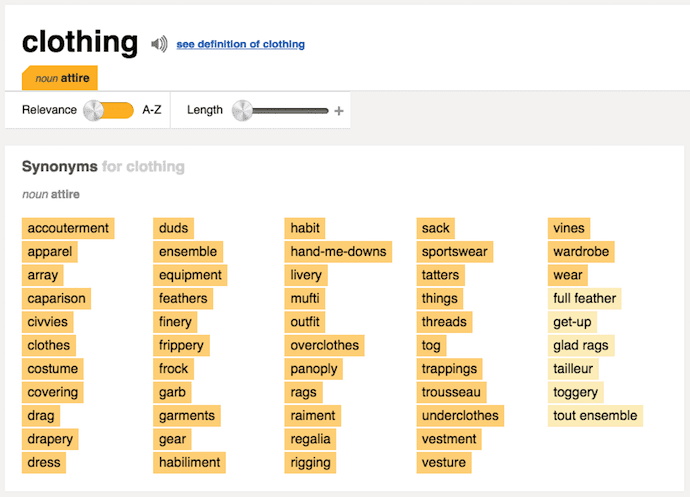
3. Create some sketches.
Now is the time to create some rough sketches. Allow your brand story and keywords to guide you and make some initial logo ideas.
Remember, these are your first drafts. The important thing is to get the ideas out of your head and onto the paper, so trust the process and just let the ideas flow. You’ll have the opportunity to refine your ideas later.
“The beauty of a first draft lies in its imperfections; it’s the starting point for refining ideas and finding the perfect balance.” – David Airey
Logo designer David Airey knows a thing or two about sketching. Embrace the imperfections of your first drafts and let your creativity flow!
As you’re sketching the concepts for your logo, keep these tips in mind:
- Keep the shape simple. You’re in good shape if you can sketch the most symbolic components in seven seconds or less.
- Avoid any popular clip-art artwork or generic symbols like a globe, star, or similar icons that people too quickly identify from other places.
- Be strategic about your use of color. Consider today’s color trends as well as popular colors in your industry. As a general rule, don’t choose more than three colors. Choose a color or group of colors that will make you stand out from your competition, but please, for the love of marketing, don’t use the whole rainbow!
4. Choose a sketch and refine it.
Now that you have some sketches, pick the one that speaks to you most and put on your thinking cap.
“Design is thinking made visual.” – Saul Bass
Make a deep effort to reflect on your brainstorming words and brand story and visualize your thoughts. Use your mental efforts to refine your logo sketch into a meaningful, deep, relatable design that ties back to your brand’s core values.
Easier said than done, but this is where the heavy lifting comes in.
5. Develop your logo’s layout on a free design platform.
If you’ve been working on paper until now, now is the time to bring your design to the computer and create a layout. Your logo layout is how individual elements of your logo are organized and positioned in relation to each other.
Here are some free tools you can use to scan your sketch and start creating a layout:
Proper alignment of your logo is the key here. Your logo doesn’t need to be perfectly symmetrical, but it should appear visually balanced.
“Whitespace is like air: it is necessary for design to breathe.” – Wojciech Zieliński
The whitespace between different elements of your logo is the unsung hero of your design and the secret you must uncover in this step of the process.
Strive for a crisp, balanced logo where everything feels like it’s in the right place. If your design looks great in black and white, then you know you have a well-balanced logo.
6. Choose your colors.
The color palette you choose for your logo says a lot about your brand.
For example, blue communicates trustworthiness and maturity, while red shows passion and excitement. Consider your brand story and the keywords you brainstormed earlier when choosing your logo colors.
“When you choose a new color palette, 60% of the palette should be dedicated to one color (usually, it’s a neutral color), another (complementary) color makes up 30% of the palette, and a third color (accent) is used for the remaining 10% of the design.” – Nick Babich
Product designer Nick Babich drops some wisdom about the three-color rule in design. You don’t need to choose multiple colors for your logo, but if you decide to go the multicolor route, keep everything harmonious by following this design principle.
7. Choose a font.
Now it’s time to combine text with imagery.
Consider the typeface this text will carry if your company name ever stands without your logo. If you decide on a wordmark or lettermark logo as opposed to a symbol, your font choice is even more crucial.
Believe it or not, your font choice can say a lot about your business. You can choose a font that’s either serif (with stems on each letter) or sans serif (no stems) — also known as classic or modern, respectively.

Stay away from generic fonts that come standard on every word processor. Some examples of generic fonts are Times New Roman, Lucida Handwriting, and Comic Sans. These fonts will only work against you and your company by making you less memorable.
“Display type is a visual voice. Without reading, it imparts its message.” – Laura Worthington
Designer and typography guru Laura Worthington hits the nail on the head regarding the importance of font selection. Your font choice goes beyond just conveying information as text; it is a crucial aspect of your design.
8. Ensure scalability.
Logos are meant to represent your company on multiple platforms — in print, on your website, on each of your social media business pages, and across the internet as your business grows.
You want a logo that can be blown up super large for a billboard or scaled down for screening onto the side of a pen.
Every part of your logo should be legible, regardless of the logo’s size.
9. Get feedback.
“There are three responses to a piece of design — yes, no, and WOW! Wow is the one to aim for.” – Milton Glaser
Once you feel your logo design is ready, consider sharing it with others and seeking constructive feedback.
Of course, you can seek input at any point in the process, but it is precious to get people’s reactions to your realized vision and reiterate from there.
Whew — still with us? We know this might seem a little overwhelming, but take it slow and don’t rush yourself.
It’s better to follow the process through to completion and end with a remarkable logo than to start over a few months later due to a design error or change of heart.
Once you’ve completed your logo, how can you tell if you scored a winner? Easy: Use our Logo Grader to assess the sustainability and effectiveness of your new logo.
With millions of logos worldwide, you may be surprised that they all fit into one of seven main categories.
Each logo type has its characteristics, strengths, and weaknesses, so choose the variety that best aligns with your brand values and goals when designing your logo.
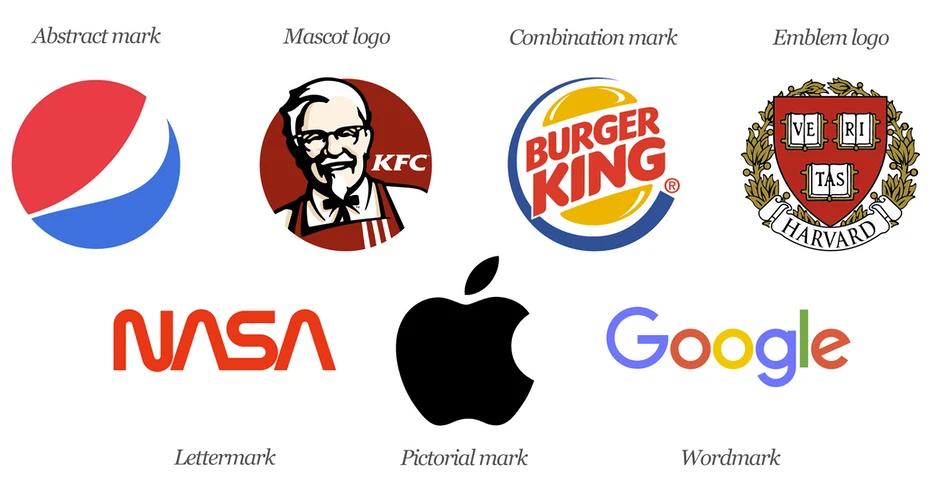
Emblems
An emblem is a logo incorporating text within a symbol for a cohesive image, often conveying formality and tradition. It is strong and impactful, yet challenging to separate for integration and may not reproduce well in small sizes.
Pictorial Marks (or Logo Symbols)
Pictorial marks, also known as logo symbols, are logo types that rely on a single image to represent a brand. These logos can be iconic and memorable and are effective at conveying a brand without text, yet may pose challenges in establishing brand recognition and connecting to the brand’s purpose without words.
Wordmarks (or Logotypes)
Wordmarks are text-based logos that use typography to turn the brand name into a logo, ideal for companies with unique names. They offer simplicity and integration ease, but may struggle to stand out or suit longer, less distinctive names.
Monogram Logos (or Lettermarks)
Monogram logos, also called lettermarks, use initials to create a concise logo suitable for companies with longer names. They are easy to remember and scale, but may require displaying the full brand name initially for recognition and could be confused with other brands if the initials are similar.
Abstract Logomarks
Abstract logos, such as the Pepsi logo, are unique representations of brands using geometric forms and colors instead of real-life images. They are inherently unique and capable of communicating complex ideas through simple shapes and colors but may be open to misinterpretation due to their abstract nature and unclear meaning for unestablished brands.
Mascot Logos
Mascot logos feature illustrated characters to personify a brand with a fun and friendly image, ideal for brands seeking a light-hearted and family-friendly appeal. They offer an inviting and controllable brand storytelling approach but may not suit serious or corporate brands, and their complex design can pose challenges for reproduction at smaller sizes.
Combination Marks
A combination mark integrates text with an icon, offering versatility by combining a brand name with a memorable symbol. This type of logo provides clarity in brand messaging but may become overly busy if not carefully designed and could face challenges in scaling down for smaller applications.
Logo Design Best Practices
1. Keep it simple.
Simplicity is key in logo design. Aim for a clean, uncluttered design that communicates your brand identity as straightforwardly as possible. The goal is for viewers to recognize and understand your logo instantly.

Take Nike’s logo, for example. Its simplicity makes it iconic. There’s a reason they haven’t updated it since 1995.
2. Prioritize versatility.
Your logo should be versatile enough to work across various backgrounds and colors. Test your logo against multiple backgrounds and mediums to ensure legibility and clarity in all possible scenarios.
That means you should have alternate color palettes and logo orientations to suit any situation.
3. Design for your audience.
Your logo design should be consistent with how you perceive your brand and how your customers already perceive it.
You must consider your target audience’s buyer persona by researching their demographics and interests. Only then can you serve their expectations and needs in your design.
4. Be original.
Standing out from the pack is essential. Today, almost every market is saturated with competition and options. The design of your logo is as vital to carving out your niche as creating a unique value proposition.
Avoid generic logo designs and cliché symbols that are easily spotted elsewhere. For example, globe-based logos are a dime a dozen:

5. Be timeless.
Your logo should be iconic and timeless. Easy enough, right? Epochal logos like Coca-Cola’s are as rare as they are significant, but that doesn’t mean you can’t aim for a timeless logo as well.

A timeless logo means that it will never go out of style.
One way to ensure that is to steer clear of today’s hottest design trends (which will go out of style sooner or later). Instead, opt for a simple, classic design that would be comfortable representing your brand for years to come.
Logo Design Tools
1. HubSpot Logo Maker
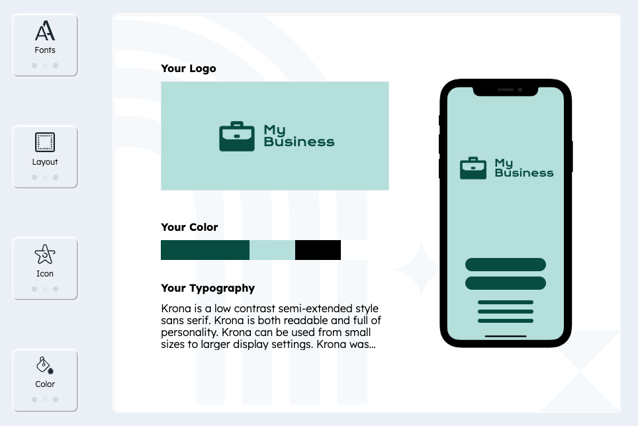
Get started with HubSpot’s Logo Maker
Our logo maker can assist you in designing and customizing the ideal logo for your brand, offering a wide range of professionally designed templates that eliminate the need to start from scratch. By simply providing your industry, company name, and slogan, the tool will offer personalized recommendations tailored to your needs.
2. Canva
Canva is an all-in-one, web-based graphic design tool that you can use to design anything you can think of, including logos. Anybody can use Canva’s intuitive drag-and-drop interface and extensive library of templates and design assets.
In my opinion, Canva is one of the most accessible logo generators, as I have been using the platform for years, making professional graphics without a formal degree or training in design. And my favorite aspect is that you can use pre-existing colorways to create a more visually appealing and aesthetic logo.
Best for: Beginner designers and small business owners who desire a hands-on approach to logo creation.
Pricing: Free plans are available. Canva Pro costs $14.99 monthly. Canva for Teams costs $9.99 monthly for up to three users.
3. Adobe Illustrator
Illustrator is the industry-leading, vector-based graphics software from Adobe, the maker of other popular tools like Photoshop, Lightroom, and InDesign.
Illustrator is a staple for many professional design groups and can be used to create professional logos and limitless other designs.
Illustrator is vector-based, meaning graphics are made of points, lines, shapes, and curves based on mathematical formulas rather than a set amount of pixels.
Accordingly, an Illustrator logo can be scaled up or down while maintaining image quality.
Best for: Experienced design professionals and agencies that require powerful features and ultimate customization and control.
Pricing: Plans start at $22.99 monthly.
4. Hatchful
Hatchful is a fast and easy-to-use logo-maker tool from Shopify. The tool will ask you questions about your company’s industry, preferred visual style, brand name, and where you expect to use the logo (print, digital, etc.).
Using the provided information, Hatchful will automatically generate a slew of logo options, which you can select and further customize.
Best for: Entrepreneurs and small business owners looking to create a high-quality logo with minimal design effort quickly.
Pricing: Free.
5. Squarespace Logo Creator
Squarespace’s logo creator tool lets you quickly generate a clean-looking logo for your business. The logos that this tool empowers you to create are consistent with the modern and minimal aesthetic that Squarespace is known for.
Input your business name, and Squarespace allows you to serve it up in a beautiful font alongside an icon of your choice. The tool has thousands of vectorized icons and a curated selection of high-quality fonts.
Best for: Entrepreneurs and small businesses looking to quickly create a clean, minimal logo.
Pricing: Free.
6. Looka
Anyone can design a logo using Looka’s AI-powered logo creation engine. Input your brand name and industry, select your favorite colors, and pick some example logos that speak to you.
Based on your input data, Looka will generate an AI-curated selection of logos. Choose one and customize it to your heart’s content.
Best for: Entrepreneurs and small business owners without design experience who won’t compromise on the quality of their logo.
Pricing: A basic logo package costs $20 for a one-time purchase. A premium logo package is a $65 one-time purchase
7. CorelDRAW

CorelDRAW is a fully loaded, desktop-based vector design program that runs on Windows and macOS.
CorelDRAW is an alternative to Adobe Illustrator that offers nearly all the same functionality and allows you to transform sketches and ideas into fully-fledged logos.
Since you can purchase CorelDRAW outright instead of as a subscription, it can be a more budget-friendly choice than Adobe.
Best for: Professionals and experienced designers who require a complete design toolkit.
Pricing: Plans cost $22.42 monthly or $549 for a one-time purchase.
8. Affinity Designer

Affinity Designer is another fully-featured desktop alternative to Adobe Illustrator that runs on macOS, Windows, and iPad.
It is considerably more budget-friendly than alternatives. It features a slick, dark UI, fast performance, and all the features a professional designer needs to create logos and other design assets.
Best for: Professional designers and agencies looking for a fully featured, budget-friendly alternative to Adobe.
Pricing: Affinity Designer is a $69.99 one-time payment.
Designing a Logo for Your Brand
Now that you know about the types of logos, the process for creating one, best practices, and some tools you can use, get started crafting the perfect logo for your brand.
Create a logo that captures your audience’s attention, communicates your brand values, and makes you stand out from the crowd.
Editor’s note: This article was originally published in October 2023 and has since been updated for comprehensiveness.