Category Archives for Motivational Video
5 Marketing Trends That Might Not Survive in 2024 [HubSpot Research + Expert Insights]

Few marketing trends last forever. In reality, they come and go at rapid speed — and marketers must adapt.
Few marketing trends last forever. In reality, they come and go at rapid speed — and marketers must adapt.
Because marketing is always evolving, your marketing playbook should, too. But if your strategy looks the same as years prior, it’s time to do some housekeeping.
Here, we’ll cover five marketing trends that are losing steam and how marketers can respond.
![Download Now: Free State of Marketing Report [Updated for 2024]](https://no-cache.hubspot.com/cta/default/53/b0f73a5e-16e4-41fd-9511-8564efc560a7.png)
1. Account-based marketing.
In 2023, only 13% of marketers leveraged account-based marketing (ABM), according to HubSpot’s annual State of Marketing report.
To Dustin Brackett, CEO and Founder of HIVE Strategy, this makes sense. As he told me, “While I strongly believe in ABM and the power it has for organizations trying to sell into a targeted list of other organizations, I can see why it will never be at the top of the marketing trends lists. ABM is really only valuable for organizations that have high-value customers. There isn’t a ton of ROI to be had by investing in ABM for a B2C organization, or any organization that has a lower customer lifetime value because ABM is a large investment in time, resources, and dollars.
Matt Freestone, Managing Director at Unmatched, sees many of his clients investing in ABM. However, he believes the resistance to ABM comes from sales and marketing alignment issues.
As he puts it, “We’ve found that the reason ABM tends to not be utilized by marketers is that many businesses still have sales and marketing alignment issues. I think ABM will see a resurgence in 2024, as long as Sales and Marketing teams can come together, build effective campaigns, and share common goals.”
Finally, Katherine Forbes, Senior VP of Marketing at Creative Circle, believes ABM isn‘t topping the ’marketing trends of 2024‘ list because it’s become status quo for most sales reps. As she puts it, “The ABM approach has become so mainstream for B2B businesses that it can no longer be considered a differentiating tactic or a trend. In fact, it likely is the foundation of a typical seller’s sales methodology, rather than an approach employed solely by marketing teams.”
She adds, “ABM is still a productive tactic, but marketing teams (such as ours) may be better off focusing on delivering a white-glove and personalized experience through their e-commerce and self-service options. According to a Gartner, Inc. survey of 771 B2B buyers, 75% of B2B buyers now prefer a rep-free experience, but those who purchase through digital channels alone are more likely to regret their purchase.”
2. The metaverse.
Marketing is all about experimentation, and the metaverse became a new playground for marketers to explore. However, this initial excitement seems to be fizzling out.
In 2024, 14% of marketers plan to stop marketing in the metaverse (e.g. Horizon Worlds and Roblox). In addition, 13% plan to stop leveraging VR and AR.
Although the metaverse is intriguing, it’s proving difficult to execute. The equipment is expensive, the hardware is uncomfortable, and adoption is slow.
Adrian Alexandrescu, CEO of Mediapost Martech, says, “I wasn‘t a big believer in the whole Metaverse concept, as it seemed too much like something inspired by movies such as ’Ready Player One.‘ Fast forward to today: most of our clients haven’t invested a dime in Metaverse Marketing, Roblox, or similar platforms and have absolutely no plans for the near future to do so.”
That said, the metaverse is still in its infancy. As it continues to evolve, things could turn around.
3. Podcasts and other audio content.
This one surprised me. As a consumer, I listen to podcasts daily. And I’m not alone – around one in four internet users listen to podcasts, and in 2024, there are over 500 million podcast listeners.
So why wouldn’t podcasts be appealing to marketers?
As Blend’s Marketing Manager Dan Stillgoe told me, “Businesses are often quick to shutdown podcasts because they don’t see direct ROI from them. It’s true that you can’t directly attribute leads or revenue from a podcast, but that’s not its purpose. Podcasts are a long-term brand-building channel that can improve affinity and connection for your brand like no other channel. When you realize the long-term and surrounding benefits, podcasting becomes a clear and obvious investment.”
He adds, “Podcasting is the perfect way to craft content that’s engaging and authentic — something buyers are beginning to crave in this AI era.”
Additionally, I’m assuming some marketers feel the barrier-to-entry is a little high. Creating a full, high-quality podcast episode requires time and resources. It takes more effort than, say, posting an Instagram Reel, and it‘s harder to track ROI. But while it’s not easy, it’s worth considering if most of your consumers are podcast-listeners.
4. Audio chat rooms.
If you’ve been keeping up with tech news and tech publishers like TechAcute, you probably have come across an audio chat room at some point. Audio chat rooms — like Clubhouse and Twitter Spaces — surged in popularity during the start of the pandemic, when many people were seeking opportunities to connect with others.
Fast forward to today, and more than a quarter (14%) of marketers are planning to stop investing in audio chat rooms in 2024.
Additionally, only 13% of marketers invested in audio chat rooms in 2023.
From a marketing perspective, the biggest problem with audio chat rooms is that users prefer to speak with people — not brands.
Stephen Lackey, VP of Marketing at SmartBug Media, says, “The transient nature of audio content in these rooms makes it challenging for marketers to create lasting impressions. Unlike visual or written content, which can be revisited and shared easily with direct attribution, spoken words dissipate into the digital ether, making it harder for brands to maintain a sustained presence in users’ minds.”
He continues, “Moreover, the lack of visual elements restricts marketers from leveraging the power of visuals and multimedia content, a cornerstone in digital marketing in the upcoming year. Without the ability to showcase products or services, marketers struggle to engage their audience effectively, potentially losing valuable opportunities to convert interest into action (especially considering the significant time investment required for these platforms).”
Rather than leaning into audio chat rooms, Lackey suggests marketers focus on platforms that allow for a more controlled, visually engaging, and scalable approach.
5. User-generated content.
In 2024, 13% of marketers plan to decrease their investment in user-generated content (UGC).
There could be several reasons for this, including:
- Quality concerns: It can be difficult to maintain a consistent brand image when you‘re relying on content created by users, and that content might not always be as high-quality as you’d like.
- Limited control: Marketers have limited control over messaging when they’re reposting user-generated content. Additionally, it can be much harder to monitor comments and engagement on those posts.
- Difficulty in tracking ROI: It is difficult for marketers to track ROI on user-generated content.
During this tumultuous time where consumer preferences and behaviors are changing rapidly as a result of AI and shifting algorithms, marketers might prefer to keep full control over the content they produce – particularly since it’s easier to track impact on their own content.
However, when I spoke with Emplifi’s Chief Strategy Officer Kyle Wong earlier last year, he highlighted the importance of UGC, telling me, “When investing in a strategy around user-generated content, it’s important to understand the basics, which is this: We are investing in a strategy to essentially help capture more positive word-of-mouth marketing from our customers.”
I don’t think UGC is going away, but I could understand why marketers might be temporarily decreasing their investment as they consider how consumer preferences and behaviors are changing in 2024 — particularly with the current popularity of influencer marketing, instead.
Back to You
Marketing is always evolving, so your marketing playbook should, too. As we inch closer to 2023, it’s essential to take stock of which trends you want to leverage, and which ones are better left behind.


I Asked ChatGPT to Write 5 Types of Counteroffer Emails — Here’s What I Got

You’ve made it through multiple rounds of interviews, the hiring team has selected you as their top candidate, and they’ve made you an offer. But you aren’t quite satisfied with all of the terms. This is where a counteroffer comes in.
You’ve made it through multiple rounds of interviews, the hiring team has selected you as their top candidate, and they’ve made you an offer. But you aren’t quite satisfied with all of the terms. This is where a counteroffer comes in.
Counteroffers are expected. If you haven’t written a counteroffer email before or feel like it’s not something you need to do, it may be time to reconsider.
According to a survey from Fidelity Investments, 85% of people who make a counteroffer receive at least some of what they negotiated. This can include an adjustment to the salary, terms, or benefits.
![→ Download Now: The Beginner's Guide to Email Marketing [Free Ebook]](https://no-cache.hubspot.com/cta/default/53/53e8428a-29a5-4225-a6ea-bca8ef991c19.png)
If you’ve never written a counteroffer email, you probably don’t even know where to start. Below, I’m breaking down exactly what a counteroffer is and how to make one. I also asked ChatGPT to help write a few counteroffer emails to give you an idea of what one looks like so you can start practicing writing your own.
What is a counteroffer letter?
A counteroffer letter is a letter, typically an email, that candidates send to a hiring team to negotiate the terms of a job offer. A counteroffer email is sent before formally accepting a job offer as part of the negotiation process. Counteroffers can negotiate any part of the offer, from the base salary to bonuses to work schedule.
How to Give a Counteroffer
To understand exactly how to write a counteroffer email, I spoke with Sarah Johnston, founder and CEO of executive resume writing and interview coaching firm Briefcase Coach. Here are the steps she recommends following when you have an opportunity to give a counteroffer.
Affirm you want the role.
Before you state your counteroffer, you need to affirm that you want to move forward with the company. Start by letting the recruiter or hiring manager know that you appreciate the offer and you’re excited about the opportunity to work at the organization.
Johnston also suggests emphasizing the knowledge you have about the role and the company.
“The more specific you can be about the passion you have for the mission or projects that you’ll be contributing to, the better,” she says.
Negotiate a specific counteroffer.
After you emphasize your desire to work with the team, it’s time to negotiate. Your negotiation should be clear and specific and outline the terms you want to adjust.
And don’t forget — the salary isn’t the only part open to negotiation. Your counteroffer can be about the benefits or other terms that contribute to your work-life balance, like your schedule.
“The negotiation period is a great time to ask for remote days as well as a non-traditional schedule,” says Johnston. “I recently had a client negotiate to start her day at 7:00 am so that she could leave by 3:00 p.m. to pick up her kids from school.”
Explain your justification.
Follow up your negotiation with a brief explanation that demonstrates you’ve done your research. Showing that you have given your counteroffer thought and have done market research helps prove not only how committed you are to the role, industry, and organization but also that you’re confident in what you bring to the table.
Johnston recommends framing your counteroffer like this:
“According to my market research, this position should pay between $75-92K a year. The offer of $76K that you presented falls in the low range for the position. I bring 10 years of experience to the table, and my compensation should reflect the depth and breadth of knowledge that I can offer. Additionally, the cost of living index for this area is one of the highest in the country. Based on my experience and qualifications, I think a salary of 85K would be more appropriate.”
Wrap up with final remarks.
Finally, wrap up your email by thanking the recruiter or hiring manager for their time and consideration. This could be the beginning of a new work relationship, so it’s important to remain professional and kind. The last thing you want is to be confrontational and end up hurting your chances of securing the job.
What ChatGPT Wrote Me: 5 Counteroffer Email Examples
I was curious to see if AI could help me write a counteroffer email that I could use in the interview process.
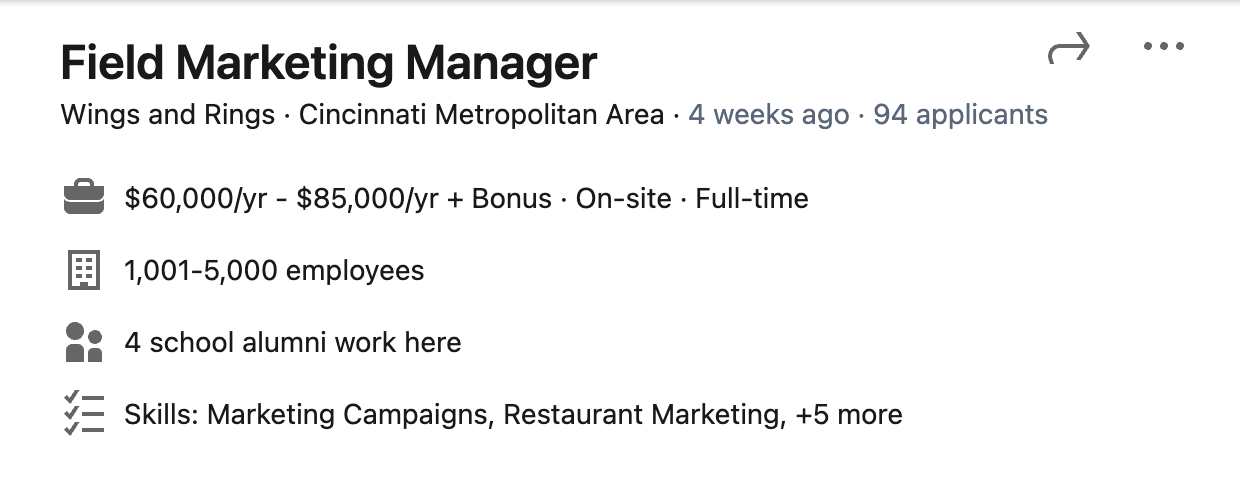
For this example, I found a job posting for a Field Marketing Manager at Wings and Rings, a restaurant franchise.
1. Counteroffer Email Example: Salary Negotiation
For my first prompt, I’m going to assume the company offered me a salary at the low end of the salary range, $60,000. My counteroffer will be $75,000. Here is the first prompt I gave ChatGPT:

And here is the counteroffer email that it came up with:
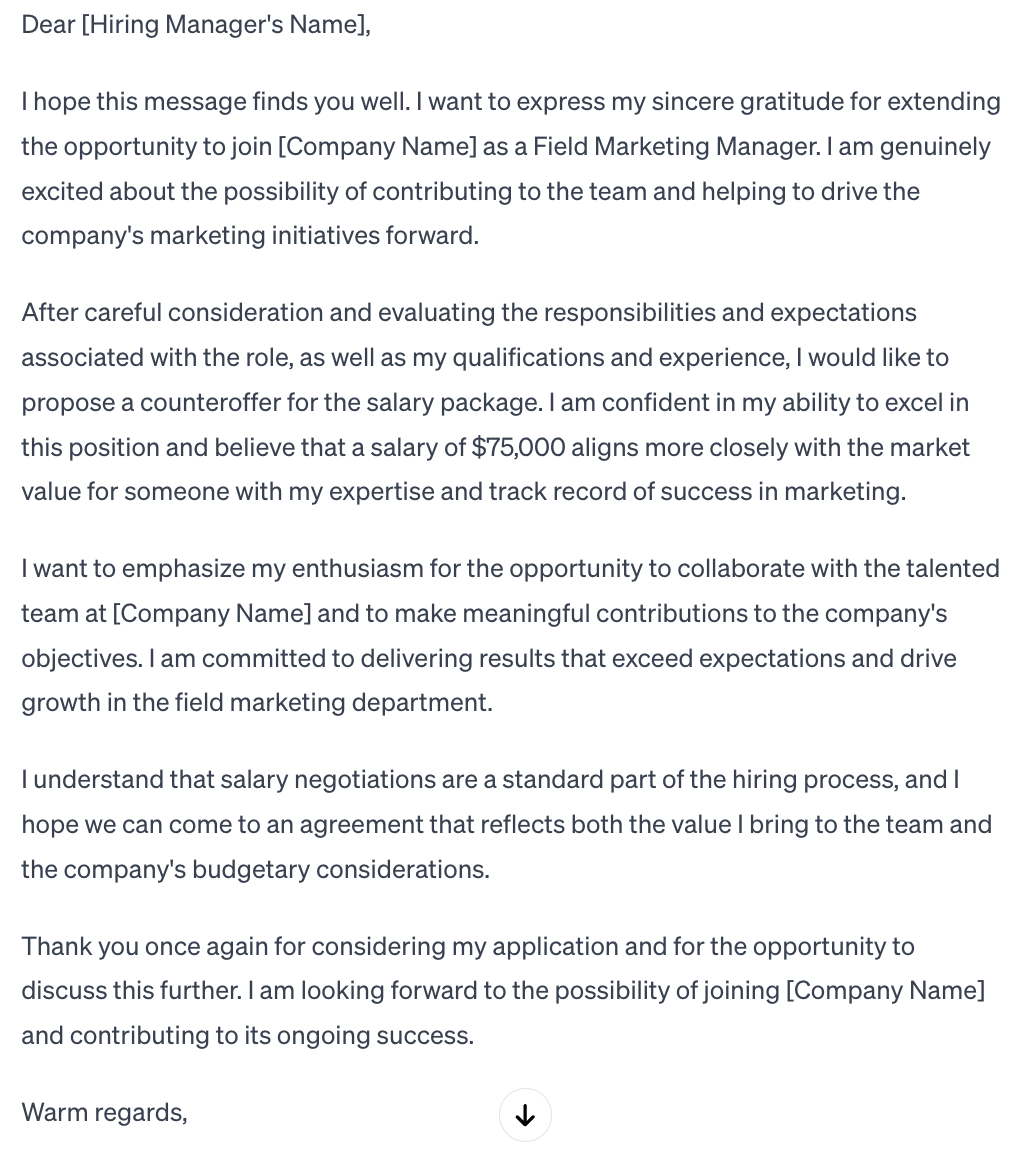
While this email is on the longer side, it gets a lot of things right. The email begins by stating an appreciation for the job offer and an emphasis on why they’re excited to join the company.
The next section briefly touches on the candidate’s qualifications and why they’re proposing a counteroffer. The email then reiterates their enthusiasm for the opportunity and how they will contribute to the position.
If it were me, I’d remove the second to last paragraph. I don’t think it’s necessary to say, “I understand that salary negotiations are a standard part of the hiring process,” because the hiring manager is well aware of that already.
What I like: I like how the email communicates enthusiasm for the position before and after the counteroffer. In my experience, this shows that the candidate is taking this offer seriously and is eager to come to an agreement.
2. Counteroffer Email Example: Market Research
I want to see if ChatGPT can create a similar counteroffer negotiating a higher salary, but this time, I want to show that I’ve done my research.
Here’s the prompt I gave ChatGPT:

And here is the email it generated. I highlighted the main difference between this email and the last.
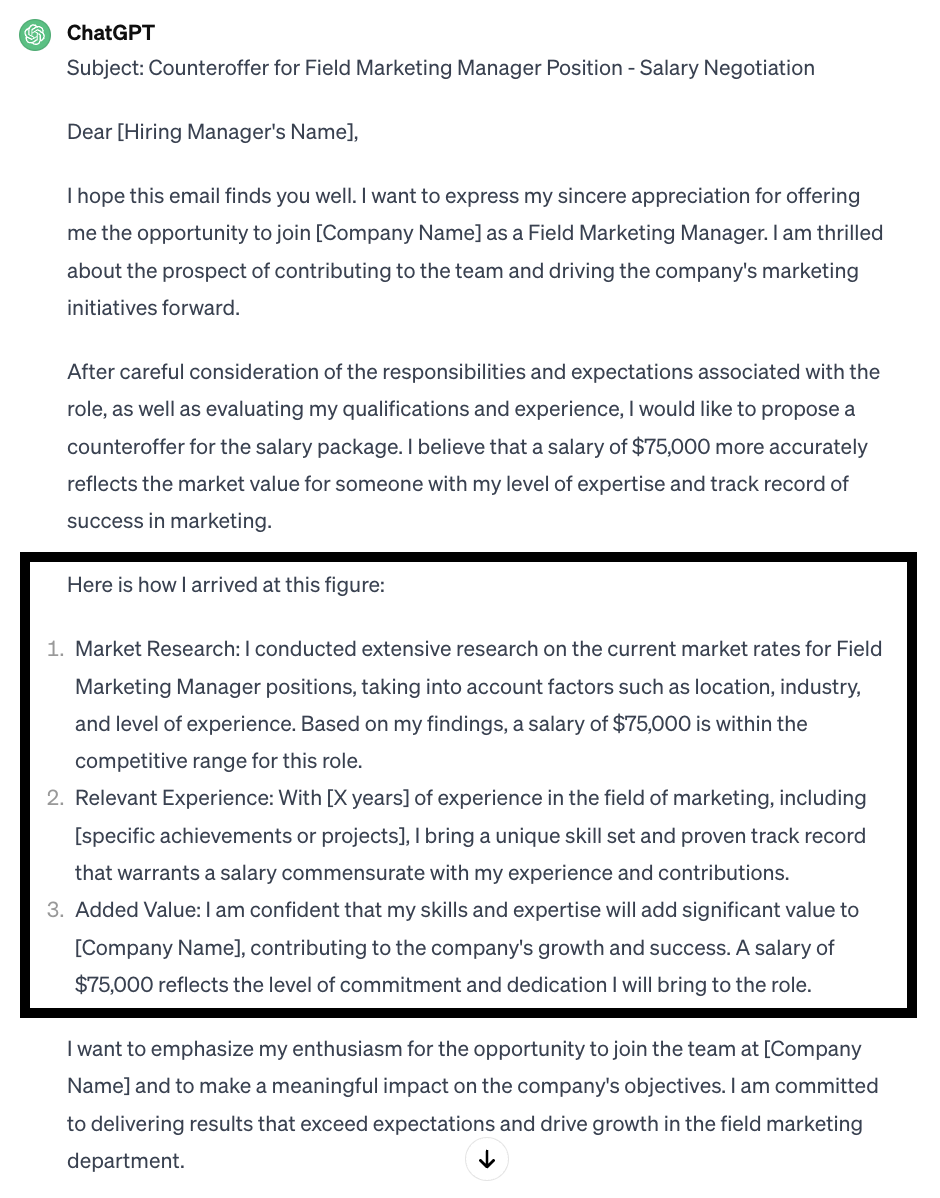
This email is similar to the script Johnston provided when she shared her tips for writing a counteroffer email. It demonstrates that a lot of research has gone into this counteroffer, and I didn’t just request a random number.
The rest of the email could stand to be edited down, but overall, I think a strong point was made.
What I like: Using a numbered list makes the email easier to scan and digest.
3. Counteroffer Email Example: Benefits Negotiation
For my next prompt, I want my counteroffer email to negotiate a different work structure. Since this is an on-site field marketing position, we can assume that the work schedule would involve a lot of travel to different franchise locations. I want my counteroffer to negotiate having one day be remote or work from home.

I was curious to see how ChatGPT would frame this negotiation since it’s not about money. Here’s what the chatbot came up with:
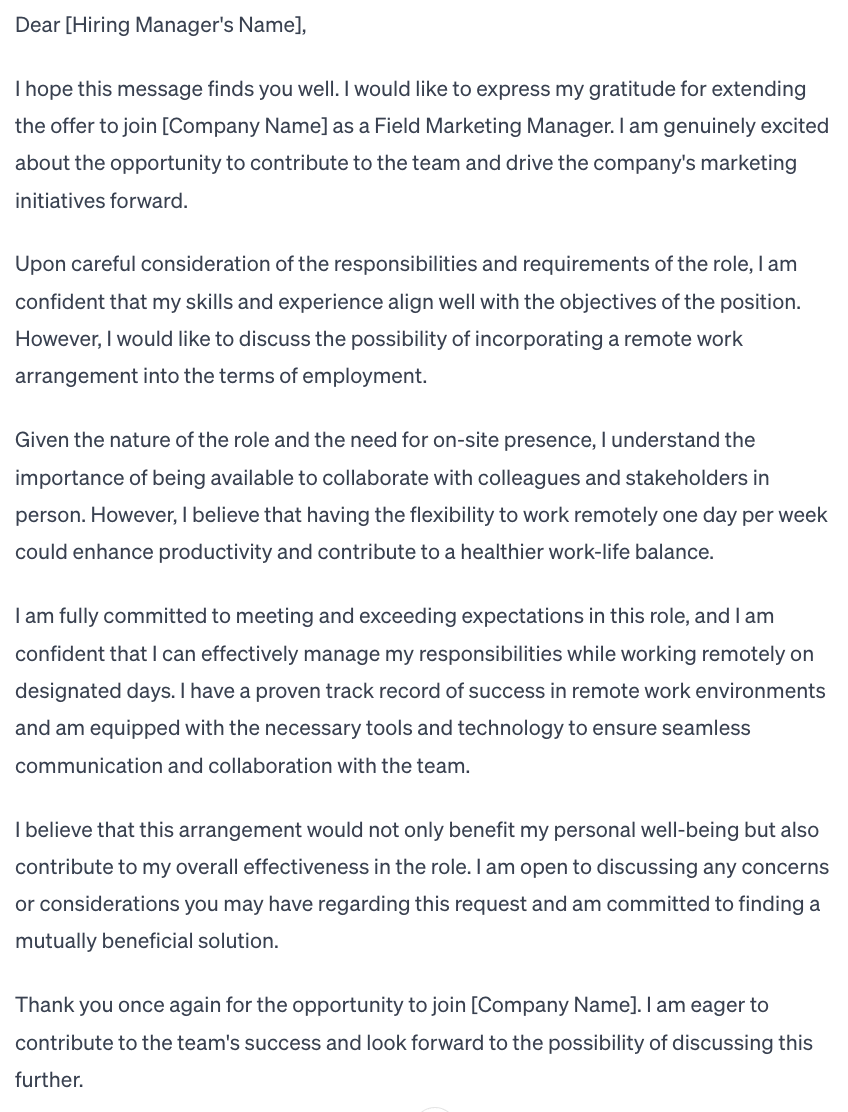
Overall, I think this is a strong counteroffer email. Not only does it communicate enthusiasm for the offer, but it provides a strong rationale for remote work.
The email thoroughly describes the situation and shows an understanding of why the role needs to be primarily onsite. But the message also includes a line about the candidate’s proven track record in remote work environments, which reassures the hiring team that there won’t be an issue with this setup.
What I like: My favorite line is, “I believe that this arrangement would not only benefit my personal well-being but also contribute to my overall effectiveness in the role.” This outlines the benefit for both the candidate and the hiring team, communicating that the candidate will perform better overall if they have a more flexible work arrangement.
4. Counteroffer Email Example: Relocation Assistance
For my next prompt, I want to send a counteroffer that negotiates relocation assistance. The Field Marketing Manager role I’m using for this example is based in Cincinnati, Ohio, and I currently live in Austin. If I got an offer, I’d need to relocate. Here’s the prompt I gave ChatGPT:

Here’s the counteroffer email ChatGPT generated:
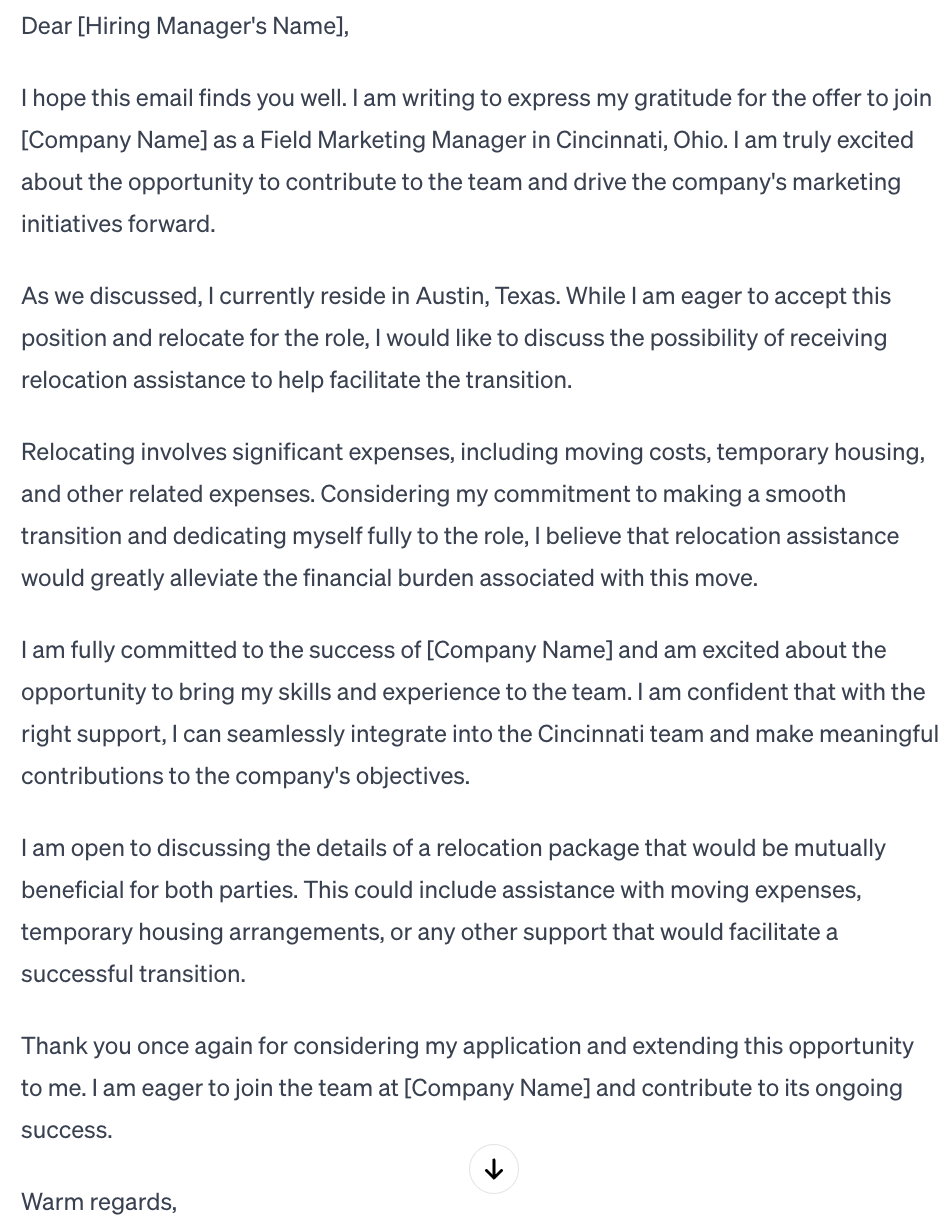
If I were this far along in the interview process, the hiring team should already be aware that I would need to relocate for the job. However, if they didn’t already include relocation assistance in my job offer package, this counteroffer email would be a strong way to negotiate.
What I like: I appreciate that the email is specific about what expenses I’d need assistance with, including moving costs and temporary housing. I also like that the email says this line to justify the counteroffer: “Considering my commitment to making a smooth transition and dedicating myself fully to the role…”
5. Counteroffer Email Example: Short Email
I noticed that all of the responses ChatGPT generated were long. I was curious what the email would look like if it were more concise, so I asked the chatbot to make it shorter. Here’s what it generated:
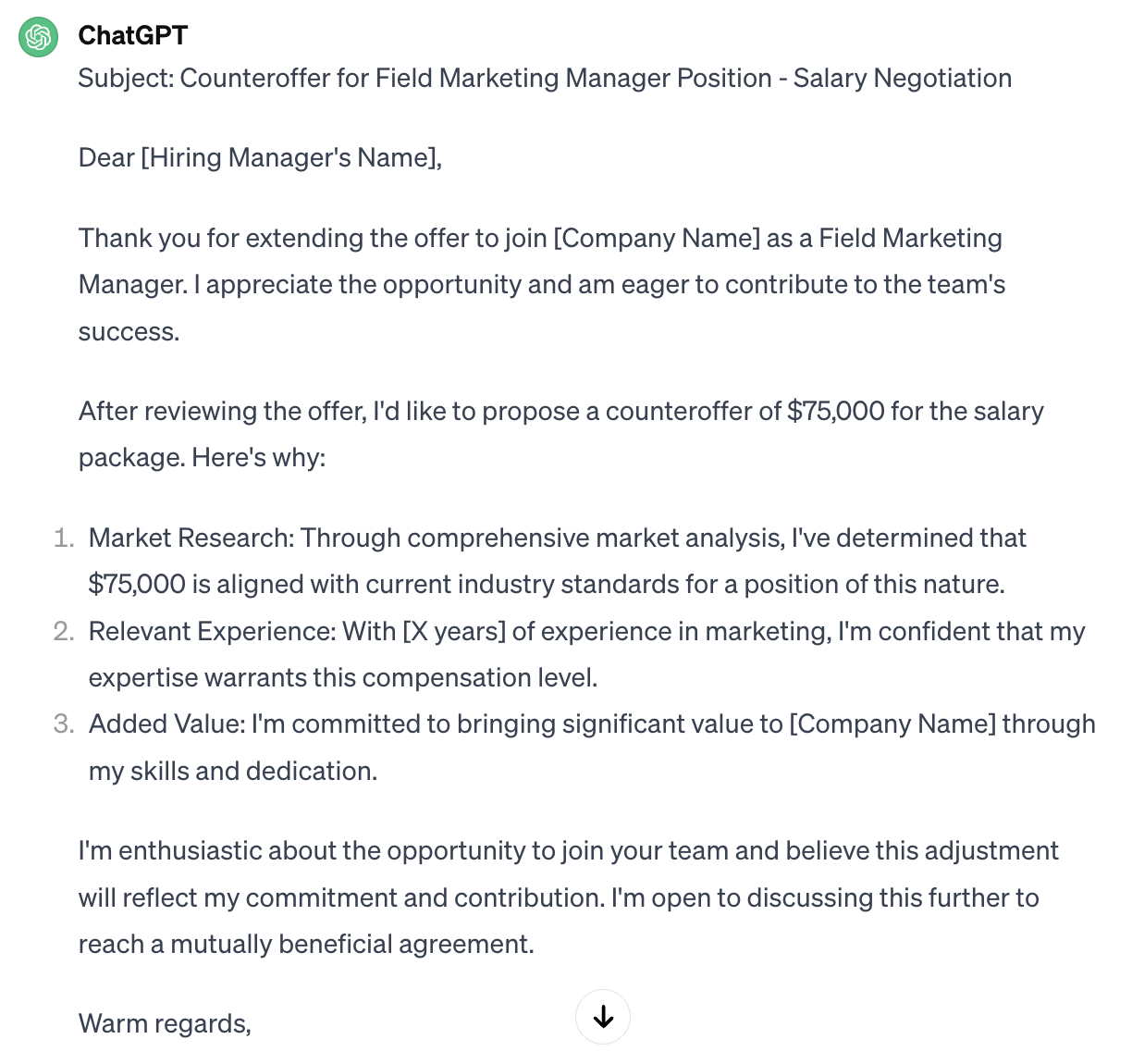
This is probably the closest to a send-ready email that ChatGPT has generated so far. It’s more straightforward and succinct while still outlining the essential parts of a counteroffer email. If I were actually about to send a counteroffer for a job, I’d be comfortable using this email (after some light editing to align with my voice).
What I like: The numbered talking points are briefer than in previous emails, but they still make a strong point and demonstrate that I’ve done my research.
What I Learned from AI
In my opinion, ChatGPT generated some pretty decent counteroffer emails. The structure and talking points of these emails aligned with the tips Johnston shared, indicating that ChatGPT is familiar with counteroffer best practices.
And, while I didn’t prompt ChatGPT to use a certain tone or style for this experiment, you can get more specific with your prompts if you want to generate a counteroffer email that aligns more with your voice.
If you want to use AI to assist in writing emails during the job search process, I’d use ChatGPT for practice rather than for your actual email to the hiring team.
You can conduct a similar exercise to the one I did by giving the chatbot multiple prompts for different negotiation scenarios. Writing and refining your prompts helps you narrow down what you’re willing to negotiate on and the terms you may be less flexible about.
Overall, AI works well for crafting a solid counteroffer email structure, but it’s up to you to conduct research, come up with a desired salary, and confidently pitch yourself.
Making Your Counteroffer
Making a counteroffer is an anticipated part of the interview process. Prepare ahead of time by practicing writing counteroffer emails. Preparing what you would negotiate in different scenarios can help you clarify your desired salary and non-negotiables and help you improve how to justify the counteroffer and communicate your value.
By practicing your script and following the expert tips above, you can write an effective counteroffer email that helps you land a job with a salary and benefits package that you’re satisfied with.

Bluesky is Now Open to the Public. Should your business be there? [Expert Interview]

Like dozens of other “Twitter killers,” Bluesky has sat in limbo since its launch– thanks mostly to an invite-only policy.
Like dozens of other “Twitter killers,” Bluesky has sat in limbo since its launch– thanks mostly to an invite-only policy.
But when the micro-blogging site went public last month, it skyrocketed to an estimated 4 Million users almost overnight.
That kind of growth can be chum in the water for marketers. But is the social media startup worth your time?

I sat down with HubSpot’s Manager of Brand Social Strategy and Analytics to find out.
But first, let’s jump back a bit for those who don’t know what Bluesky is.
What is Bluesky?
Bluesky is one of dozens of social media apps that have popped up in the hopes of X (formerly Twitter) dying off.
It joins the ranks of micro-blogging sites like Mastodon, Threads, Plurk, Cohost, Compost, Sparklefyre, and Snuffleupagus. (Admit it. You have no idea which of those I just made up. That’s how many X-alternatives there are.)
So, what sets Bluesky apart from the others?
Bluesky was designed as an open-source social media app built on a decentralized infrastructure (called the AT Protocol) and funded by Twitter co-founder Jack Dorsey.
That’s a mouthful. But what exactly does it mean?
- Open source means the code is available for anyone to see (or even tinker with).
- Decentralized means that anyone can host a version of Bluesky on their own server.
That combo gives users a lot more transparency into how the platform works. It also gives them a lot more agency when something goes wrong.
For example, if you don’t like what the Facebook algorithm serves you, there’s not much you can do.
But if you don’t like the Bluesky algo? You can just launch your own Bluesky. (Blackjack optional.)
When Bluesky was invite-only, it had gathered an estimated 3 Million monthly active users. Compare that to the 130 Million users claimed by Threads.
But when Bluesky opened up to the public in early February, it jumped by 800,000 users in a single day.
It’s even attracted celebs like Chrissy Teigen and Neil Gaiman, as well as major media outlets like The New York Times and The Washington Post.
So, should your company be counted among those names?
Should your business be on Bluesky?
To get the scoop on all things social, I spoke with Erin McCool, HubSpot’s Manager of Strategy and Analytics, Brand Social.
Let’s start by putting our money where our mouse is…
Is HubSpot on Bluesky, or do we plan to be?
“Currently, we’re not on Bluesky, and there are no immediate plans to join,” McCool says. “When it began as invitation-only, it was less of a priority for us because, naturally, fewer individuals within our target audience will have access to join.”
But that may not be the case for every business. As a B2B SaaS, HubSpot may have a very different audience than yours.
It’s important to identify your audience and meet them where they are.
But don’t forget, the world of social media is always moving. Where your audience is today might change tomorrow.
“We are always monitoring emerging platforms because the social landscape moves quickly, so we’ve got to be ready to move with it,” she adds.
So, when should marketers pay attention to a new social channel?
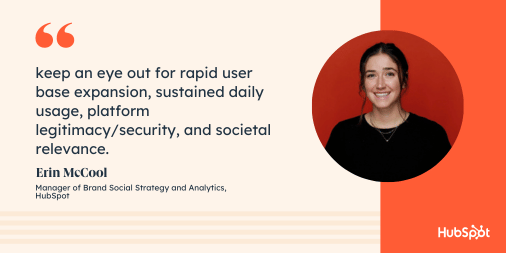
“I’d keep an eye out for rapid user base expansion, sustained daily usage, platform legitimacy/security, and societal relevance,” McCool explains.
Remember those 130 Million Threads users I mentioned earlier?
“When Threads launched last summer, it hit all those factors- we joined the platform quickly,” she says. “We’ve since grown our following to 90k, organically!”
But that kind of growth won’t happen if you spread your time and talent across too many platforms.
How does HubSpot’s social team choose which platforms to focus on?
“We’re constantly auditing our target audience’s preferences and habits– alongside our own social performance– to refine our content strategy,” Erin says. “As well as how and where we show up in the social world.”
Pro tip: Not sure what to look for? You can learn more about what she means in our Social Media Analytics: The Ultimate Guide.
But it’s not just about numbers.
“We also want a combination of platforms that allow us to diversify our content formats,” McCool explains.
Think about the difference between LinkedIn, TikTok, and Instagram. Each platform works best with a different format, and each format will allow you to speak to a different segment of your audience.
If you only engage on micro-blogging platforms, you could be limiting your reach.
Just don’t go too far in the other direction, either.
“Entering a new platform is an investment of time and effort, so we align our decisions with what we feel will drive lifelong engagement and brand growth.”
And that gets to the heart of the matter: There are so many social media platforms that even with a team of marketers, you still have to decide where to invest that time and effort.
So now, bottom line:
Should our readers consider Bluesky?
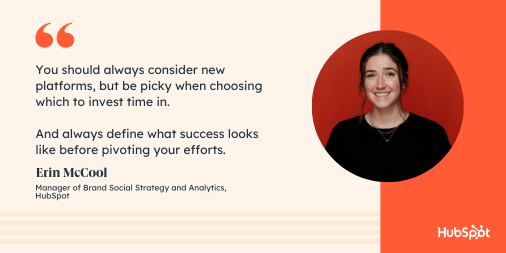
“You should always consider new platforms, but be picky when choosing which to invest time in,” she advises. “And always define what success looks like before pivoting your efforts to a new platform.”
In other words, don’t join a platform just to join. Remember that you’re there to promote your brand.
Instead of asking yourself, “Should we join this platform?” McCool suggests you prioritize questions like:
- “Is our audience here?”
- “Do the content features match our capabilities?”
- “Do we have the resources to sustain this presence?”
And, finally, remember that you don’t have to decide right away. McCool adds one more piece of wisdom:
“It never hurts to secure your brand’s handle while you experiment on the platform from your personal account.”


How to Get Verified on TikTok: A Step-by-Step Guide

As a content creator and marketer, I often see creators and brands clamoring for verification checkmarks on TikTok — and I understand the excitement. To be verified on TikTok is like getting a golden ticket to the chocolate factory.
As a content creator and marketer, I often see creators and brands clamoring for verification checkmarks on TikTok — and I understand the excitement. To be verified on TikTok is like getting a golden ticket to the chocolate factory.
It feels exclusive and rare, meaning you stand out from the crowd. And with TikTok predicted to be among the video-centric apps to see the most growth in 2024, standing out will be crucial.
A blue checkmark on TikTok doesn‘t mean you’ll automatically step into the celebrity world and get the red carpet treatment. However, I can guarantee it’s a good look for your brand and a great step in growing your platform.
But how do you get verified on TikTok? It‘s actually a bit easier than you might think. Here’s how to get verified on TikTok and some tips I’ve gathered from being an endless scroller on the app.
And from being an experienced marketer, of course.
What does TikTok verification mean?
How many followers do you need to get verified on TikTok?
How to Grow Your TikTok and Boost Your Chances of Verification
![Free Ebook: The Marketer's Guide to TikTok for Business [Download Now]](https://no-cache.hubspot.com/cta/default/53/2c7242e4-ad54-4f63-8627-a15aa6a2ea50.png)
What does TikTok verification mean?
At its core, TikTok verification means that the account is verified to belong to the person or brand it represents.
You’ve probably noticed that your favorite brands, musicians, creators, and public figures sport a blue checkmark next to their username. The checkmark means it’s their actual account, and you are following the right person.
Why is TikTok verification important?
Let‘s be honest: It’s a bit of a status symbol. Being verified on TikTok lets your followers know you‘re not some imposter — but it also lets others know you’re worth following.
Think about it: TikTok users will see your verified profile and think, “This person is so important that people want extra assurance that it’s them and not a bot or a faker.” It adds legitimacy to your platform and a slight sense of exclusivity.
Even I can admit my interest in some creators has been piqued by the appearance of a blue checkmark.
Status aside, a verification badge also builds trust with your followers and establishes authority in specific topics or industries on the platform.
For example, entertainment journalist Mona Kosar Abdi is verified on TikTok, so her followers know the news they‘re receiving comes from a legitimate and reliable source.
So, how do you get verified on TikTok? Let’s dive in.
How to Get Verified on TikTok
In 2022, TikTok made it possible for users to apply for verification. Until then, it was up to a secret society behind the scenes to find creators and verify them as a reward for creating popular, high-quality content.
OK, it wasn’t a secret society — just TikTok staff. Still, the process seemed really shrouded in secrecy, and it was always a delightful surprise for creators to log in and see that shiny blue checkmark.
Nowadays, creators can fill out a simple application to be verified, though the app still reserves the right to choose or decline someone for verification.
Here’s how to apply:
- Open the TikTok App and click Profile in the bottom right corner.
- Click the menu in the top right corner (the three horizontal lines).
- Click Settings and Privacy.
- Tap Account.
- Tap Verification.
You’ll need to meet three basic requirements to be eligible for verification:
- Have a username, bio, and profile photo
- Have verified your email and phone number
- Have turned off private account
You‘ll then need to select your verification type, which would be personal or institution. Personal means you’re a notable person, such as a celebrity, influencer, or journalist.
Institution means you’re a nonprofit institution, such as an organization or university.
If you‘re a brand or company, you must register as a business account on TikTok and then follow the steps above. Not sure how to register a business account? Don’t worry, I got you covered. Just click here.
Pro Tip: If you‘re registering as a person and not an institution or brand, make sure to have proof of ID on hand, such as a driver’s license or passport. You will be asked for proof of identity as you fill out your application.
Don’t be like me and scramble for your wallet at the last minute.
Once you submit your application, you just have to play the waiting game for about 30 days — which is the time it takes for TikTok to read your submission.
During that time, you can binge-watch your favorite shows, go on a hiking trip, backpack across Europe, or watch paint dry. But, whatever you do, do not submit another application before the 30 days are up.
Doing so will only slow down the verification process.
However, if you’re still not verified after 30 days, you can submit another request.
How many followers do you need to get verified on TikTok?
Contrary to popular belief, TikTok doesn‘t consider follower count or likes on a page when verifying users. I’ve seen pages with hundreds of thousand of followers not be verified, despite having gone viral or gained traction.
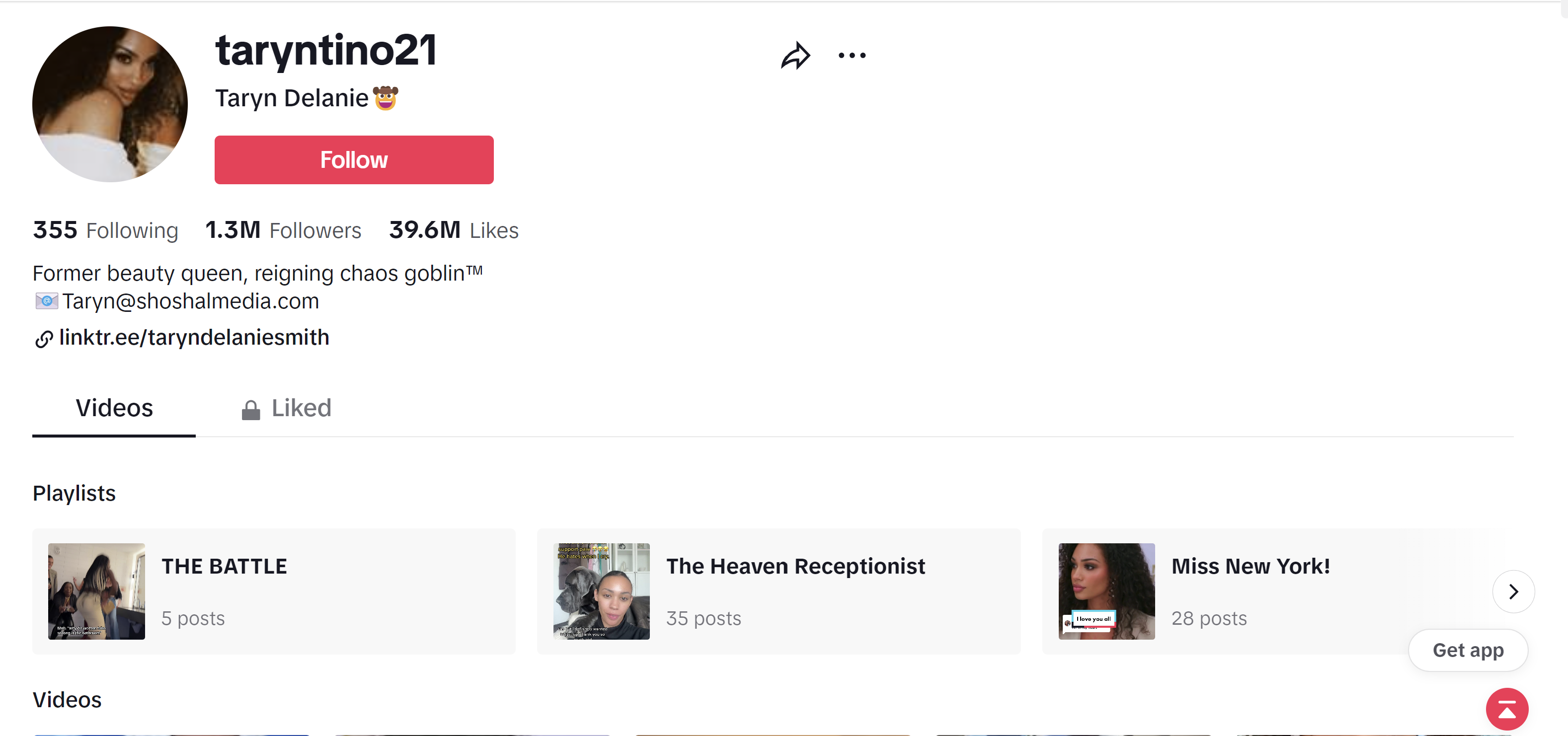
For example, one of my favorite creators, former beauty queen Taryn Delanie Smith, has over 1 million followers on TikTok and has gone viral several times. Yet, to my surprise, she’s not verified!
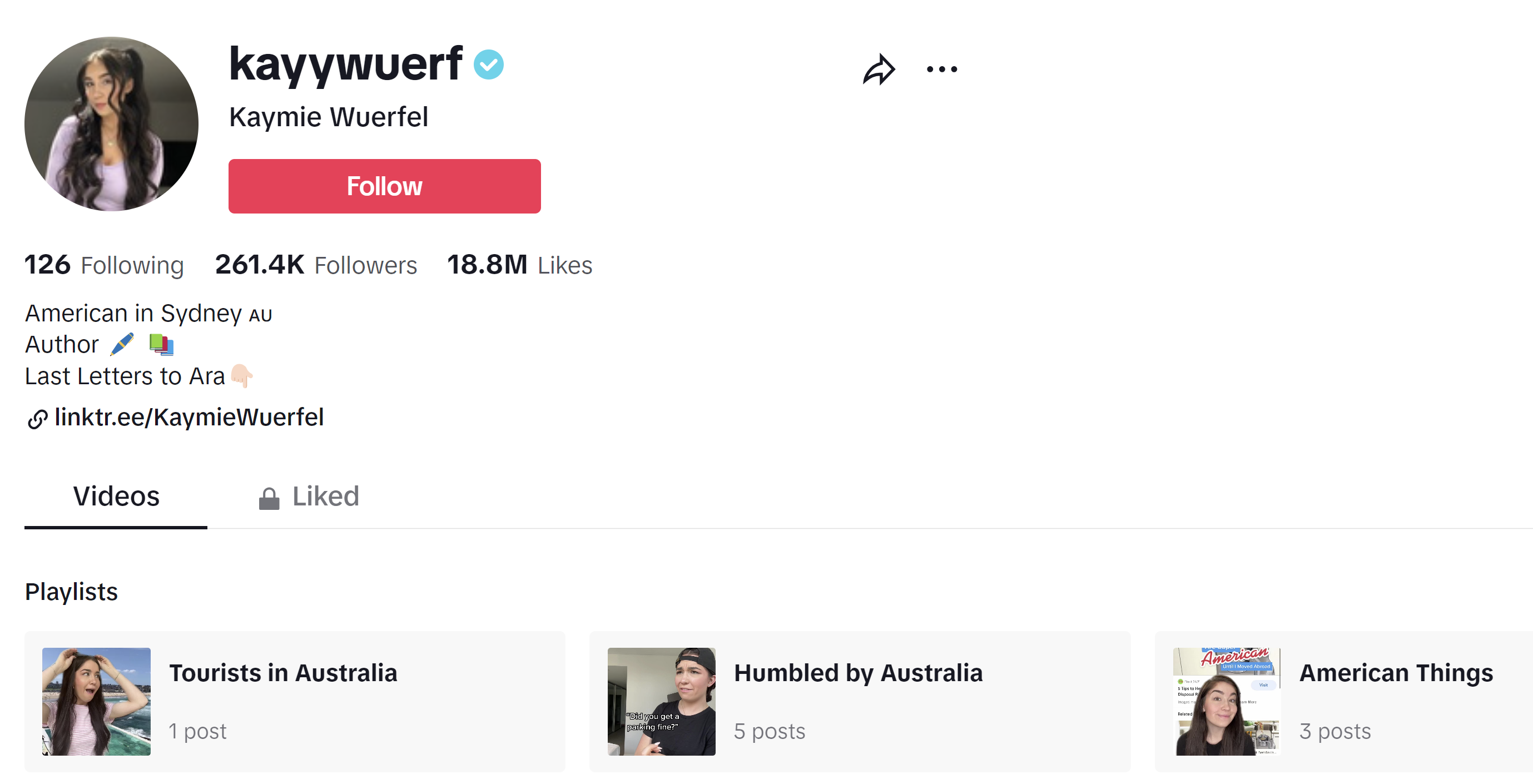
Author Kaymie Wuerfel has over 260K followers and sports a blue checkmark on TikTok. So, don’t worry too much about your follower count.
Instead of focusing on follower count, think about the quality of your content.
How to Grow Your TikTok and Boost Your Chances of Verification
If you want to give yourself the best chance at being verified on TikTok, follow these tips I’ve gathered based on the verified accounts I follow:
1. Be consistent.
According to TikTok, you must have logged into your account in the last six months to be eligible for verification. However, simply logging in isn’t enough to give yourself the best odds.
You want to post frequently and consistently, like artist Kaarin Joy. Joy is an interior decorator who posts 1-2 TikToks a day detailing the different art and design projects she completes around her house.
I started following this creator when she had less than 1 million followers, so trust me when I say I definitely noticed her following dramatically increase when she went from posting every few days to once or twice per day.
So, I’m not surprised that she’s amassed 2.4 million followers and the coveted blue checkmark on TikTok after years of consistent content.
You should also try posting at the most optimal time for your audience. Our research shows the best time to post on TikTok is between 6-9 PM, followed by 3-6 PM and 12-3 PM. But feel free to experiment to see what your audience prefers.
2. Keep track of media coverage.
This is less of a tip and more of a must-have, but I worry it’s not something many creators or brands think about when applying for verification — media coverage!
According to TikTok, applicants must have been featured in multiple news sources to be considered for verification.
Press releases and sponsored or paid media do not count.
I’ve followed content creator and influencer Bretman Rock’s career for almost 10 years. The entertainer has been featured in outlets such as Vogue, Insider, and Elite Daily — and, of course, is verified on TikTok.
So, if you have a video that’s gone viral, take a minute to search yourself or your brand on Google or other search engines to see if your content was featured in any news outlets.
Make sure to bookmark or save whatever posts you find so you can submit them in your application.
Though press releases or sponsored media will not be considered in the application process, you can still use them to form relationships with journalists and news outlets, leading to genuine media coverage of your brand.
3. Be authentic.
I always shine a light on Keith Lee‘s platform when it’s time to discuss authenticity. The family man and food critic has made a name for himself on TikTok for simply being himself.
His commitment to providing genuine reactions to the food he tries and his transparency with his audience have made him stand out on TikTok and helped him earn his verification checkmark.
Pro Tip: Speaking of authenticity, make sure your username is similar to your business name. Notice Keith Lee’s username is the same as his real name. Doing so makes it easier for TikTok to verify the account belongs to a real person.
4. Get creative.
Adventures in Arcadia is a TikTok account that blends food with role-play games like Dungeons & Dragons. Its most popular series on TikTok is Roll for Sandwich, where the host uses D&D dice and character sheets to craft a sandwich.
The TikTok trend of using D&D dice to randomly curate a meal started with Adventure in Arcadia, but it was soon picked up by other creators to make pizza, nachos, burritos, and more.
However, while all are entertaining in their own way, Adventures in Arcadia’s Roll for Sandwich remains the most popular in the “Roll For Universe,” and the account is the only one of its kind to be verified.
While trying new TikTok trends doesn‘t always hurt, it’s best to be creative and craft your own lane in your niche. Doing so will help your platform grow, cultivate a dedicated audience, and give you a better shot at being verified on TikTok.
Getting verified on TikTok is a huge milestone for creators, marketers, and brands alike. It lends legitimacy to your platform, builds trust with your audience, and lets people know you’re an important person in your niche/industry.
Now that you know how to apply and boost your chances of getting that shiny blue checkmark, you have all the information you need to start your verification process. Good luck! Don‘t forget this post when you’re famous.

15 Email Preview Text Examples That Would Catch My Attention

I believe in the concept of inbox zero, so I have a sinking feeling every time we approach the holidays or big occasions (think Black Friday) when I know a mass of emails are heading my way.
All floodgates burst open — my inbox quickly becomes an overflowing chaos.
I believe in the concept of inbox zero, so I have a sinking feeling every time we approach the holidays or big occasions (think Black Friday) when I know a mass of emails are heading my way.
All floodgates burst open — my inbox quickly becomes an overflowing chaos.
I usually send all these unread promotional messages straight to spam. But, occasionally, a few brilliant emails catch my eye because of their intriguing, clever, or motivational preview text messages.
The bottom line: A good preview text in email can help you stand out even in the busiest inboxes.
So, I curated 15 of my favorite preview text email examples to inspire you.
I’ll break down why they work + how to write your own.
We’ll cover:
- What is preview text in an email?
- The Best Preview Text in Emails to Check Out
- Turning Preview Text into Opens
What is preview text in an email?
Preview text is a short snippet presenting a summary or the first few words in an unopened email. It appears next to the subject line and gives you a glimpse of what’s inside.
While subject lines greatly influence your email open rates, preview text messages can also amp up this number. An awesome preview text piques your curiosity, presents a compelling offer, and nudges you to open the email.
Let’s look at some of the best examples of email preview text and some actionable tips for writing them.
The Best Preview Text in Emails to Check Out
I scoured my inbox to find 15 awesome examples of preview text in emails. These are some of my favorite messages from over 700 emails I reviewed. Let’s explain why they work and what you can learn from each.
1. Hootsuite
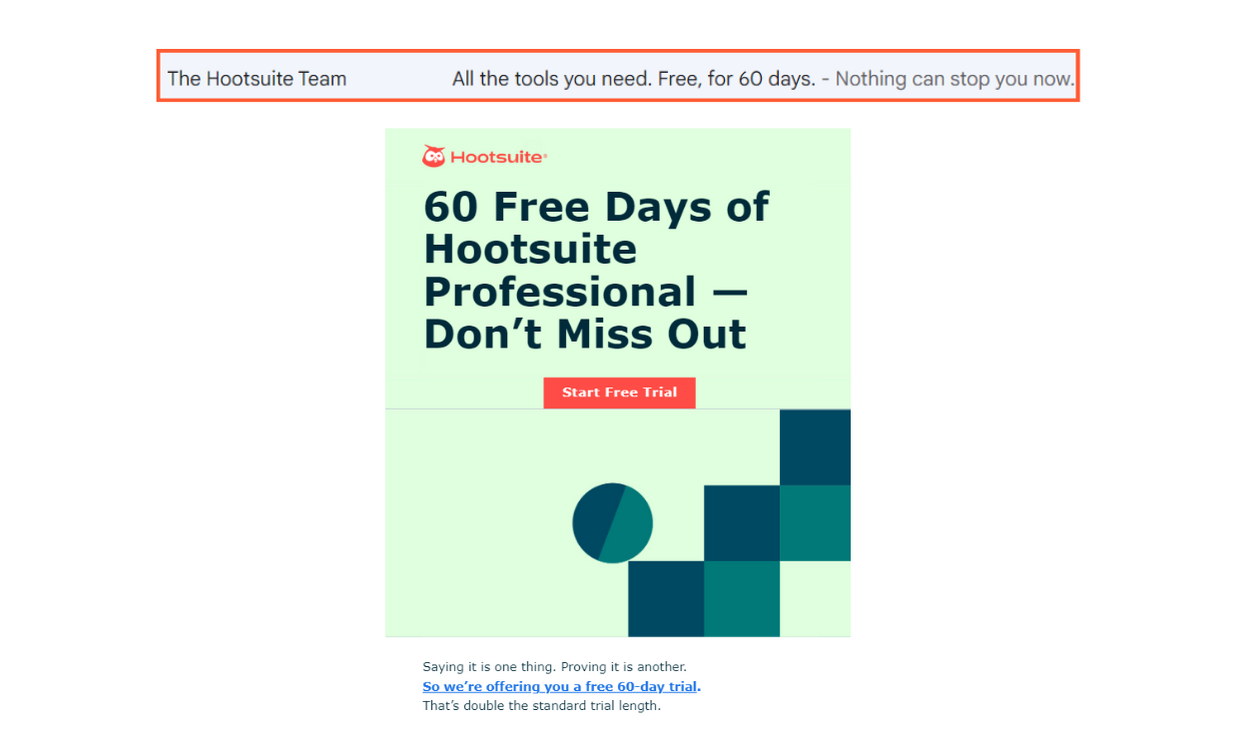
Hootsuite announced their 60-day free trial with this banger email. The subject line gives you a promise — all the tools for free.
The intriguing preview text elevates this promise and makes it look like there’s something really powerful inside this email.
What I like: I was curious about what Hootsuite had to offer — all because the preview text gave me confidence. It’s a crisp and clear message to inspire people. Instead of discussing their product, the subject line and preview text spotlight users.
Takeaway: Focus on your recipients. Keep yourself in their shoes to emphasize how they’ll benefit from each email.
2. Semrush
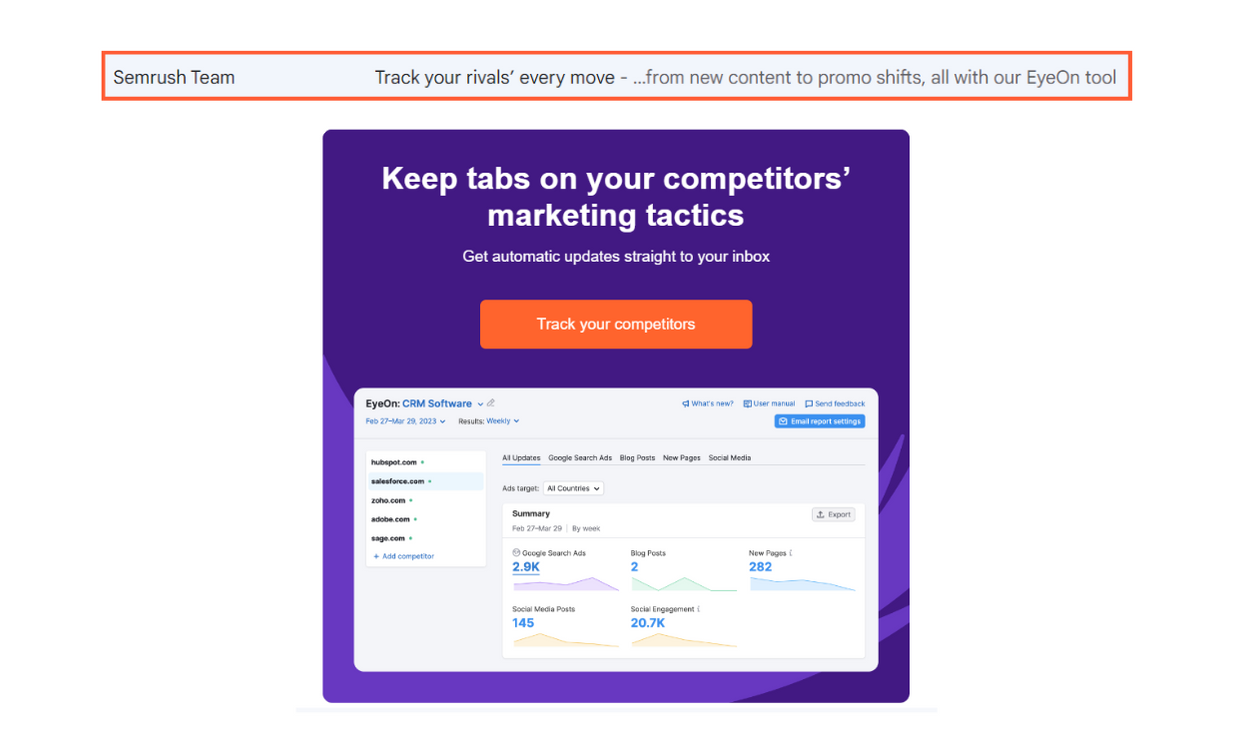
Semrush pulled off this masterstroke by making the preview text an extension of the subject line. The brand sent an email introducing a new feature to track competitors.
The subject line is a clever clickbait that can repel some people. However, the preview text adds more context and explains the “how” behind this subject line.
What I like: The preview text goes well with the subject line. This subject line + preview text combination also introduces the new tool in just under 10 words—neat!
It’s one of the few examples where the preview neatly fits into the subject and elaborates on the email’s core message.
Takeaway: Write a super short, one-line summary of what’s inside your email. Then, break this sentence into the subject line and the preview text.
3. Freelance Bold
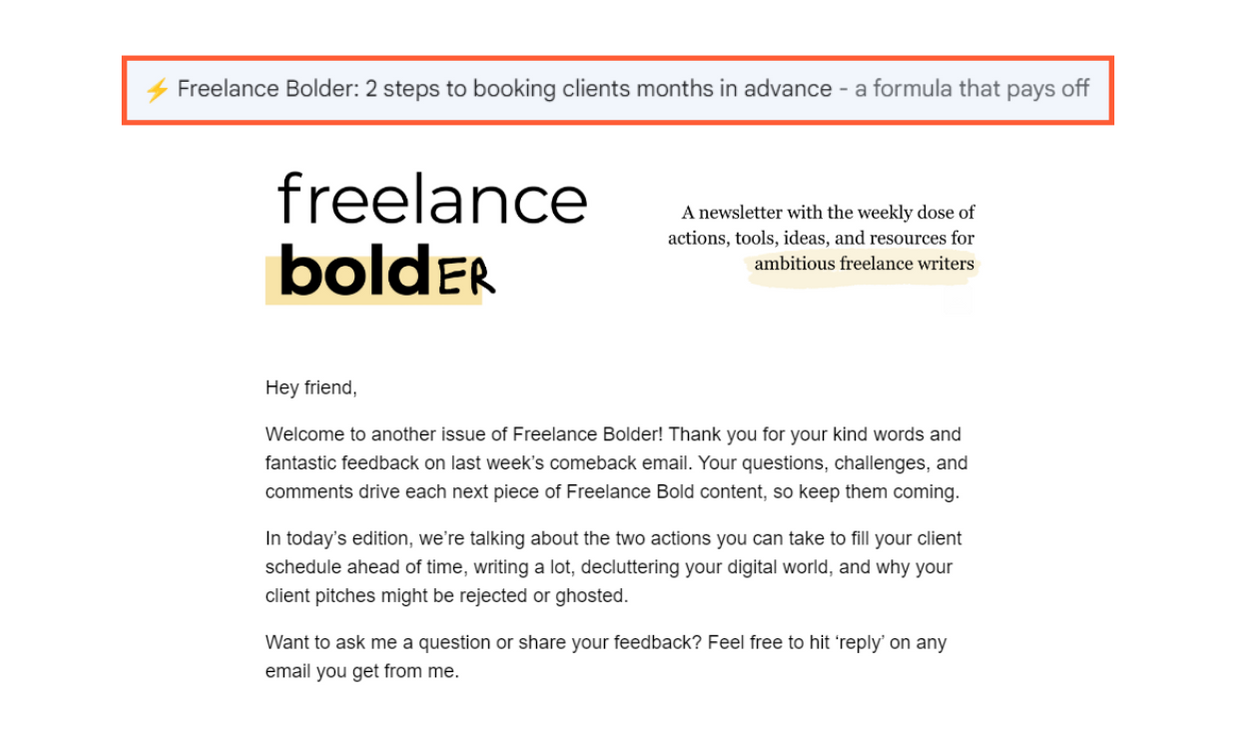
This preview text in one of Marijana Kay’s newsletters made me open the email quickly. Marijana is a freelance writer and content marketer for B2B SaaS brands.
This preview text is a classic — make an offer people can’t refuse. In the subject line, Marijana discusses the two main steps for taking bookings.
And the preview text promises her “formula” with tips to secure clients even when you’re fully booked.
What I like: This preview text has only 20 characters but still significantly impacts readers. Why? Because it gives you an irresistible promise.
Since Marijana is a leading expert, her subscribers (including me) would be more than curious to open this email and find her proven formula.
Takeaway: Make your offer sound unmissable and build credibility around it. Tell people what you share (formula, framework, template, etc.) and why they should get it.
4. Mutiny
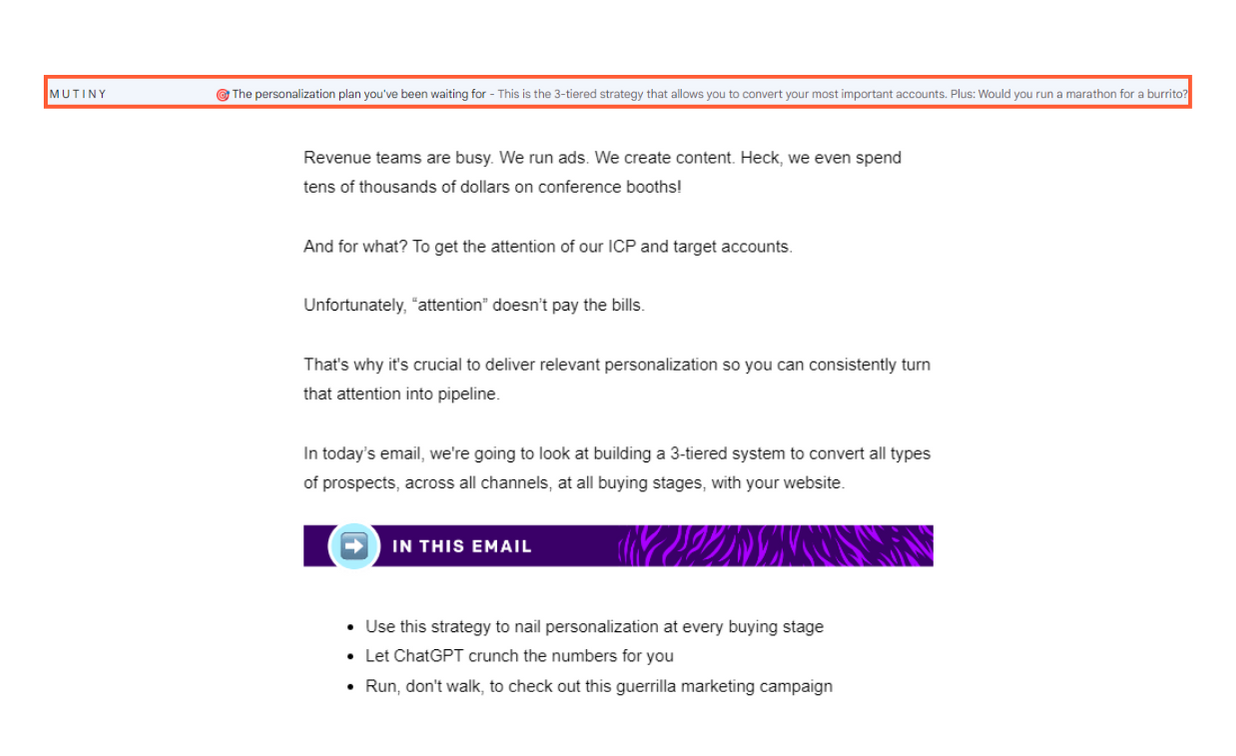
I found an excellent preview text from Mutiny, one of the most unique examples in this list. Even though this preview text is longer than usual, it piqued my curiosity with an out-of-context question — Would you run a marathon for a burrito?
What I like: This preview text cleverly makes people excited about what’s inside the email.
While the subject line will talk about the actual content of the email, the preview text can mention something irrelevant yet interesting to draw people’s attention.
Takeaway: Don’t stick to the topic; that’s boring. Go beyond your email’s central theme to discuss something unusual in the preview text.
5. Why We Buy
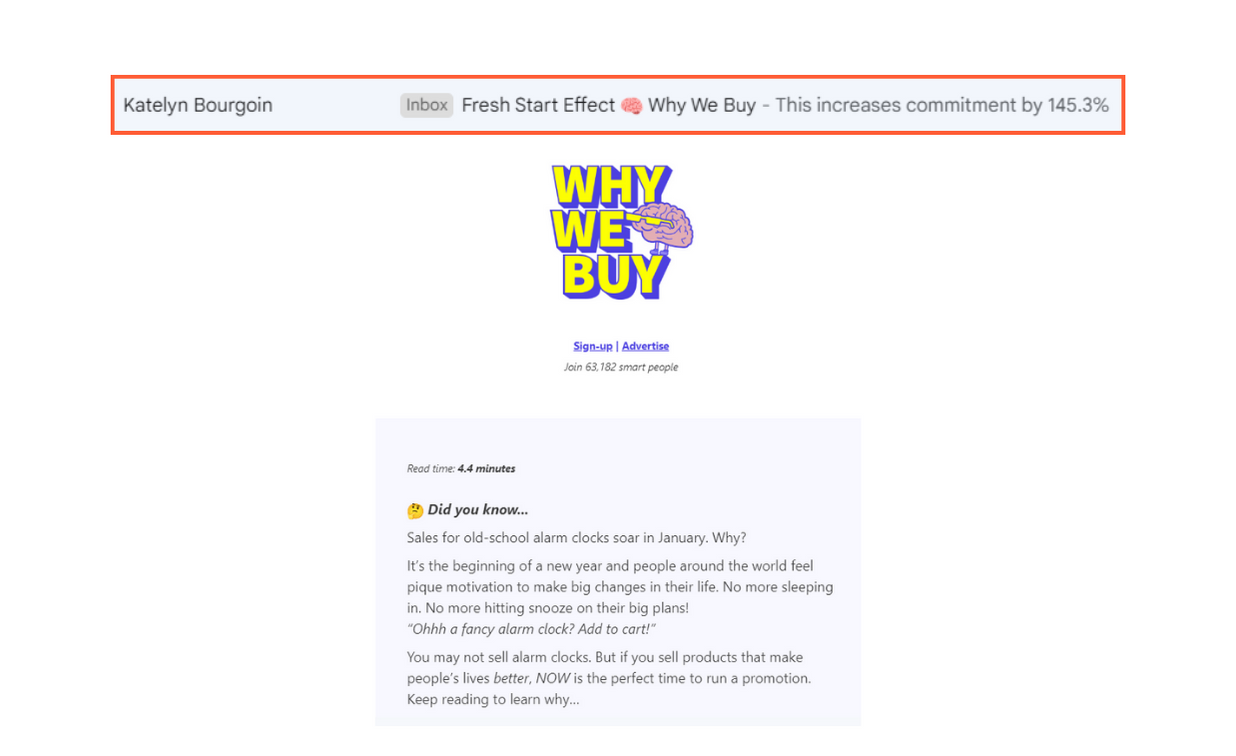
Image Source
Katelyn Bourgoin’s Why We Buy newsletter always has 2 or 3 letters to describe the theme of each email. I know Katelyn is a 4-time founder and customer-focused marketer with a personal branding agency.
That’s good enough for me to open and read the message, even if not instantly. But, this email was unique because the preview text immediately convinced me to check out the message.
It’s an aspirational message with a concrete number to show how I can achieve this goal.
What I like: This short preview text builds exciting proof around the subject line. It convinces me that the email talks about a proven method, and I can use it to increase commitment by over 100%.
Takeaway: Share some proof of concept in the preview text. Give readers a reason to view the message by hinting at the success they can achieve with the tips inside.
6. Notion
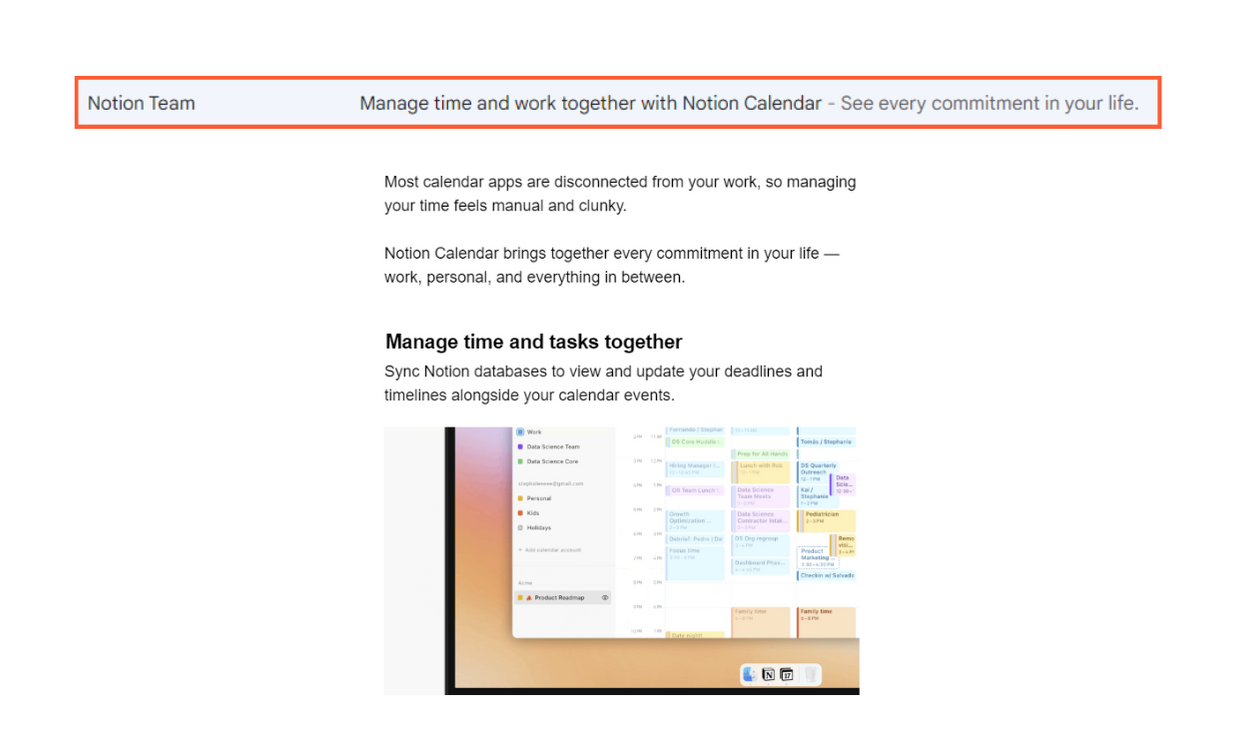
When Notion launched Calendar, they sent four emails introducing different capabilities and use cases. But this was the best because the preview text beautifully contextualizes this feature.
It directly pokes at the pain of managing multiple tasks, meetings, and timelines to propose a single solution — all in five words.
What I like: This message taps into a big emotion: motivation. It tells me that Notion Calendar will offer enough motivation to stay on top of all my commitments.
And the preview text increases open rates by evoking this powerful emotion.
Takeaway: Make your preview text personal. Speak directly to your readers and explain what they can do better with the insights inside the email.
7. Junia
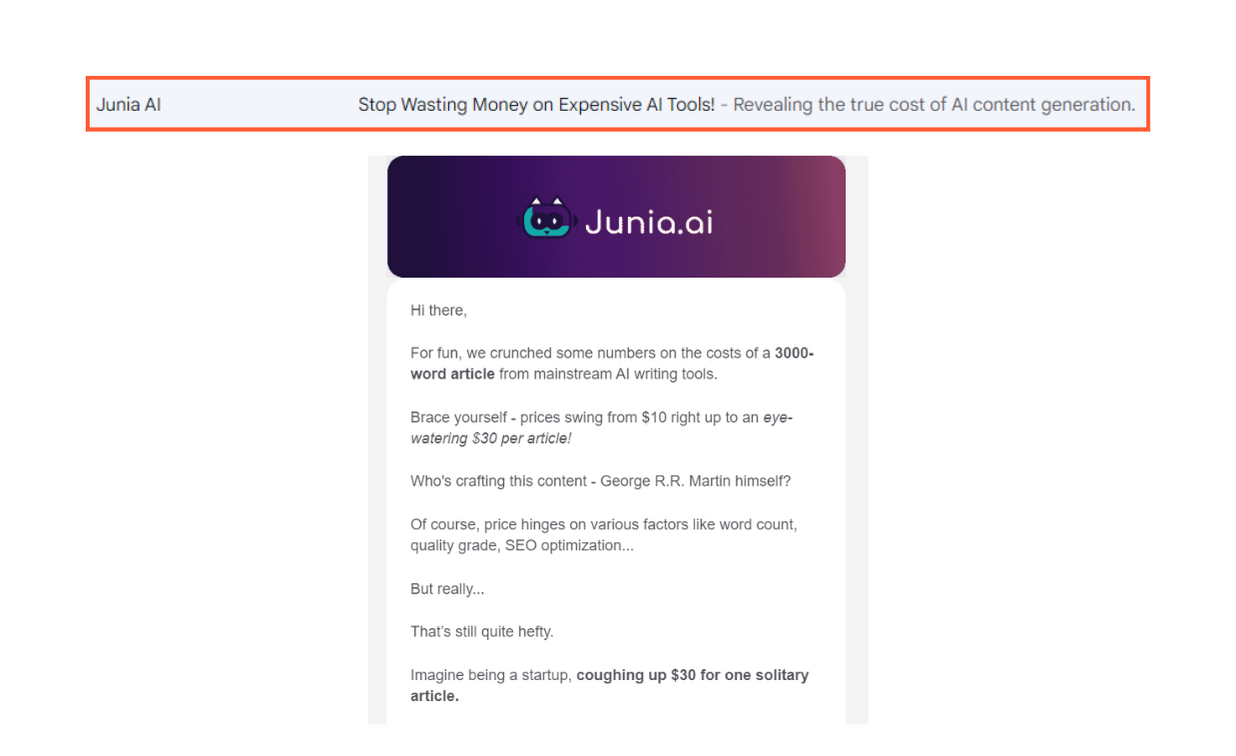
Junia ran a small experiment and shared their findings through an email. I wouldn’t usually have opened this message, but I felt compelled to click on the email because of the preview text.
It creates suspense and a sense of excitement, mentioning revelations inside.
What I like: The subject line + preview text combination gives you an action and a reason to work with. The subject line states a clear ask, and the preview text hints that there’s a reason behind this ask. It makes people curious to learn more.
Takeaway: Mention a simple action in the subject line and use the preview text to briefly explain why you’re asking people to take this action. Hint at these reasons instead of revealing everything.
8. Vidyard
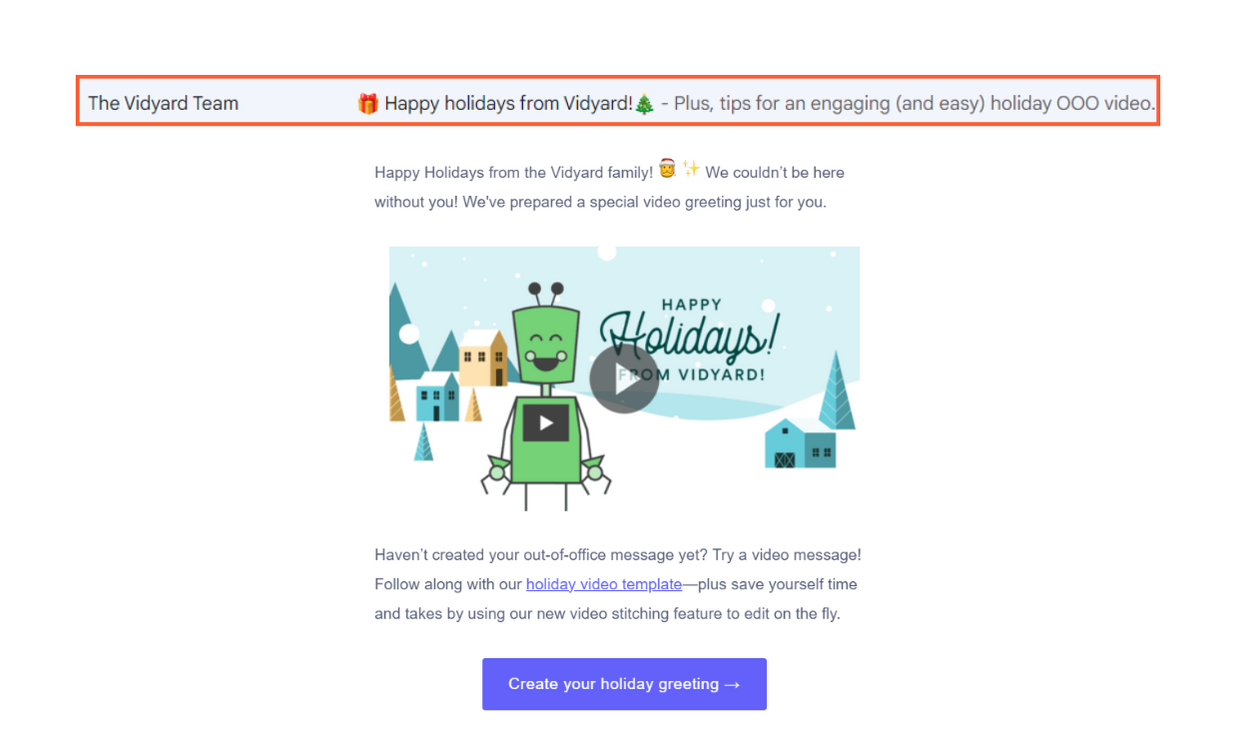
Holidays are the busiest of times for our inboxes. But Vidyard’s creative message was one of the few emails I opened right before signing off for my year-end vacation. Why?
Because it gave me something new to check out: tips to make an OOO video.
What I like: This isn’t one of those typical happy holiday emails. It promises something meaningful and topical.
At a time when everyone was setting out-of-office responders, Vidyard’s preview text instantly caught my attention because I wanted to do something fun.
Takeaway: Even when sending mainstream emails for holidays or occasions, make them more appealing with a unique take or creative tips.
9. Triple Whale
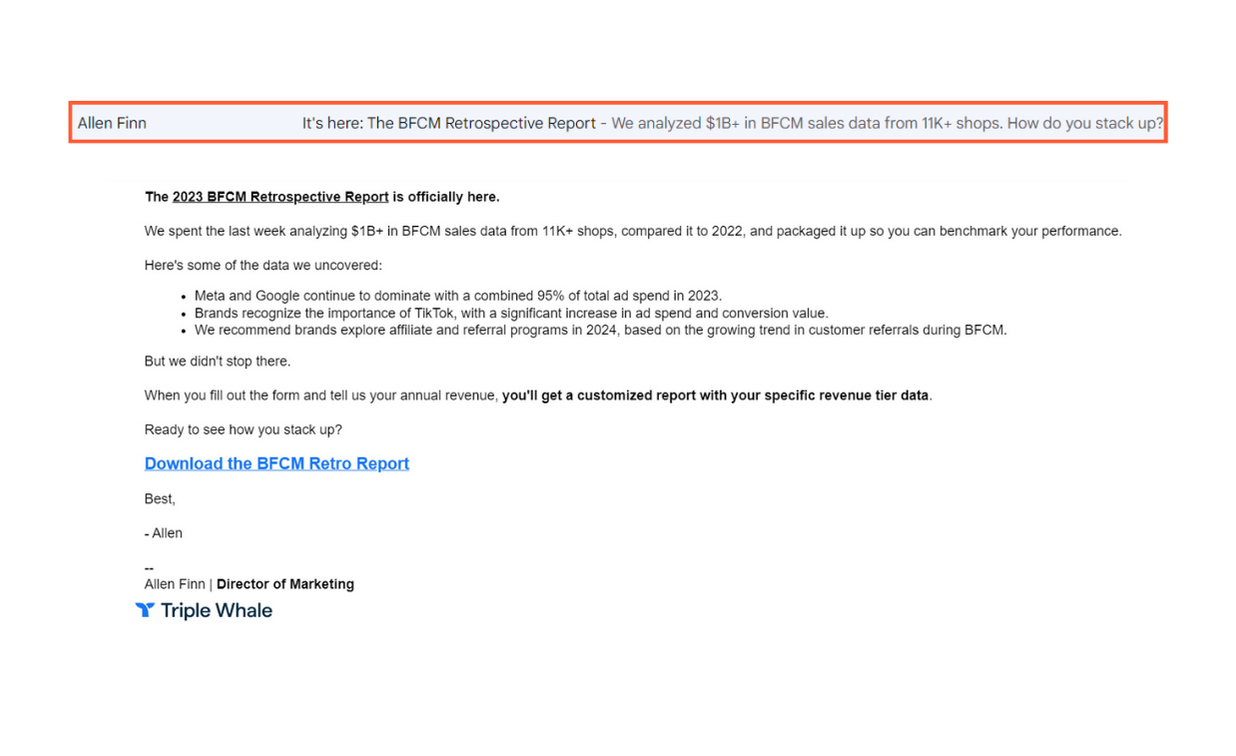
I’ve received dozens of eBooks and reports over email, but this one from Triple Whale was at a whole different level. The preview text neatly summarizes what their BFCM report analyzes and the data points it includes.
And the best part? It nudges me to open this email with a short question — how do you stack up?
What I like: I felt excited because this preview text gave me some context about what’s inside the report.
If I were an e-commerce business owner, I’d open the email faster than the speed of light because I’d want to evaluate my performance against this data.
Takeaway: When sharing a report or resource (like an ebook), briefly summarize the numbers or themes inside and end with a personal question.
10. Content Workshop
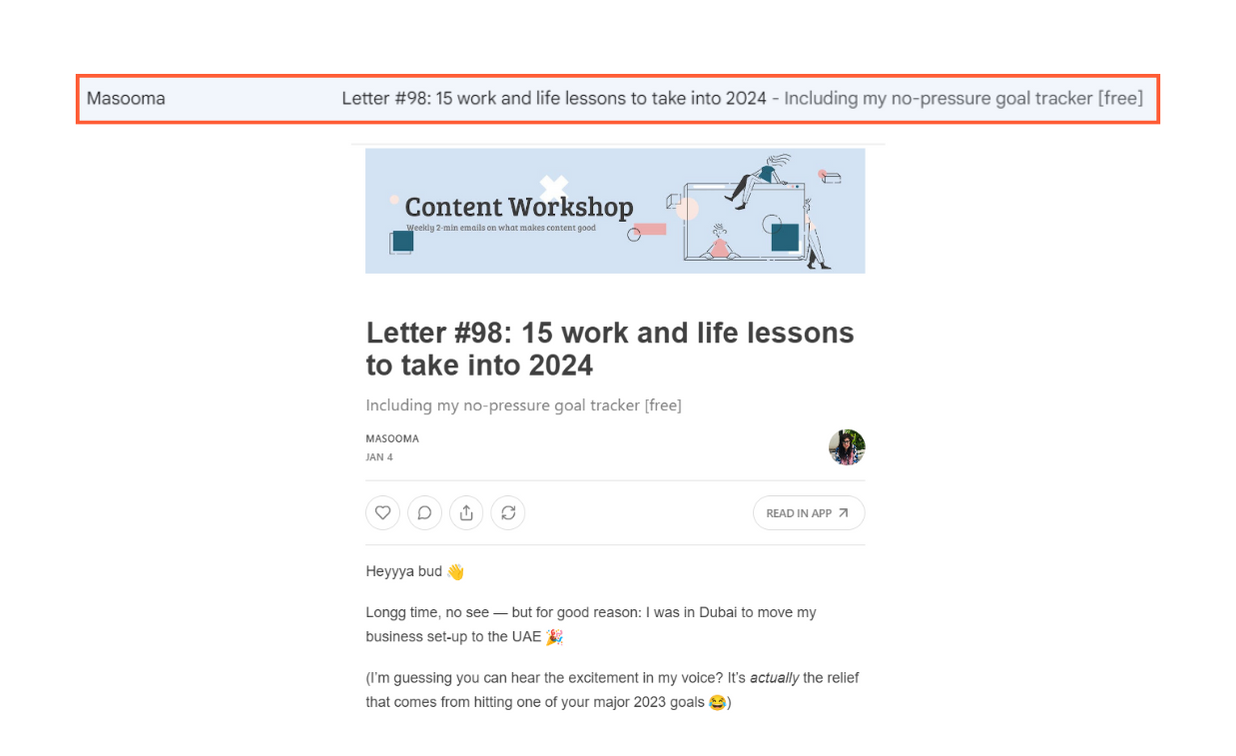
This edition of Masooma Memon’s Content Workshop is another of my favorite examples of email preview text because it promises a free resource.
Masooma is a freelance writer and content marketer for some of the biggest names in the B2B SaaS industry.
The subject line explains that she’ll talk about 15 lessons, and the preview text invites me to download her tried-and-tested goal tracker.
What I like: This preview text is a quick nudge to download the goal tracker. It’s an added motivation to open the email. And if some people aren’t intrigued by the subject line, they’d view the email looking at this offer.
Takeaway: If you offer a resource within your email, highlight it in the preview text. Position this resource as a tried-and-tested way to accomplish the goals discussed in the subject line + email.
11. Catalyst
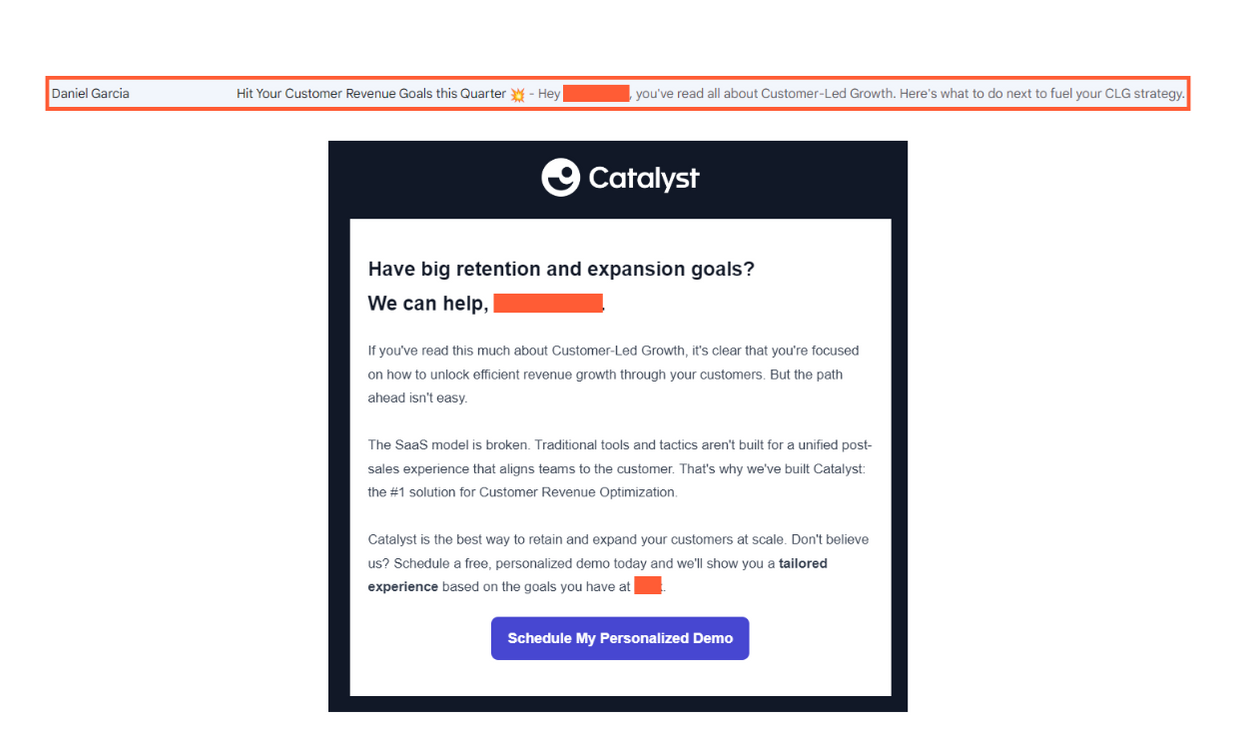
Catalyst uses preview text to guide users through the following steps after someone downloads their ebook on customer-led growth. Most companies throw people into their “lead nurturing sequence” and send random emails.
But Catalyst contextualized this nurture email for readers to instantly recognize why they’re receiving it and what’s inside.
What I like: This preview text immediately tells me why I’m receiving the email so that I don’t delete/spam it immediately. Plus, it sets the stage for me to open the message because the email contains the next steps.
And the personalization looks great, too!
Takeaway: Use the preview text snippet to create context around why you’re sending an email. You can significantly minimize unsubscribe rates by setting this context.
12. Atlan
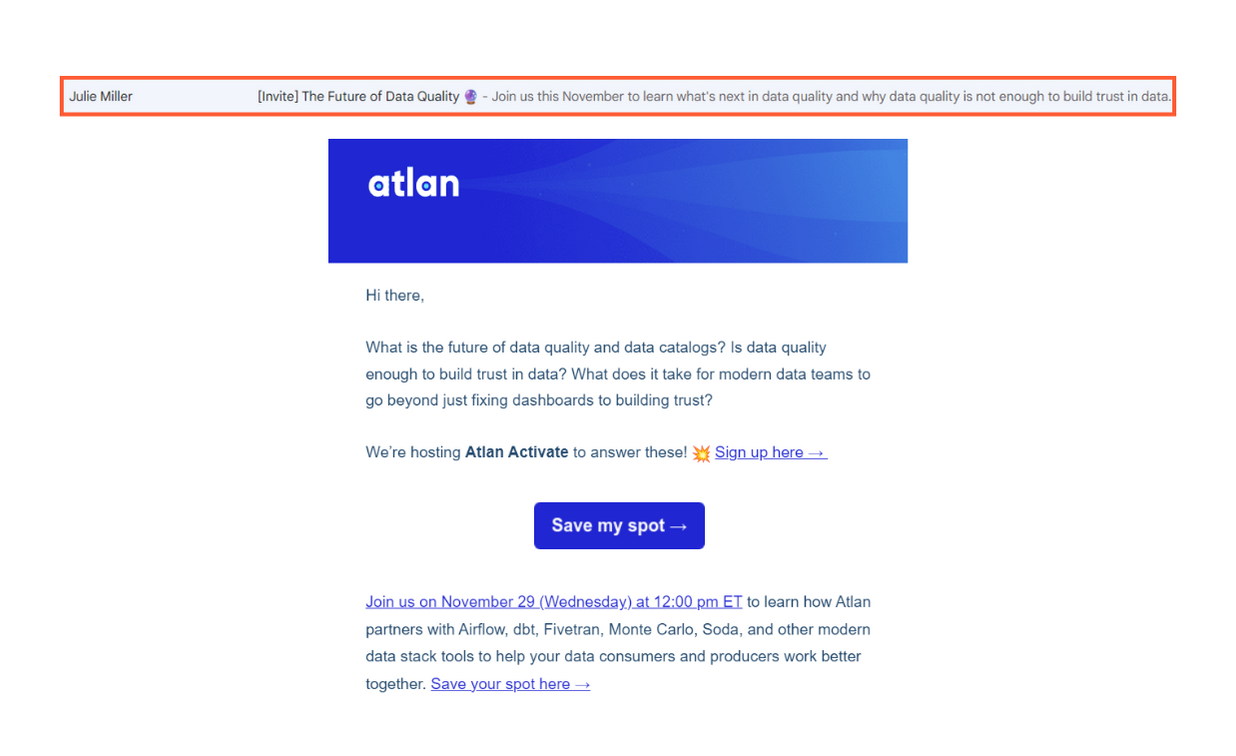
My inbox is filled with invites for webinars, events, fireside chats, and whatnot. This email by Atlan was one of the few such invites that stood out for me. It has three main elements:
- A recognizable [Invite] tag
- Event name + time
- Preview text with themes of discussion
What I like: This preview text is a one-line webinar summary. It’s clear and convincing for readers to explore more if the topics seem interesting.
Takeaway: Use the preview text to quickly summarize your event invites. It can save readers the time to jump through hoops.
13. Asana
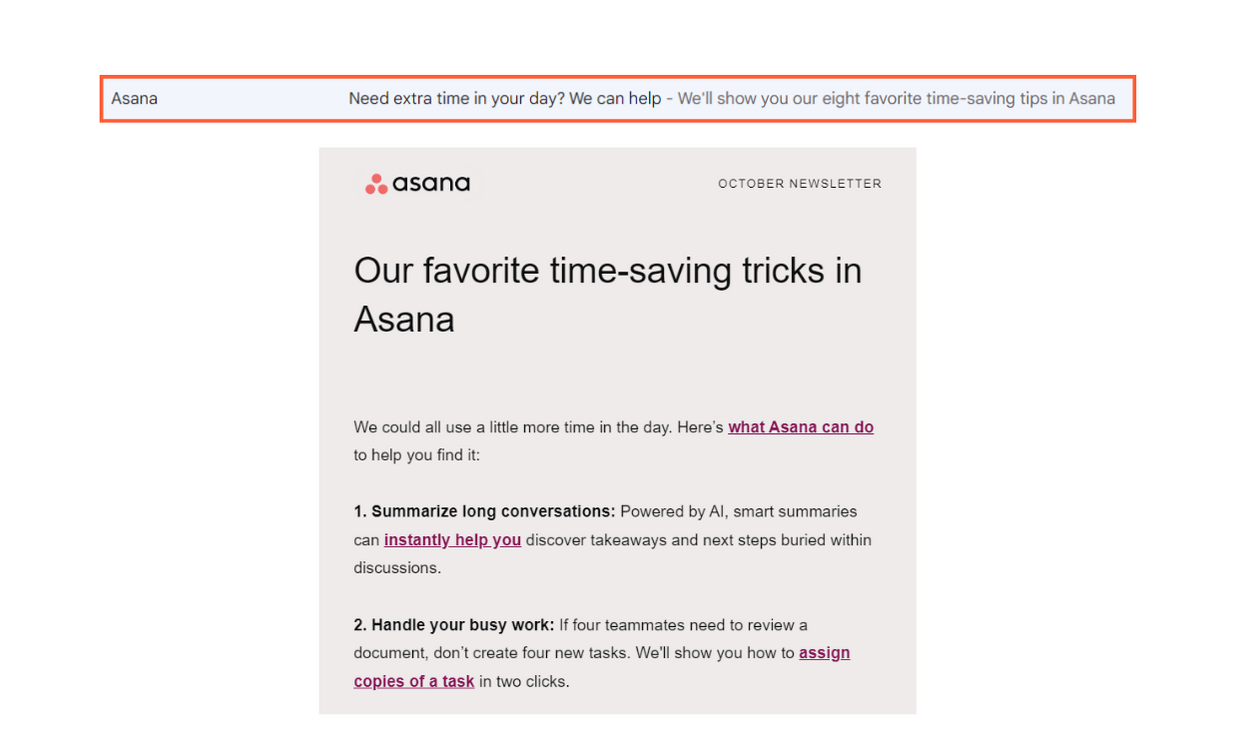
Asana is one of my go-to project management tools. And when your favorite brand wants to share their tips, you’ll open the email. This preview text draws on Asana’s brand strength and popularity to excite readers.
What I like: I consider Asana’s team project management experts. By hinting that this email includes their best time-saving tips, this preview text creates curiosity to open the email.
Takeaway: Leverage your brand image to write preview texts in first-person POV and share your first-hand experiences or expertise.
14. Coda
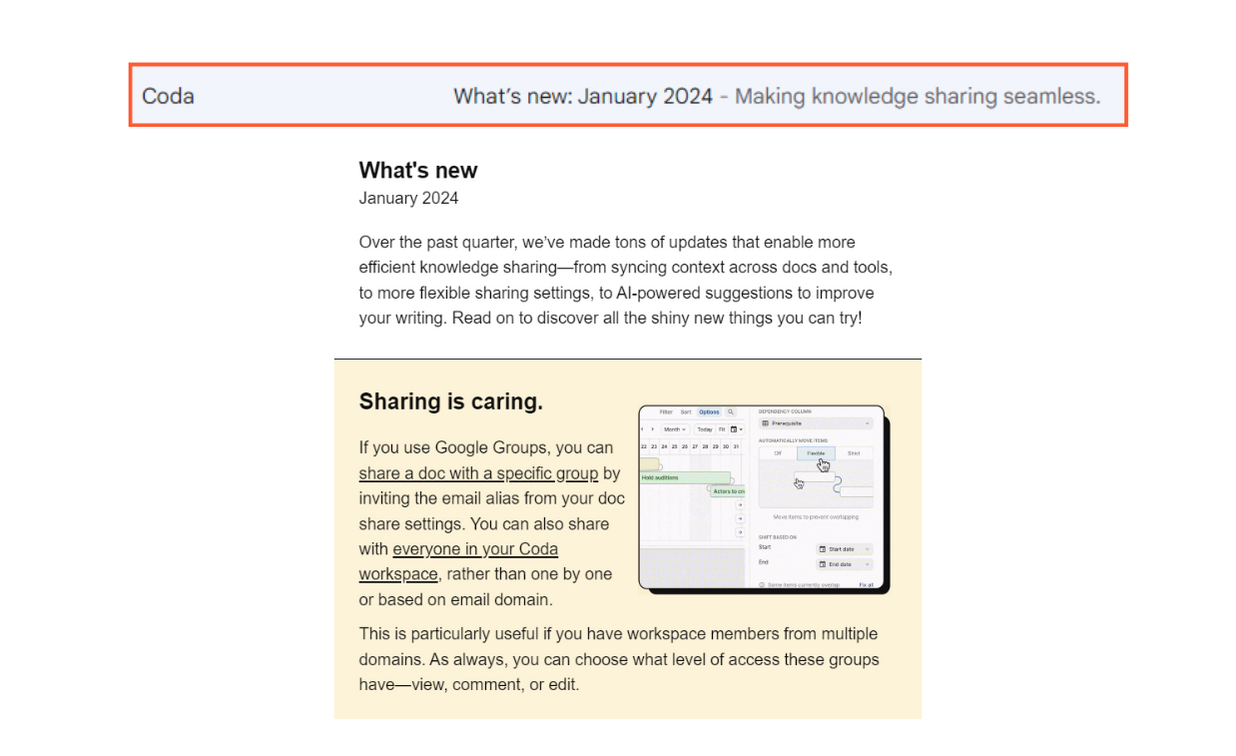
This product update email by Coda has a simple and powerful preview text message. It tells readers they can achieve something big using the new capabilities in the tool.
But, they must view the email first to learn about these new features.
What I like: The simplicity. This preview text doesn’t have anything extraordinary. Yet, for Coda users, it talks about a big goal and incentivizes them to achieve it by checking out the features inside the email.
Takeaway: Don’t be afraid to keep things simple. Test a few variations of such preview texts with your subscribers to choose the most optimized ones.
15. Vimeo
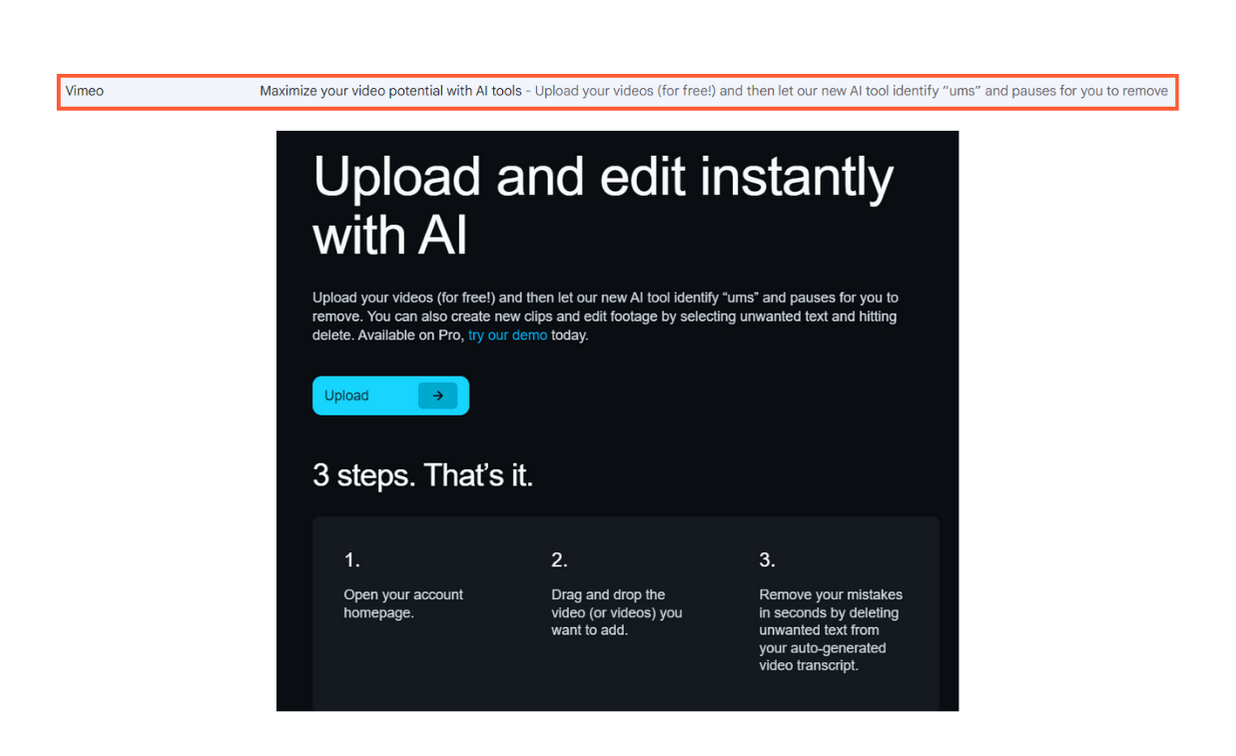
This preview text by Vimeo is one of my favorite examples because of its realistic message. While the email discusses a specific feature, the preview text zooms in on the pain points this feature can solve.
It also told me about the option to try this feature for free.
What I like: The preview text contextualizes Vimeo’s new AI feature. It explains how the tool removes phrases we don’t want to include in the video, making it an instant hit.
Takeaway: Speak directly to your users and lead with their pain points to craft a successful preview text.
Turning Preview Text Into Opens
That’s a wrap on my favorite preview text examples! Remember to spend extra time drafting the preview text the next time you create an email campaign.
You can make a checklist of these tips and takeaways to reel in more people and increase your open rates with an awesome preview text.

The Top 5 B2C Marketing Trends of 2024 [New HubSpot Blog Data + Expert Insights]

In 2024, 43% of B2C marketers plan to increase their marketing budget.
In 2024, 43% of B2C marketers plan to increase their marketing budget.
The question is: Where is that budget going? Will marketers reinvest in the same strategies or try new trends?
To understand what trends B2C marketers are leveraging in 2024, we surveyed 1,460 global marketing professionals working in B2B and B2C companies.
From influencer marketing to short-form video, there are so many efforts brands can focus on. Let’s see what our latest research says about what worked well for B2C marketers this year and where they plan to invest in 2024.
1. Short-form video content will be a top priority for B2C marketers.
Short-form video took off in early 2020 and shows no signs of slowing down.
Back then, TikTok was the number one place to go for short-form content. Today, Instagram Reels and YouTube Shorts are also competing for users’ attention.
This is good news for brands, as short-form video trend content resulted in the biggest ROI for marketers in 2023.
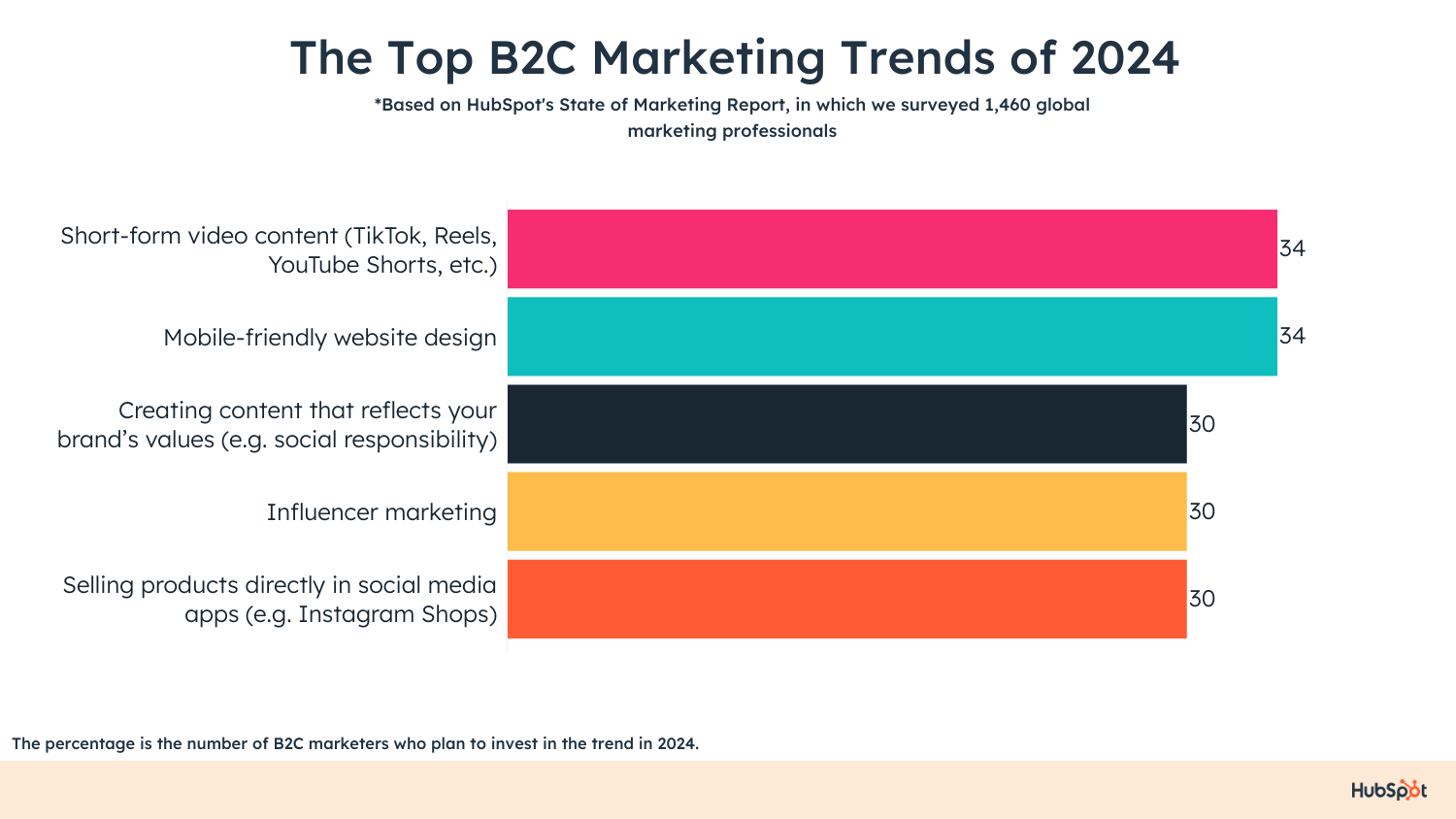
Additionally, 34% of B2C marketers said short-form video is the #1 trend they plan to invest in in 2024.
Why now? Well, short-form video is a key feature in social media today.
Last Crumb, an LA-based homemade cookie company, is a good example of a B2C brand dominating short-form video. They have over 200K followers and over 2 million likes on TikTok, and their videos are light-hearted and fun, with a healthy mix of user-generated videos and studio-produced clips:
Ultimately, short-form video is a powerful strategy for reaching new audiences.
As Director of Research & Training at Blue Frog, Jillian Streit, told me: “For the generations that prefer to listen and watch their content, short-form videos offer a unique opportunity to showcase your brand personality that is more difficult to do through imagery or text. With storytelling and a little humor, you can connect with your audience more personally and generate longer-lasting loyalty in your customers.”
Streit adds, “Organizations that sell tangible products should utilize short-form videos to quickly and efficiently showcase key features and uses of your products.”
Today, with so many platforms offering in-app shopping experiences and advanced ad formats, brands can meet more of their marketing goals.
2. B2C marketers will lean into mobile-friendly website design.
34% of B2C marketers say mobile-friendly website design is the top trend they’re focused on in 2024.
To understand why mobile-friendly web design matters so much for B2C brands, I spoke with Bill Lorimer, Associate VP, Ecommerce at SmartBug Media.
Lorimer told me, “Mobile-friendly design is more than just a buzzword – it’s a crucial strategy to stay ahead of the competition and ensure a positive digital experience for your brand. Prioritizing mobile optimization turns your e-commerce site into a magnet for on-the-go shoppers, offering them a seamless and enjoyable experience regardless of the device they’re using.”
He adds, “Mobile-friendliness isn’t just about the front-end experience, either: Search engines also prioritize mobile-friendly sites over ones that aren’t. Ultimately, investing in mobile optimization translates into increased traffic, higher conversion rates, and greater revenue generation, making it a fundamental strategy for the success of your brand in today’s digital landscape. If this isn’t a priority for your brand, be ready for challenging times ahead.”
Unsure where to begin? Take a look at our guide on optimizing your site for mobile users.
 3. B2C marketers will become obsessed with creating content that reflects their brand’s values (e.g. social responsibility).
Manuela Gaitan, Head of Marketing at Awtana, told me: “There has been a growing trend towards creating content that reflects a brand’s values, particularly those centered around social responsibility. While this approach may not be as popular as focusing solely on product features or lifestyle imagery, it’s proving to be a worthwhile investment for B2C companies.”
Gaitan believes there are three reasons creating content that reflects brand values is important for B2C marketers. As she puts it:
- Aligning marketing content with a brand’s values helps establish a deeper emotional connection with consumers. By showcasing a commitment to social responsibility through content, companies can resonate with their target audience on a more profound level, fostering loyalty and trust in the process.
- Communicating brand values in marketing content can set a company apart from its competitors in a crowded marketplace. By highlighting these values, B2C companies can carve out a distinct identity for themselves, attracting like-minded consumers who are drawn to their mission and purpose.
- Investing in content that reflects brand values can have long-term benefits for a company’s reputation and bottom line. By demonstrating a genuine commitment to social responsibility through their content, companies can enhance their reputation as ethical and socially conscious entities, which can translate into increased customer loyalty and positive word-of-mouth.
A whopping 46% of B2C marketers plan to increase their investment in creating content that reflects their brand’s values in 2024. As your competitors increase their investments, you’ll want to consider doing the same.
4. Influencer marketing will reign supreme.
For most B2C marketers, the power of influencers is clear.
In 2023, 54% of B2C marketers worked with creators or influencers — and 49% plan to increase their investments in influencer marketing in 2024.
This is because in 2023, influencer marketing offered businesses the best returns. When asked to select their top ROI driver from a list of 26 tactics and strategies, 12% of marketers chose influencer marketing — ahead of AI/automation and native advertising.
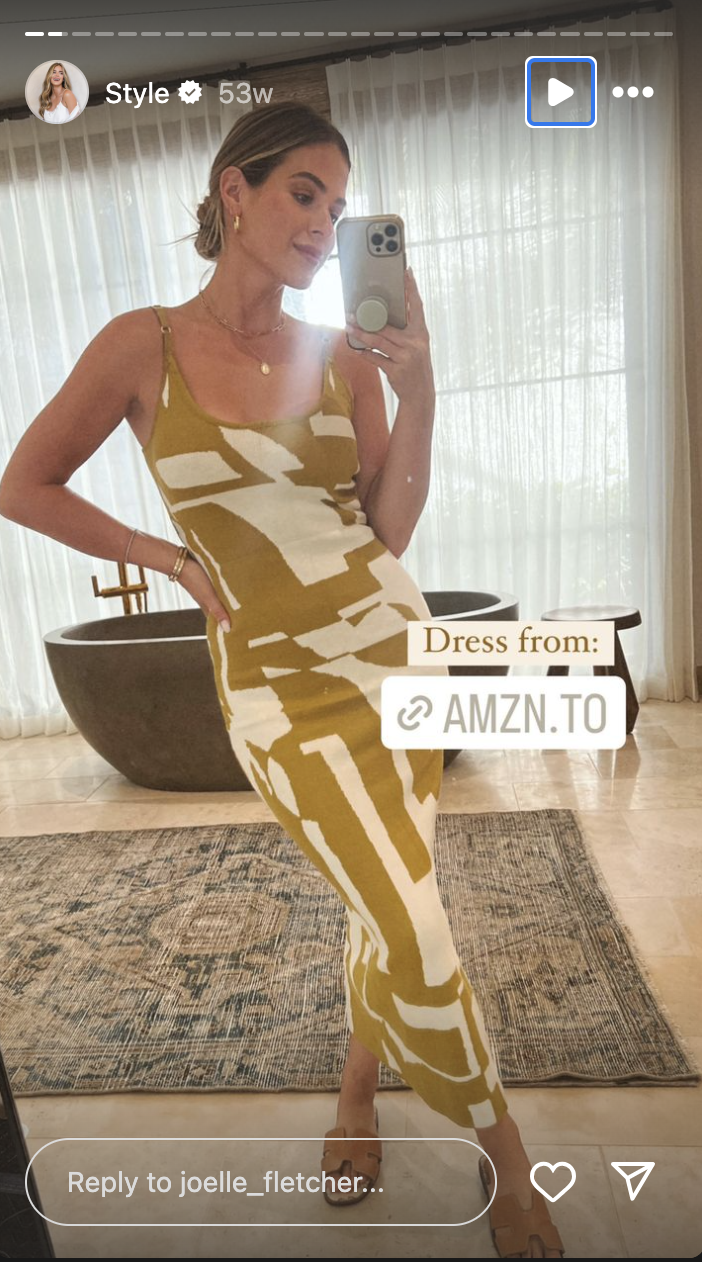
I can personally attest to the power of influencer marketing: Almost daily, I am purchasing B2C products from my latest favorite influencer. Most recently, I’ve bought skincare products, an Amazon head-scratcher, and a daily vitamin supplement — all thanks to influencer marketing.
5. B2C marketers will lean heavily into social selling.
Speaking of my aforementioned online shopping habits: Social selling will be huge in 2024.
In fact, 30% of B2C marketers predict it will be the top trend of the year.
As seen in our Consumer Trends survey, social media is the future of shopping. Within Gen Z, Millennials, and Gen X, social media is the preferred channel for product discovery. Among all consumers, there is a growing number of social media users who buy on social media.
That number is especially high among younger generations, with 27% of millennials and 22% of Gen Z purchasing products directly in-app.
When determining how to sell products on social media, it‘s critical you start with the platforms on which you already have a following. For instance, if your brand sees high engagement on Instagram, it makes sense to start selling your products to your Instagram audience, who’ve already demonstrated interest in your brand.

TikTok Creativity Program: Is it better than the Creator Fund?
Just before the start of 2024, TikTok made a massive change in how the platform pays its creators by replacing the controversial Creator Fund with the new TikTok Creativity Program Beta.
Just before the start of 2024, TikTok made a massive change in how the platform pays its creators by replacing the controversial Creator Fund with the new TikTok Creativity Program Beta.
I wasn‘t surprised the fund was put to rest, considering how many creators expressed frustration over the fund’s payouts. However, I was skeptical of this new pay model, and if you‘re a creator on TikTok, you’re probably side-eyeing it as well.
Well, in case you don‘t know, I’m pretty much HubSpot‘s resident creator economy expert, so it’s my job to keep up with the latest creator trends and happenings.
That said, I‘ve researched and scoured TikTok for reviews of the new program straight from the creators who joined, so I’m prepared to give you a rundown and help you decide if you want to give TikTok Creativity Program Beta a shot.
Let’s dive in.
What is the TikTok Creativity Program?
How to Join TikTok Creative Program Beta
What happened to the Creator Fund?
TikTok Creativity Program Beta Payout
Is the TikTok Creativity Program Better than the Creator Fund?
What is the TikTok Creativity Program?
According to the platform, TikTok Creativity Program Beta is an initiative to reward creators for creating high-quality, original content, and it serves as a monetary incentive for creators who make longer content (over a minute).
TikTok’s website explains, “With Creativity Program Beta, you have the potential to collect rewards as you create and publish longer video content.”
As the name suggests, the program is still in beta mode and is only available in limited regions — the U.S., France, Brazil, Germany, Japan, Korea, and the U.K.
How to Join TikTok Creative Program Beta
To be eligible for the program, you must have an account based in one of the above regions, be at least 18 years old, have no less than 10,000 followers, and have at least 100,000 video views in the last 30 days.
How you enroll in the program depends on whether you‘re already registered in the defunct TikTok Creator Fund. If you’re enrolled in the Creator Fund, you can switch to TikTok Creative Program Beta via the following steps:
- Open the TikTok app and go to your profile.
- Tap the menu button (the three horizontal bars), then tap Settings.
- Tap Creator Tools, then Creator Fund.
- Finally, tap Switch at the bottom of the page.
Pro Tip: Once you join TikTok Creative Program Beta, you cannot switch back to the Creator Fund. But, also … why would you want to? The Creator Fund is dead.
If you‘re not enrolled in the Creator Fund, you’ll follow steps 1-3 but tap Creator Program instead of Creator Fund. You‘ll be notified three days later whether you’ve been accepted into the program.
What happened to the Creator Fund?
Okay, why did the Creator Fund go the way of the dinosaurs? The $2 billion fund was launched in 2020 and was discontinued in December 2023 after many creators criticized the program for low payouts.
In a 2022 interview with Business Insider, wellness influencer Mandana Zarghami said her biggest payout from TikTok was just $24 from a video that garnered 1.1 million views. Her lowest earning day at the time was 5 cents.
Most shocking was when I found out how much (or little) viral content creator John Eringman made from the Creator Fund. When he spoke to Business Insider,
Eringman had 1.3 million views, and at least one of his videos would reach a million-plus views each week.
The most he earned in a single day was $189.13 for a video with 13 million views. However, Eringman reported getting payouts ranging from 67-84 cents and averaging just a few dollars in one month.
In other words, even viral creators like Eringman were getting inconsistent payouts and were not receiving enough to make a living — prompting TikTok to sunset the Creator Fund.
TikTok Creativity Program Beta Payout
So, how much are creators making via the TikTok Creativity Program Beta? While the platform’s website is being hush-hush about exactly how much the new program is rewarding creators, some users are already sharing their experience.
Finance content creator Miki Rai shared that her experience with the program was off to an underwhelming start but improved significantly over time.
“Immediately after I joined (in November 2023), my video views tanked so bad,” Rai explains in a TikTok. Rai believes the tank occurred because her audience was used to her posting short-form videos rather than videos longer than a minute.
Remember that the program only generates revenue if the videos are longer than 60 seconds.
Rai reports only making $146 her first month into the program, even after posting multiple times a day.
“Which makes that less than $5 per video that I made,” she says. Rai’s earnings jumped to $436.76 the following December and about the same in January. But, in February, Rai saw a major difference.
“We’re only halfway through, and so far, I’ve made $1,273.48,” she says in her TikTok. The app projected she’d earn $2288.66 by the end of the month.
Rai says the boost in earnings is likely connected to a couple of her videos going viral that month, one of which earned 3.8 million views. Both videos were over a minute long.
Creator Kait Alayna says she made $629 in one week. That week, daily income ranged from $4.90 to $193.24.
However, it’s important to note some creators, like Rai, have reported a tank in views shortly after joining the program, prompting some users to discourage others from joining the program or dropping out themselves.
That said, the drop in viewers seems temporary as they get used to creators posting longer content.
Is the TikTok Creativity Program Better than the Creator Fund?
In short, I say it‘s definitely better. The program is still fairly new, so there aren’t many reliable statistics comparing the program to the fund.
But, based on videos I’ve seen of creators discussing their payouts, the program seems to be facing less criticism than the Creator Fund.
If you’re a creator used to generating short-form videos under a minute long, then exceeding 60 seconds can pose a challenge. You may also notice at least a temporary drop in views as your audience adjusts to the new direction.
All that aside, I think the program is worth applying if you want to generate income on TikTok. Now, do I think you’ll generate enough income to survive solely off the TikTok Creativity Program — no.
The fact is only 12% of creators make over $50,000 a year, regardless of the platform. The real money comes from brand partnerships, deals, sponsorships, ad revenue, and commissions.
Regarding TikTok, you can generate additional income via TikTok Live and TikTok Shop, as well as the above methods.
My advice, you‘ll stand to benefit in the long run from switching to the new creativity program. Plus, there really isn’t much of a point in sticking to an old fund that was so widely criticized it was discontinued.
Just make sure you have other streams of income, too.

YouTube Competitor Analysis: How I Do It in 5 Easy Steps
YouTube competitor analysis is essential to your video content strategy this year. Take it from me — I lead HubSpot’s YouTube growth strategy, overseeing content strategy, trend monitoring, performance reporting, and competitor analysis.
YouTube competitor analysis is essential to your video content strategy this year. Take it from me — I lead HubSpot’s YouTube growth strategy, overseeing content strategy, trend monitoring, performance reporting, and competitor analysis.
As of 2024, YouTube is the biggest video-sharing platform and the second-biggest social media in the world, with over 2.70 billion users. And believe me, it’s not slowing down anytime soon, the number of YouTube’s global users is estimated to reach 2.85 billion by 2025.
![→ Free Templates: How to Use YouTube for Business [Download Now]](https://no-cache.hubspot.com/cta/default/53/b33cfd44-133a-49e3-a943-086c5679d485.png)
With this ongoing video growth on the horizon, it’s important to assess your competition.
Table of Contents
- What is a competitor analysis on YouTube?
- Why is a YouTube competitor analysis important?
- How to Do Competitor Analysis on YouTube
What is a competitor analysis on YouTube?
Competitor analysis on YouTube involves studying the content created by competitors in your desired niche or subject matter area. These insights help you understand your competitors’ strengths, weaknesses, and strategies.
This analysis can be conducted on a monthly, quarterly, or annual basis. Your goal is to learn what competitors are doing well and to emulate it in your own style.
You’ll also want to figure out what they aren’t doing so you can do it and stand out in the competitive YouTube landscape.
Why is a YouTube competitor analysis important?
Competitor analysis helps you understand the competitive landscape for your target market.
This is crucial in my role because it allows me to gain valuable insights into what other brands are doing on the platform.
By understanding competitors’ strategies, content performance, audience engagement tactics, and overall presence on YouTube, I can identify industry trends and pinpoint areas where content gaps exist.
I can also discover opportunities for improvement, and make informed decisions to stay ahead.
This analysis will help you better understand your audience and create a comprehensive YouTube content strategy.
How to Do Competitor Analysis on YouTube
Step 1: Create a list of your top competitors.
You should start your competitor analysis by identifying five to ten YouTube channels that are competitors.
These competitors can be based on your specific industry (e.g., cosmetics), niche (e.g., clean, cruelty-free cosmetics), and/or target audience (e.g., environmentally conscious cosmetics consumers).
In my experience here at HubSpot, I’ve learned the art of selecting a diverse range of competitors.
This thoughtful approach acknowledges the presence of niche competitors within topics we cover while aligning seamlessly with our channels that may explore broader subjects.
I find these competitors by searching for specific topics I want to cover on YouTube and by finding the top-ranking videos for each search result on YouTube.
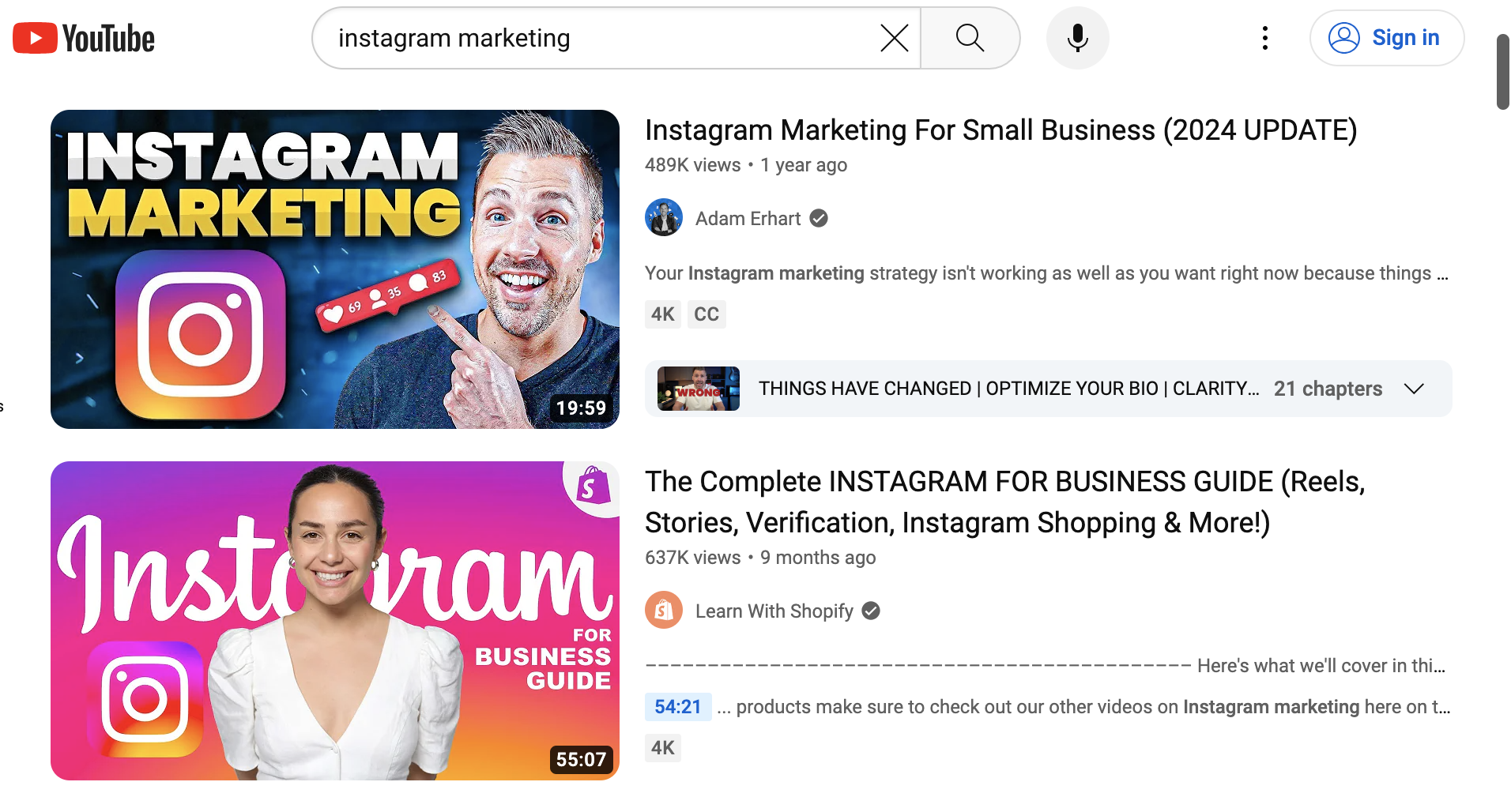
In the example below, you can see the top-ranking results for the topic “Instagram marketing,” based on the results, Adam Erhart and Learn With Shopify may be the current key competitors for this topic.
You can also use YouTube Shorts to identify key competitors.
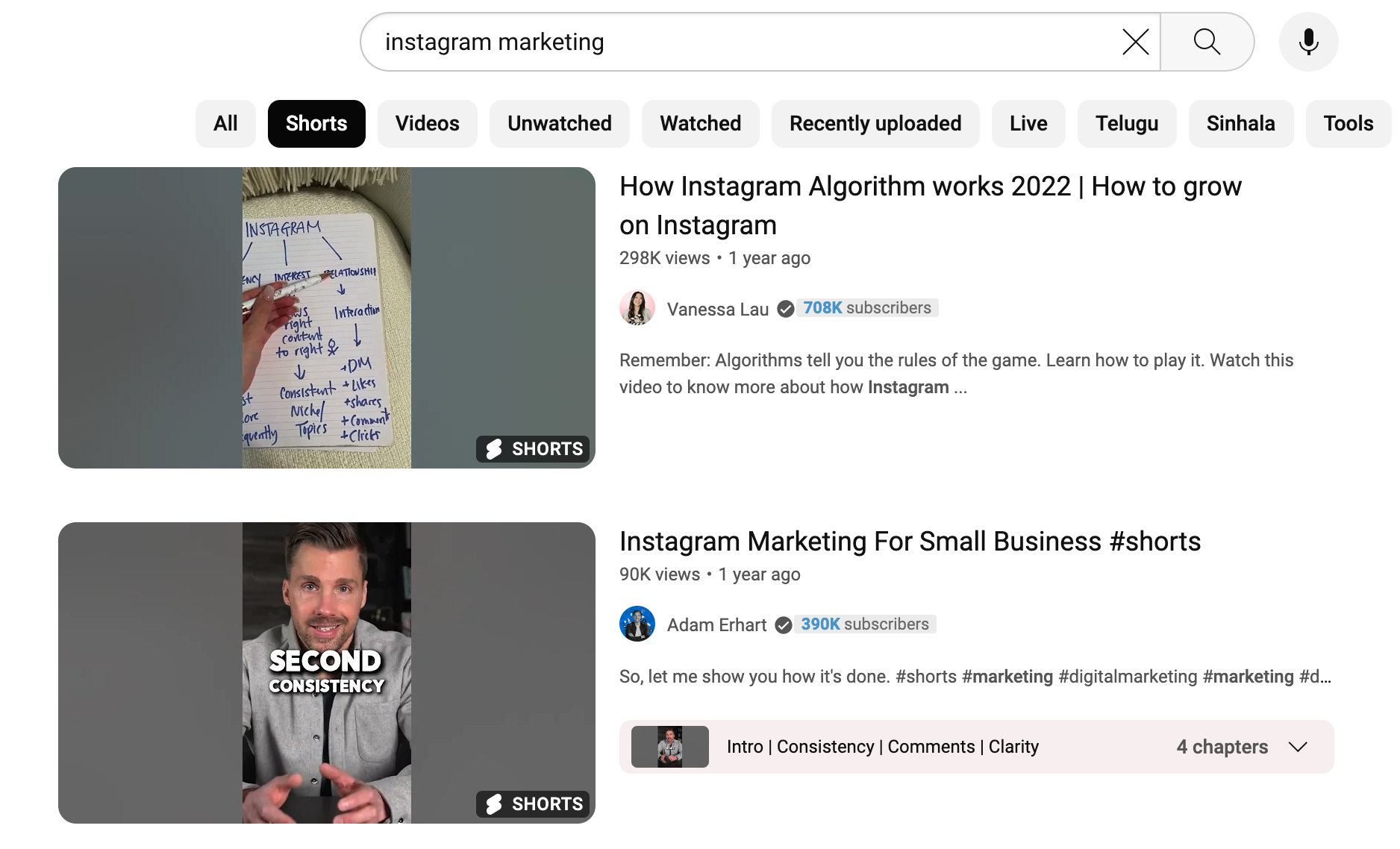
Start by searching for the focus keyword and clicking the “Shorts” tab.
For example, the current top-ranking Shorts competitors for the keyword “Instagram marketing” are Vanessa Lau and Adam Erhart.
Be sure to go to the YouTube creator’s account to review the videos they’ve posted in the past year to ensure that the topics they cover align with the overall content pillars or topics that you intend to cover on your channel.
Step 2: Analyze competitor YouTube videos.
Once you’ve identified 5-10 competitors, it’s time to analyze the content your competitors have published for the year.
For example, I just conducted a 2024 competitor analysis for HubSpot analyzing all the videos created by our competitors in 2023.
I recommend considering the following things when completing a competitor analysis:
- What topics are your competitors discussing?
- What type of videos are they making (tutorials, vlogs, reviews, etc.)?
- How often are they publishing content?
- How long are their videos?
- What are their most popular videos from the past year?
- Do competitors have a video series or recurring theme?
- Are competitors using interactive elements such as polls, clickable links, or end-screen features?
Let’s continue with the Instagram marketing example from Step 1.
Below are examples of data and information you may find from your analysis of top-ranking Instagram marketing competitors:
- Topics discussed: General Instagram marketing, Instagram updates/trends, Instagram marketing tools, Instagram marketing strategy
- Type of videos: Tips, how-to tutorials, explainers
- Publishing cadence: Once per week
- Length of videos: 10-20 minutes
- Popular videos: “Instagram Marketing for Business” / “How to Create a Instagram Content Planner Calendar”
Pro Tip: I like to explore how competitors organize their playlists and video series. I assess the strategy behind grouping certain videos and creating a seamless viewing experience.
And don’t skip out on thumbnail research. I pay attention to the visual style of our competitors’ popular video thumbnails. I also identify trends in design, color schemes, and elements that grab attention.
Once you’ve aggregated this data, you can use it to identify and make note of any recurring themes.
These insights will be instrumental in crafting your content strategy because it will allow you to create content that resonates with your target audience and ensures your channel is competitive with other creators in a similar landscape.
Step 3: Identify SEO keywords and strategies.
Next, it’s time to examine your competitor’s video titles, descriptions, and tags.
This will allow you to understand how your competitors are optimizing their videos for YouTube search.
You can use competitor research in combination with SEO tools like TubeBuddy and VidIQ to review the monthly search volume of the keywords your competitors are using.
Video Titles
For video titles, examine how each competing video is structured and identify any common keywords/phrases. These titles communicate what keywords resonate with your audience and inform their searches on YouTube.
This analysis will inform how you shape your titles to include keywords or phrases that your target audience wants to see.
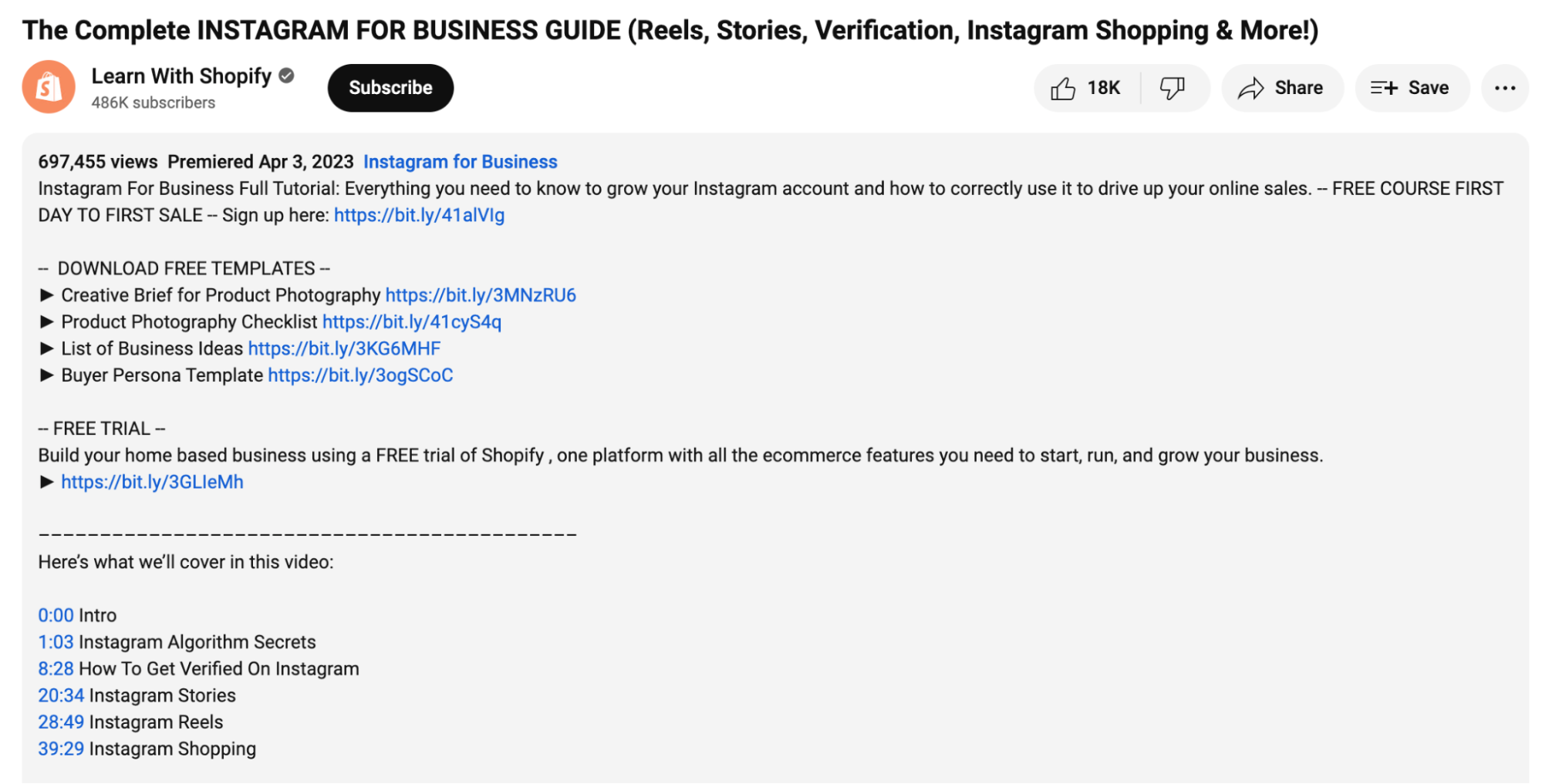
In our Instagram marketing example, the title in the top-ranking video says: “The Complete INSTAGRAM FOR BUSINESS GUIDE (Reels, Stories, Verification, Instagram Shopping & More!)”.
This title includes the focus keyword “Instagram for business” in all caps, it indicates that it is the complete guide, and gives a preview of what will be discussed in the video.
Video Descriptions
For video descriptions, analyze your competitor’s video description based on structure, if/where they include relevant keywords, links, and additional context. This will help develop the framework for your video descriptions.
In our Instagram marketing example, a description from a top-ranking social media marketing competitor may say: “Instagram For Business Tutorial: Grow your Instagram and use it to drive your online sales.”
This indicates that the competitor is using the primary focus word (“Instagram for business”) within the first sentence and tells the viewer exactly what to expect in the video.
Video Tags
For video tags, make note of any tags competitors use to enhance discoverability.
Video tags help categorize your content and indicate to your viewers what your videos are about.
Using the appropriate video tags for your video will best allow YouTube to share your content with viewers who are interested in that content.
In our Instagram marketing example, video tags from a top-ranking Instagram competitor may be: #instagramtutorials #instagramforbusiness.
This communicates to YouTube and the viewer that they will receive information about Instagram, a tutorial, and specifically for businesses.
Pro Tip: Beyond content analysis, I dive into competitors’ audience interactions. I identify recurring keywords in comments and observe how competitors engage. Pinned comments offer valuable insights into favored terms. I then leverage these findings to tailor my engagement strategy.
Step 4: Observe community engagement and audience feedback.
In this step, I like to observe how competitors engage with their YouTube community and how the audience responds to their content.
Community Engagement
Community engagement can help a creator connect with their audience.
You’ll want to look into how your competitors are using community features on YouTube to engage with their viewers.
I look for patterns in how competitors respond to comments, run polls, and address feedback.
Further, you’ll want to keep a close eye on whether your competitors are partnering with other creators to create their content. This will allow you to refine and adapt your community engagement strategy.
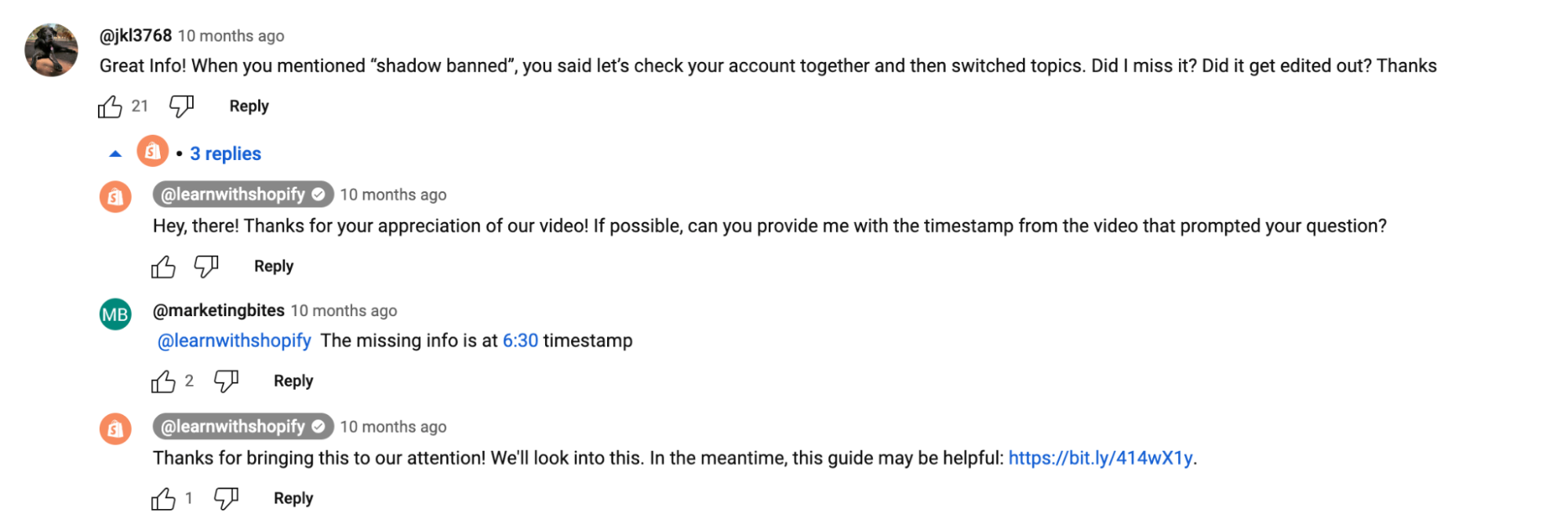
For example, under the “Instagram for business” video a viewer left a comment asking for clarity about a part of the video. Learn with Shopify responded and provided additional resources for the viewer.
This indicates to the Channel’s audience that Learn with Shopify is actively reviewing comments and looking to answer questions and provide educational resources for their audience.
This is something you’ll want to make note of and incorporate into your strategy.
Conversely, if your competitor has several questions under their videos that are left unanswered, that may serve as a point of differentiation for your videos.
You may want to create videos about those unanswered questions, and/or create an engaging presence in your comments to harbor a greater sense of community with your audience.
Audience Feedback
Analyzing the audience interaction on competitor videos such as likes will also allow you to understand how the audience received the video.
For example, if I notice that a video has a lot of views and ranks #1 for the topic, but it has limited likes, this may suggest that the viewers did not enjoy the content that was delivered.
Reviewing comments on competitor videos can give you a lot of helpful insight too. Viewer comments may tell you exactly what they liked or disliked about the video, what they want to see next, and what they wished was included.
These comments can set the stage for what you should include or avoid in your videos.
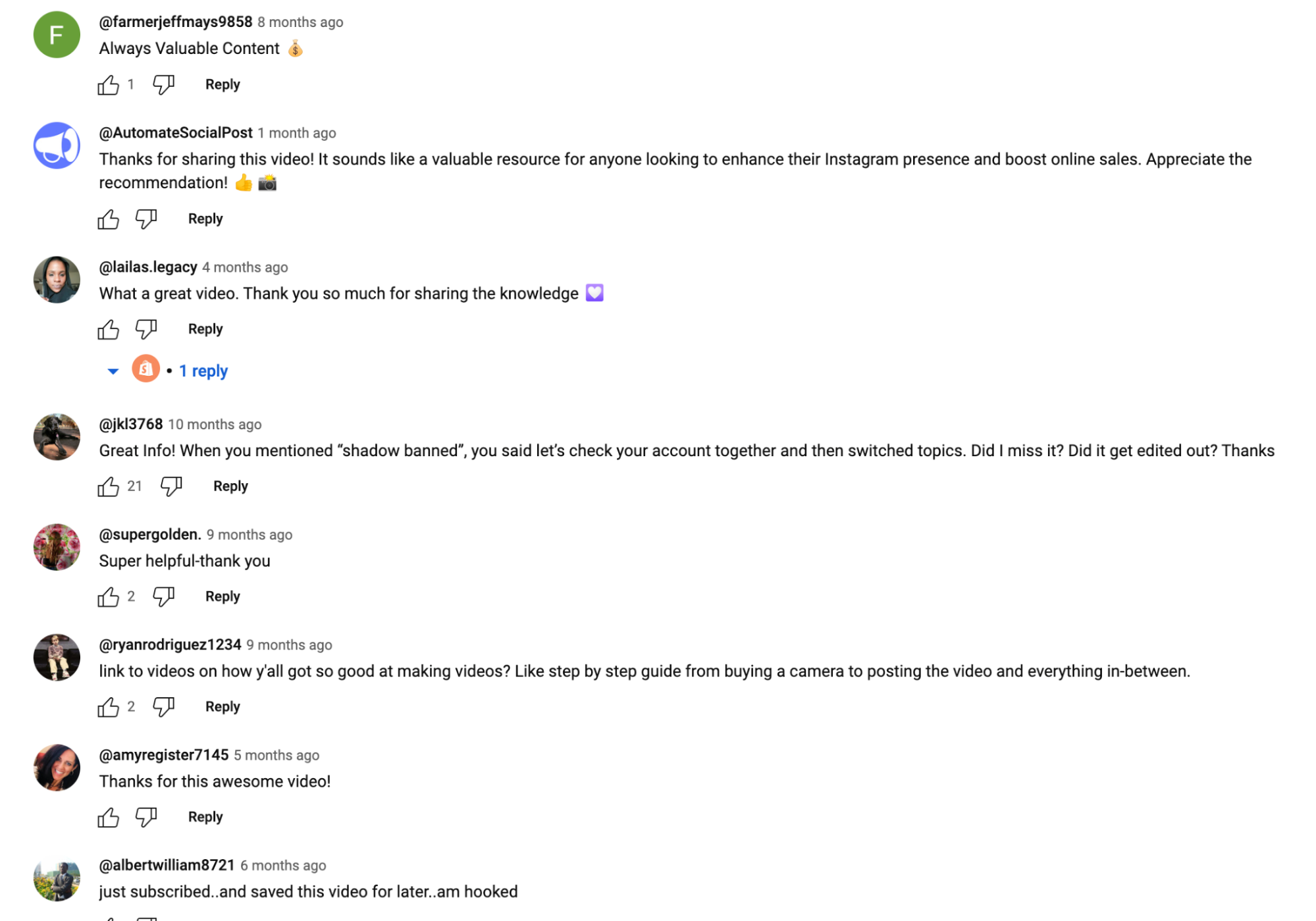
In the example below, under the “Instagram for business” video, viewers left several positive comments about how much they enjoyed the video. This is a great indicator that the video successfully delivered value to viewers.
You can take inspiration from this video by analyzing how the video is structured, how information is presented, the length of the video, along with other insights.
Remember, taking inspiration from a competitor does not mean copying. You want to create original content that delivers value to your audience independently and originally.
Viewers don’t need another video like this, they need something unique.
Further, there is a comment requesting a step-by-step guide on how to create videos. This comment indicates that there is a desire for this type of video.
If it fits your content strategy, this may be a video that you can create for your audience.
Step 5: Identify content gaps and use them to stand out.
It’s time to take all of the competitor insights you’ve found and turn them into content strategies for your YouTube channel.
You’ve evaluated and made note of what your competitors are doing well and where they are falling short. You will try to use what they’re using well as inspiration.
The areas where your competitors are falling short are called content gaps.
To round out our Instagram marketing example, let’s say I noticed that competitors are making long videos without outlined chapters.
This would be a great chance to not only adopt their successful elements but to also enhance the viewer experience by incorporating clear chapter markers.
This strategic differentiation is your key to standing out amidst competitors and delivering more refined and engaging video content.
Pro Tip: I like to explore how competitors use captions and transcriptions. I also assess whether they provide engaging supplementary content. For example, HubSpot provides its viewers with free content offers on the HubSpot Marketing Channel as supplementary educational content.
Level up your content strategy with a competitor analysis.
YouTube competitor research can help take your content strategy to the next level.
Competitor research and analysis serve as a compass for guiding your content strategy, offering insights into trends, audience engagement, and content gaps for opportunity.
These insights lay the foundation for a strong well-informed content strategy.
The digital landscape is continuously evolving and with that it requires us to both remain vigilant and flexible. These competitor insights lay the groundwork for your content strategy, but they are meant to evolve with emerging trends, audience preferences, and platform changes.
While adhering to the framework you’ve outlined from competitor research, you should continue to experiment and test new strategies.
With the combination of competitor insights, experimentation, and monitoring trends, you’ll know how to create content that your audience wants to see.
That’s all from me for now — good luck with your research.

Online Marketing: The Who, What, Why, & How of Digital Marketing
As a millennial marketer, I can tell you quite a bit about the internet — we practically grew up together!As a millennial marketer, I can tell you quite a bit about the internet — we practically grew up together! Not only has a lot changed about the internet since I was an elementary schooler but it’s also changed how we shop, making online marketing crucial for businesses. As of 2024, there are 2.71 billion online shoppers, about a third of the world’s population. So, offline marketing can’t be your only strategy for driving sales because you need to meet audiences where they’re already spending time: on the internet. Enter digital marketing — in other words, any form of online marketing. If you’re curious about the ins and outs of online marketing, you’ve come to the right blogger. I’m here to answer your questions about all things digital marketing. Keep reading to learn more. What is digital marketing? Why is digital marketing important? Types of Digital Marketing What does a digital marketer do? Inbound Marketing vs. Digital Marketing: Which is it? Does digital marketing work for all businesses? How to Do Digital Marketing Digital Marketing Examples So, how do you define digital marketing today? A seasoned inbound marketer might say inbound marketing and digital marketing are virtually the same thing, but trust me when I say there are some minor differences. In conversations with marketers and business owners in the U.S., U.K., Asia, Australia, and New Zealand, I’ve learned a lot about how those small differences are being observed across the world. How does a business define digital marketing? At this stage, digital marketing is vital for your business and brand awareness. It seems like every other brand has a website, and if they don’t, they at least have a social media presence or digital ad strategy. Don’t believe me? Well, our 2024 State of Marketing Survey found that Social media is the highest ROI marketing channel and will see the most growth in 2024. Digital content and marketing are so common that consumers now expect and rely on it as a way to learn about brands. Because digital marketing has so many possibilities, you can get creative and experiment with a variety of marketing tactics on a budget. Overall, digital marketing is defined by using numerous digital tactics and channels to connect with customers where they spend much of their time: online. The best digital marketers have a clear picture of how each digital marketing campaign supports their overarching goals. And depending on the goals of their marketing strategy, marketers can support a larger campaign through the free and paid channels at their disposal. A content marketer, for example, could create a series of blog posts that generate leads from an ebook. A social media marketer might help promote those blogs through paid and organic posts on the business’s social media accounts, and the email marketer could create an email campaign to send those who download the ebook more information on the company. I’ll talk more about these specific digital marketers in a minute. There are a few major benefits of digital marketing: You can focus your efforts on only the prospects most likely to purchase your product or service. It’s more cost-effective than outbound marketing methods. Digital marketing evens the playing field within your industry and allows you to compete with bigger brands. Digital marketing is measurable. It’s easier to adapt and change a digital marketing strategy. Digital marketing can improve your conversion rate and the quality of your leads. You can engage audiences at every stage with digital marketing. Let’s dive deeper. 1. You can focus your efforts on only the prospects most likely to purchase your product or service. If you place an advertisement on TV, in a magazine, or on a billboard, you have limited control over who sees the ad. Of course, you can measure certain demographics — including the magazine’s typical readership or the demographic of a certain neighborhood — but it’s still largely a shot in the dark. Digital marketing allows you to identify and target a highly-specific audience with personalized and high-converting marketing messages. For instance, you might use social media targeting to show ads to a certain audience based on variables like age, gender, location, interests, networks, or behaviors. Alternatively, you might use PPC or SEO strategies to serve ads to users who’ve shown interest in or searched for specific keywords related to your product, service, or industry. Ultimately, digital marketing helps you conduct the research necessary to identify your buyer personas and refine your strategy to ensure you’re reaching prospects most likely to buy. 2. It’s more cost-effective than outbound marketing methods. Digital marketing helps you track day-to-day campaign performance, so you know what channels are performing well and which aren’t, helping you optimize your campaign budgets for high ROI. The same can’t be said for traditional forms of advertising. It doesn’t matter how your billboard performs — it still costs the same, even if it doesn’t convert. Plus, with digital marketing, you have complete control over where you choose to spend your money. Perhaps you spend money on design software to create high-converting Instagram content rather than paying for PPC campaigns. A digital marketing strategy allows you to pivot continuously, ensuring you never waste money on channels that don’t perform well. By and large, digital marketing is a more cost-effective solution and provides unique opportunities to ensure you get the most bang for your buck. For instance, if you work for a small business with a limited budget, you might try investing in social media, blogging, or SEO – three strategies that can give you high ROI even with minimal spending. 3. Online marketing evens the playing field within your industry and allows you to compete with bigger brands. If you work for a small business, it’s likely difficult for you to compete with the major brands in your industry, many of which have millions of dollars to invest in campaigns. Fortunately, there are plenty of opportunities to outrank the big players through strategic digital marketing initiatives. For instance, you might use long-tail keywords to create high-quality content that ranks on search engines. Search engines don’t care which brand is the biggest, but it does care about prioritizing content that resonates best with target audiences. 4. Digital marketing is measurable. While traditional advertising can be helpful for specific goals, its biggest limitation is measurability. This is one of the biggest benefits of digital marketing, as it can give you a start-to-finish view of all the metrics that matter to your company — including impressions, shares, views, clicks, and time on page. Unlike most offline marketing efforts, digital marketing allows marketers to see accurate results in real-time. If you’ve ever put an advertisement in a newspaper, you’ll know how difficult it is to estimate how many people flipped to that page and paid attention to it. There’s no surefire way to know if that ad was responsible for any sales at all. On the other hand, with digital marketing, you can measure the ROI of pretty much any aspect of your marketing efforts. Here are some examples: Website Traffic With digital marketing, you can see the exact number of people who have viewed your website’s homepage in real-time by using digital analytics software available in marketing platforms like HubSpot. You can also see how many pages they visited, what device they were using, and where they came from, amongst other digital analytics data. This intelligence helps you prioritize which marketing channels to spend more or less time on based on the number of people those channels drive to your website. For example, if only 10% of your traffic is coming from organic search, you know that you probably need to spend some time on SEO to increase that percentage. With offline marketing, it can be difficult to tell how people interact with your brand before they interact with a salesperson or make a purchase. With digital marketing, you can identify trends and patterns in people’s behavior before they’ve reached the final stage in their buyer’s journey, meaning you can make more informed decisions about how to attract them to your website right at the top of the marketing funnel. Content Performance and Lead Generation Imagine you’ve created a product brochure and posted it through people’s letterboxes — that brochure is a form of offline content. The problem is that you have no idea how many people opened your brochure or threw it straight into the trash. Instead, imagine you have that brochure on your website. You can measure exactly how many people viewed the page it’s on, and you can use a form to collect the contact information of those who downloaded it. It’s twofold: you measure how many people engage with your content and generate qualified leads when people download it. Attribution Modeling An effective digital marketing strategy combined with the right tools and technologies allows you to trace all of your sales back to a customer’s first digital touchpoint with your business. We call this attribution modeling, and it allows you to identify trends in the way people research and buy your product, helping you to make more informed decisions about what parts of your marketing strategy deserve more attention, and what parts of your sales cycle need refining. Connecting the dots between marketing and sales is hugely important. According to LinkedIn, 87% of sales and marketing leaders say collaboration between sales and marketing enables critical business growth, but misalignment between both teams can damage financial performance. If you can improve your customer’s journey through the buying cycle by using digital technologies, then it’s likely to reflect positively on your business’s bottom line. 5. It’s easier to adapt and change an online marketing strategy. A lot of work goes into developing a marketing strategy. Generally, you will follow through with that strategy until completion, allow it to take effect, and then judge its results. However, things do not always go according to plan. You may realize halfway through that a calculation was off, an assumption was incorrect, or an audience did not react how they were expected to. Being able to pivot or adjust the strategy along the way is highly beneficial because it prevents you from having to start over completely. Being able to change your strategy easily is a great benefit of digital marketing. Adapting a digital marketing strategy is a lot easier than other, more traditional forms of marketing, like mailers or billboard advertising. For instance, if an online ad isn’t delivering as expected, you can quickly adjust it or pause it to yield better results. 6. Online marketing can improve your conversion rate and the quality of your leads. As digital marketing makes it simpler to measure your marketing efforts, this makes improving your conversion rate simpler as well. Being able to measure the effectiveness of each tactic helps you develop better strategies. Continuously refining your methods improves your conversion rate. Investing in online marketing ensures that everything is optimized for the highest amount of conversions. Additionally, all leads do not offer the same value for your business. Digital marketing allows you to target a specific audience that will yield higher-quality leads that are more likely to become customers. Connecting your business with the most valuable leads will directly improve your conversion rate. 7. You can engage audiences at every stage with digital marketing. It’s essential to begin engaging your audience as early as possible. Making a connection at the first stage of the buyer’s journey helps push the lead through the customer funnel. Using digital marketing allows you to accomplish that from start to finish and at every point in between. Online channels allow you to follow the entire buying journey of your customers. Understanding and analyzing how customers are move and operate is important for converting leads. Digital marketing allows you to track them through that process. And, even if they don’t convert in the early stages, it at least helps ensure they have made a connection with your business. Here’s a quick rundown of some of the most common digital marketing tactics and the channels involved in each one. 1. Search Engine Optimization (SEO) This is the process of optimizing your website to “rank” higher in search engine results pages, thereby increasing the amount of organic (or free) traffic your website receives. The channels that benefit from SEO include websites, blogs, and infographics. There are a number of ways to approach SEO in order to generate qualified traffic to your website. These include: On-page SEO: This type of SEO focuses on all of the content that exists “on the page” when looking at a website. By researching keywords for their search volume and intent (or meaning), you can answer questions for readers and rank higher on the search engine results pages (SERPs) those questions produce. Off page SEO: This type of SEO focuses on all of the activity that takes place “off the page” when looking to optimize your website. “What activity not on my own website could affect my ranking?” You might ask. The answer is inbound links, also known as backlinks. The number of publishers that link to you, and the relative “authority” of those publishers, affect how highly you rank for the keywords you care about. By networking with other publishers, writing guest posts on these websites (and linking back to your website), and generating external attention, you can earn the backlinks you need to move your website up on all the right SERPs. Technical SEO: This type of SEO focuses on the backend of your website, and how your pages are coded. Image compression, structured data, and CSS file optimization are all forms of technical SEO that can increase your website’s loading speed — an important ranking factor in the eyes of search engines like Google. For a real-life example on how to successfully implement SEO into your digital marketing strategy, check out our case study on Canva here: 2. Content Marketing This term denotes the creation and promotion of content assets for the purpose of generating brand awareness, traffic growth, lead generation, and customers. Want to learn and apply content marketing to your business? Check out HubSpot Academy’s free content marketing training resource page. The channels that can play a part in your content marketing strategy include: Blog posts: Writing and publishing articles on a company blog helps you demonstrate your industry expertise and generates organic search traffic for your business. This ultimately gives you more opportunities to convert website visitors into leads for your sales team. Ebooks and whitepapers: Ebooks, whitepapers, and similar long-form content helps further educate website visitors. It also allows you to exchange content for a reader’s contact information, generating leads for your company and moving people through the buyer’s journey. Infographics: Sometimes, readers want you to show, not tell. Infographics are a form of visual content that helps website visitors visualize a concept you want to help them learn. Audio or visual content: Television and radio are popular channels for digital marketing. Creating content that can be shared online as a video or heard on the radio by listeners can greatly broaden your potential audience. Stumped? Download 150+ content creation templates by clicking below: Download These Templates 3. Social Media Marketing This practice promotes your brand and your content on social media channels to increase brand awareness, drive traffic, and generate leads for your business. If you’re new to social platforms, you can use tools like HubSpot to connect channels like LinkedIn and Facebook in one place. This way, you can easily schedule content for multiple channels at once and monitor analytics from the platform as well. On top of connecting social accounts for posting purposes, you can also integrate your social media inboxes into HubSpot, so you can get your direct messages in one place. The channels you can use in social media marketing include: Facebook Twitter LinkedIn Instagram Snapchat Pinterest Many marketers will use these social media platforms to create a viral campaign. Partnering with a popular content creator or taking part in a trend that resonates with a wide audience is a viral marketing strategy. The purpose is to create something shareworthy in the hopes that it will organically spread across a social media channel. Don’t know how to get started with social media marketing? Download our free social media content calendar to get your social strategy up and running. Download These Templates 4. Pay Per Click (PPC) PPC drives traffic to your website by paying a publisher every time your ad is clicked. One of the most common types of PPC is Google Ads, which allows you to pay for top slots on Google’s search engine results pages at a price “per click” of the links you place. Other channels where you can use PPC include: Paid ads on Facebook: Here, users can pay to customize a video, image post, or slideshow, which Facebook will publish to the news feeds of people who match your business’s audience. Twitter Ads campaigns: Here, users can pay to place a series of posts or profile badges to the news feeds of a specific audience, all dedicated to accomplishing a specific goal for your business. This goal can be website traffic, more Twitter followers, tweet engagement, or even app downloads. Sponsored Messages on LinkedIn: Here, users can pay to send messages directly to specific LinkedIn users based on their industry and background. PPC can be hard to grasp at first, so we’ve created a beginner-friendly guide to get you started. Download it below: Download This Guide 5. Affiliate Marketing This is a type of performance-based advertising where you receive a commission for promoting someone else’s products or services on your website. Affiliate marketing channels include: Hosting video ads through the YouTube Partner Program. Posting affiliate links from your social media accounts. This is part of the relatively new wave of influencer marketing. Creating a campaign using influencers can be a highly effective form of affiliate marketing. Finding the right content creators can take your digital campaign to the next level. 6. Native Advertising Native advertising refers to advertisements that are primarily content-led and featured on a platform alongside other, non-paid content. BuzzFeed-sponsored posts are a good example, but many people also consider social media advertising to be “native” — Facebook advertising and Instagram advertising, for example. 7. Marketing Automation Marketing automation refers to the software that automates your basic marketing operations. Many marketing departments can automate repetitive tasks they would otherwise do manually, such as: Email newsletters: Email automation doesn’t just allow you to automatically send emails to your subscribers. It can also help you shrink and expand your contact list as needed so your newsletters are only going to the people who want to see them in their inboxes. Social media post scheduling: If you want to grow your organization’s presence on a social network, you need to post frequently. This makes manual posting a bit of an unruly process. Social media scheduling tools push your content to your social media channels for you, so you can spend more time focusing on content strategy. Lead-nurturing workflows: Generating leads, and converting those leads into customers, can be a long process.You can automate that process by sending leads specific emails and content once they fit certain criteria, such as when they download and open an ebook. Campaign tracking and reporting: Marketing campaigns can include a ton of different people, emails, content, webpages, phone calls, and more. Marketing automation can help you sort everything you work on by the campaign it’s serving and then track the performance of that campaign based on the progress all of these components make over time. 8. Email Marketing Companies use email marketing as a way of communicating with their audiences. Email is often used to promote content, discounts and events, as well as to direct people toward the business’s website. The types of emails you might send in an email marketing campaign include: Blog subscription newsletters. Follow-up emails to website visitors who downloaded something. Customer welcome emails. Holiday promotions to loyalty program members. Tips or similar series emails for customer nurturing. Learn more about email marketing with our free guide: Download This Guide 9. Online PR Online PR is the practice of securing earned online coverage with digital publications, blogs, and other content-based websites. It’s much like traditional PR but in the online space. The channels you can use to maximize your PR efforts include: Reporter outreach via social media: Talking to journalists on Twitter, for example, is a great way to develop a relationship with the press that produces earned media opportunities for your company. Engaging online reviews of your company: When someone reviews your company online, whether that review is good or bad, your instinct might be not to touch it. On the contrary, engaging company reviews helps you humanize your brand and deliver powerful messaging that protects your reputation. Engaging comments on your personal website or blog: Similar to how you’d respond to reviews of your company, responding to the people reading your content is the best way to generate productive conversation around your industry. If you don’t have a dedicated PR team, it can be hard to get started. Luckily, we’ve got you covered. Download our free PR kit below: Download This Guide 10. Inbound Marketing Inbound marketing refers to a marketing methodology wherein you attract, engage, and delight customers at every stage of the buyer’s journey. You can use every digital marketing tactic listed above throughout an inbound marketing strategy to create a customer experience that works with the customer, not against them. Here are some classic examples of inbound marketing versus traditional marketing: Blogging vs. pop-up ads Video marketing vs. commercial advertising Email contact lists vs. email spam 11. Sponsored Content With sponsored content, you, as a brand, pay another company or entity to create and promote content that discusses your brand or service in some way. One popular type of sponsored content is influencer marketing. With this type of sponsored content, a brand sponsors an influencer in its industry to publish posts or videos related to the company on social media. Another type of sponsored content could be a blog post or article highlighting a topic, service, or brand. 12. Search Engine Marketing (SEM) When a potential lead is searching for a product or business related to yours, it’s a great opportunity for a promotion. Paid advertising and SEO are two great strategies for promoting your business to capitalize on those future leads. Search engine marketing is another way to increase website traffic by placing paid ads on search engines. The two most popular SEM services are Bing Ads and Google Ads. These paid ads fit seamlessly on the top of search engine results pages, giving instant visibility. This is also an example of effective native advertising. 13. Instant Messaging Marketing Marketing your products through messaging platforms is a fast way to reach potential leads, even for those who haven’t offered up their cell phone number. It’s a simple way to let your audience know about flash sales, new products, or updates about their orders. If your customers have questions or need more information, it’s also a convenient way for them to connect to customer service. You can send messages directly to a mobile phone via text or on platforms like Facebook Messenger or WhatsApp. The digital marketer focuses on each channel’s key performance indicators (KPIs) to properly measure performance. For example, a digital marketer in charge of SEO might measure their website’s organic traffic. At small companies, one person might own many digital channels and tactics described above, while larger companies typically have a specialist focused on one or two brand channels. Here are some examples of these specialists: SEO Manager Main KPIs: Organic traffic SEO managers work to rank a business on Google SERPs. Using various SEO strategies, this person might work directly with content creators to ensure the content is high-quality and up to Google’s standards, even if the company also posts this content on social media. Content Marketing Specialist Main KPIs: Time on page, overall blog traffic, YouTube channel subscribers Content marketing specialists are digital content creators. They might keep track of a blogging calendar, or develop a content strategy that includes video. They often work with people in other departments to ensure products and campaigns are supported by promotional content on all digital channels. Social Media Manager Main KPIs: Follows, Impressions, Shares A social media manager’s role depends on each company and industry. But above all, social media managers manage social media by establishing a posting schedule for the company’s written and visual content. They might also work with a content marketing specialist to develop a strategy for which content to share on social media. (Note: Per the KPIs above, “impressions” refers to the number of times a business’s posts appear on the newsfeed of a user.) Marketing Automation Coordinator Main KPIs: Email open rate, campaign click-through rate, lead-generation (conversion) rate A marketing automation coordinator helps choose and manage the software a marketing team uses to understand customer behavior and measure business growth. Many of the marketing operations described above might be executed separately, so it’s important for there to be someone who can group these activities into individual campaigns and track performance. Inbound Marketing vs. Digital Marketing: Which Is It? Inbound marketing is a methodology that uses digital marketing assets to attract, engage, and delight customers online. Digital marketing, on the other hand, is simply an umbrella term to describe online marketing tactics of any kind, regardless of whether they’re considered inbound or outbound. Digital marketing is often compared to inbound marketing, but it doesn’t differentiate between ‘inbound’ and ‘outbound’ methods. It’s more of an umbrella term for all marketing that involves digital communication, while inbound marketing is more of a strategy. Digital outbound tactics put a marketing message in front of as many people as possible online — regardless of whether it’s relevant or welcomed. For example, the garish banner ads you see on websites that push a product or promotion to people who aren’t necessarily ready to receive it. Marketers who employ digital inbound tactics use online content to attract their target customers by providing assets that are helpful to them. One of the simplest yet most powerful inbound digital marketing assets is a blog, which allows your website to capitalize on the terms which your ideal customers are searching for. Does online marketing work for all businesses? Digital marketing can work for any business in any industry. Regardless of what your company sells, digital marketing still involves building buyer personas to identify your audience’s needs, and creating valuable online content. However, that’s not to say all businesses should implement a digital marketing strategy in the same way. B2B Digital Marketing If your company is business-to-business (B2B), your digital marketing efforts are likely centered around online lead generation, with the end goal being for someone to speak to a salesperson. The goal of your marketing strategy might be to attract and convert the highest quality leads for your salespeople via your website and to support digital channels. Beyond your website, you’ll probably choose to focus your efforts on business-focused channels like LinkedIn, where your demographic is spending their time online. B2C Digital Marketing If your company is business-to-consumer (B2C), depending on the price point of your products, it’s likely that the goal of your digital marketing efforts is to attract people to your website and have them become customers without ever needing to speak to a salesperson. You’re probably less likely to focus on ‘leads’ in their traditional sense and more likely to build an accelerated buyer’s journey from when someone lands on your website to when they make a purchase. This can mean that your product features are higher up in the marketing funnel than it might be for a B2B business, and you might need to use stronger calls-to-action to inspire purchases. For B2C companies, channels like Instagram and Pinterest are often more valuable than business-focused platforms like LinkedIn. What types of digital content should I create? The kind of content you create depends on your audience’s needs at different stages in the buyer’s journey. You should start by creating buyer personas (use these free templates, or try makemypersona.com) to identify what your audience’s goals and challenges are in relation to your business. On a basic level, your online content should aim to help them meet these goals, and overcome their challenges. Then, you’ll need to consider when they’re most likely to be ready to consume this content in line with their stage in the buyer’s journey. We call this content mapping. With content mapping, the goal is to target content according to: The characteristics of the person who will be consuming it (that’s where buyer personas come in). How close that person is to making a purchase (i.e., their lifecycle stage). In terms of the format of your content, there are a lot of different things to try. Here are some options we’d recommend using at each stage of the buyer’s journey: Awareness Stage Blog posts. Great for increasing your organic traffic when paired with a strong SEO and keyword strategy. Infographics. Very shareable, meaning they increase your chances of being found via social media when others share your content. (Check out these free infographic templates to get you started.) Short videos. Again, these are very shareable and can help your brand get found by new audiences by hosting them on platforms like YouTube. Consideration Stage Ebooks. Great for lead generation as they’re generally more comprehensive than a blog post or infographic, meaning someone is more likely to exchange their contact information to receive it. Research reports. Again, this high-value content type is great for lead generation. Research reports and new data for your industry can also work for the awareness stage, though, as they’re often picked up by the media or industry press. Webinars. As they’re a more detailed, interactive form of video content, webinars are an effective consideration stage content format as they offer more comprehensive content than a blog post or short video. Decision Stage Case studies. Having detailed case studies on your website can be an effective form of content for those ready to make a purchasing decision, as it helps you positively influence their decision. Testimonials. If case studies aren’t a good fit for your business, having short testimonials around your website is a good alternative. For B2C brands, think of testimonials a little more loosely. If you’re a clothing brand, these might take the form of photos of how other people styled a shirt or dress, pulled from a branded hashtag where people can contribute. 1. Define your goals. When you get started with digital marketing, it’s critical to identify and define your goals since you’ll craft your strategy with them. For instance, if your goal is to increase brand awareness, you might want to focus on reaching new audiences via social media. Or maybe you want to increase sales on a specific product — if that’s the case, it’s more important you focus on SEO and optimizing content to get potential buyers on your website in the first place. Additionally, if sales are your goal, you might test out PPC campaigns to drive traffic through paid ads. Whatever the case, it’s easiest to shape a digital marketing strategy after you’ve determined your company’s biggest goals. 2. Identify your target audience. We’ve mentioned this before, but one of the biggest benefits of digital marketing is the opportunity to target specific audiences – however, you can’t take advantage of that benefit if you haven’t first identified your target audience. Of course, it’s important to note your target audience might vary depending on the channel or goal(s) you have for a specific product or campaign. For instance, perhaps you’ve noticed most of your Instagram audience is younger and prefers funny memes and quick videos — but your LinkedIn audience is older professionals looking for more tactical advice. You’ll want to vary your content to appeal to these different target audiences. If you’re starting from scratch, feel free to take a look at How to Find Your Target Audience. 3. Establish a budget for each digital channel. Your budget will depend on the elements of digital marketing you use. If you’re focusing on inbound techniques like SEO, social media, and content creation for a pre-existing website, the good news is you don’t need a big budget at all. You can aim to create high-quality content your audience will want to consume, where the only investment you’ll need is your time. You can get started by hosting a website and creating content using HubSpot’s CMS. For those on a tight budget, you can get started using WordPress hosted on WP Engine, using a simple theme from StudioPress, and building your site without code using the Elementor Website Builder for WordPress. With outbound techniques like online advertising and purchasing email lists, there is undoubtedly some expense. What it costs comes down to what kind of visibility you want to receive as a result of the advertising. For example, to implement PPC using Google AdWords, you’ll bid against other companies in your industry to appear at the top of Google’s search results for keywords associated with your business. Depending on the keyword’s competitiveness, this can be reasonably affordable or extremely expensive, which is why it’s a good idea to focus on building your organic reach too. 4. Strike a good balance between paid and free digital strategies. A digital marketing strategy likely needs both paid and free aspects to truly be effective. For instance, spending time building comprehensive buyer personas to identify your audience’s needs and creating high-quality online content that converts them, you’ll likely see strong results despite minimal ad spend. However, if paid advertising is part of your digital strategy, then the results might come even quicker. Ultimately, aim to build your organic (or ‘free’) reach using content, SEO, and social media for more long-term, sustainable success. When in doubt, try both, and iterate on your process as you learn which channels — paid or free – perform best for your brand. 5. Create engaging content. Once you know your audience and have a budget, it’s time to start creating content for the various channels you will use. This content can be social media posts, blog posts, PPC ads, sponsored content, email marketing newsletters, and more. Of course, any content you create should be interesting and engaging to your audience because the point of marketing content is to increase brand awareness and improve lead generation. 6. Optimize your digital assets for mobile. Another key component of digital marketing is mobile marketing. In fact, smartphone usage as a whole accounts for 69% of time spent consuming digital media in the U.S., while desktop-based digital media consumption makes up less than half — and the U.S. still isn’t mobile’s biggest fan compared to other countries. This means optimize your digital ads, web pages, social media images, and other digital assets for mobile devices is essential. If your company has a mobile app that enables users to engage with your brand or shop for your products, your app falls under the digital marketing umbrella, too. Those engaging with your company ovia mobile devices need to have the same positive experience as they would on a desktop. This means implementing a mobile-friendly or responsive website design to make browsing user-friendly on mobile devices. It might also mean reducing the length of your lead generation forms to create a hassle-free experience for people downloading your content on the go. As for your social media images, it’s important to always have a mobile user in mind when creating them, as image dimensions are smaller on mobile devices and text can be cut-off. There are lots of ways you can optimize your digital marketing assets for mobile users, and when implementing any digital marketing strategy, it’s hugely important to consider how the experience will translate on mobile devices. By ensuring this is always front-of-mind, you’ll be creating digital experiences that work for your audience, and consequently achieve the results you’re hoping for. 7. Conduct keyword research. Digital marketing is all about reaching targeted audiences through personalized content — all of which can’t happen without effective keyword research. Conducting keyword research is critical for optimizing your website and content for SEO and ensuring people can find your business through search engines. Additionally, social media keyword research can also help market your products or services on various social channels. You’ll still want to conduct keyword research even if you don’t have a full-time SEO strategist. Try creating a list of high-performing keywords related to your products or services, and consider long-tail variations for added opportunities. 8. Iterate based on the analytics you measure. Finally, to create an effective digital marketing strategy for the long term, it’s vital your team learn how to pivot based on analytics. For instance, perhaps after a couple of months you find your audience isn’t as interested in your content on Instagram anymore — but they love what you’re creating on Twitter. Sure, this might be an opportunity to re-examine your Instagram strategy as a whole, but it might also be a sign that your audience prefers a different channel to consume branded content. Alternatively, perhaps you find an older web page isn’t getting the traffic it used to. You might consider updating the page or getting rid of it entirely to ensure visitors are finding the freshest, most relevant content for their needs. Digital marketing provides businesses with incredibly flexible opportunities for continuous growth — but it’s up to you to take advantage of them. I’m ready to try online marketing. Now what? If you’re already doing digital marketing, you’re likely reaching some segments of your audience online. No doubt you can think of some areas of your strategy that could use a little improvement, though. That’s why we created a step-by-step guide to help you build a digital marketing strategy that’s truly effective, whether you’re a complete beginner or have a little more experience. Next, let’s look at some examples of digital marketing that will be sure to inspire you. 1. Lego’s Rebuild the World Campaign Image Source This is a great example of a digital marketing campaign because it says something about the brand. In this campaign, Lego takes a stance on important global issues as a way to connect with its audience. Nowadays, it’s becoming increasingly important for companies to discuss global issues and show alignment with their customers in that way. The major play of this campaign is to help share the brand’s story and messaging. Given that 82% of customers shop from brands that share their values, this was a good move for the toy brand. Pro-Tip: Consider a cause or concern important to your target audience. Then find a way to incorporate your stance on the matter in your marketing to show viewers that you share in their values. 2. Dove’s Reverse Selfie Campaign Image Source As we continue to learn how social media affects children, especially young girls, Dove decided to send a message. The Reverse Selfie campaign shows the reverse of what a teen girl did to prepare for a selfie and photoshop the picture. The purpose is to increase awareness of how social media can negatively impact self-esteem. This is an excellent example of what marketing content can look like when you know your audience intimately. By knowing its audience of real women, many of them parents, Dove was able to bring light to an often overlooked consequence of the growth of social media. What I Like: Dove’s campaign shows the importance of knowing your audience to create relatable, understandable, and compelling content. 3. Jennifer Lopez’s #InTheMorningChallenge Image Source In this social media campaign, Jennifer Lopez created a dance challenge to promote her new song. With this challenge, fans would do the same dance in their pajamas and in dress up clothes. This was a successful social media campaign as the video had over 16 million views and over 5,000 posts. Using social media is a great way to engage your audience and get them to participate with your brand one-on-one. What I Like: The #InTheMorningChallenge is a great example of a challenge that is fun and simple enough for fans to participate in on their own. When creating a challenge or trend to promote your brand, remember K.I.S.S. (Keep It Simple Sweetheart). 4. Always’ #DayoftheGirl Campaign Image Source This is another digital campaign focused on emotional marketing. With this campaign, Always asked their own employees what tips they would give to girls. T he women offer their valuable insight in a way meant to inspire everyone for International Day of the Girl, an international holiday that occurs annually in October. Again, this isn’t a campaign where the product is mentioned much, but that isn’t the point. The point of this digital campaign was to inspire its audience. What I Like: With that message, they could reach even more people, increase brand awareness, and show their audience that the brand aligns with their values. 5. Topicals – Email Marketing Topicals, a skincare company, uses email marketing as part of a digital marketing strategy. The image below displays a marketing email that advertises a subscribe and save deal, where people get 20% off refills if they choose to subscribe. Image Source Pro-Tip: Notice how Topicals uses bold letters and colors to emphasize their deals and CTA button. Make sure to do the same in your own emails. 6. Ashley White – Affiliate Marketing Ashley White is an esthetician who uses affiliate marketing. In her Twitter profile, she includes a link to a personal Linktree page where she shares referral codes and discounts for people that shop with her codes and links. Image Source What I Like: As she markets herself as an ambassador for these companies, the businesses generate brand awareness as someone visiting her Linktree might be inspired to try a new brand (and an influencer recommendation can make this inspiration even more powerful). 7. Samsonite – Search Engine Marketing Search engine marketing is a great example of digital marketing, where brands bid on keywords and showcase ads for their products in SERPs when someone queries a related keyword. The image below is an example from Samsonite, where a query for the word “luggage” surfaces various luggage options from known brands that have created ads to feature their products front and center in search results. Image Source 8. Yes Williamsburg – Sponsored Ad Yes Williamsburg uses native advertising within its Instagram feed to share a paid sponsorship with a local Brooklyn business. The Reel is tagged as a paid partnership, but it appears organically in a users feed like a standard post. The ad is also in line with Yes Williamsbug’s usual content of sharing information about unique local businesses for people to try. View this post on Instagram A post shared by Yes Williamsburg (@yeswilliamsburg) Pro-Tip: Today’s audiences (especially Gen-Z) do not like to be blatantly advertised to, so creating content that feels organic and natural is more helpful than content that feels like an advertisement. 9. HubSpot Blog – Content Offers Content offers are a form of digital marketing where businesses share helpful content with site visitors that it knows will benefit them. For example, the HubSpot Blog often features content offers and learning material for people to learn more about the blog topic. For its blog post 11 Marketing Strategies for Black Owned Businesses, readers that want to know more about developing a marketing strategy can download an ebook for further learning. Image Source 10. For Keeps Bookstore – Local Business SEO A search engine optimization strategy for many local businesses is an optimized Google My Business profile to appear in local search results when people look for products or services related to what you offer. For Keeps Bookstore, a local bookstore in Atlanta, GA, has optimized its Google My Business profile for local SEO so it appears in queries for “atlanta bookstore.” Image Source Integrate Digital Marketing Into Your Strategy Any opportunity where you can connect to your audience is an opportunity to convert a lead or acquire a customer. Digital marketing creates so many more of those opportunities by allowing you to reach prospective buyers through a wide variety of channels. Whether it’s social media platforms, websites, text messages, or any online medium, it’s an invaluable way to promote your business, service, or product. Editor’s Note: This blog post was originally published in September 2019, but was updated for comprehensiveness.
How to Design a Logo [Step-by-Step Guide]

A great logo is instantly recognizable, memorable, and closely connected to your brand’s core values and ideas. Just sit back and think about it, what logos are simply unforgettable? The first that comes to mind for me are iconic logos like Apple, Coca-Cola, and Nike. Logos like these are simple and elegant yet bold enough to leave a lasting impression.
A great logo is instantly recognizable, memorable, and closely connected to your brand’s core values and ideas. Just sit back and think about it, what logos are simply unforgettable? The first that comes to mind for me are iconic logos like Apple, Coca-Cola, and Nike. Logos like these are simple and elegant yet bold enough to leave a lasting impression.
When designing your logo, you can make a powerful impact on how your brand is perceived. Designing a timeless logo is challenging, I’m here to help. To get your logo right, you’ll need to have a firm grasp of your market, buyer personas, and your company’s ethos.
![Download Now: 150+ Content Creation Templates [Free Kit]](https://no-cache.hubspot.com/cta/default/53/5478fa12-4cc3-4140-ba96-bc103eeb873e.png)
Ready to dive in?
Read on for logo design best practices, helpful tools, and a step-by-step guide to creating the perfect logo.
Table of Contents
How to Design a Logo
Designing a logo that embodies your brand can help you grow better, but doing it right is just as important. Here’s how to design the perfect logo, step-by-step.
- Understand your brand.
- Brainstorm words that describe your brand.
- Sketch ideas based on these words.
- Test your top sketches with your buyer persona.
- Refine your chosen sketch.
- Develop your logo’s layout on a free design platform.
- Pick versatile color options.
- Choose a font.
- Ensure scalability.

1. Understand your brand.
The first step to designing your logo is understanding your brand. Before you think about opening Canva or starting a sketch, you must pinpoint your brand’s story and the specific values and emotions you want to synthesize in your logo.
This process involves the exploration of your target audience, your buyer personas, and, most importantly, how you want people to feel when they perceive your logo.
“It’s through mistakes that you actually can grow. You have to get bad in order to get good.” – Paula Scher
Graphic design icon Paula Scher hits the nail on the head with the above quote.
Distilling your brand story into a logo will be a challenge, and you should expect mistakes along the way. Don’t be afraid to experiment and explore when conceiving a logo that matches your brand.
2. Brainstorm words that describe your brand.
Use tools like Thesaurus.com to discover synonyms and other words that describe your brand’s central theme. Aim to choose five to ten words that best describe your brand’s ethos and use them to guide your logo design.
For example, if you‘re in the clothing industry, you might simply type in “clothing.” You’d be surprised by how descriptive the synonyms are that appear.
ou can even click these results to start new searches and dig deeper as you zero in on the words that best capture your brand.
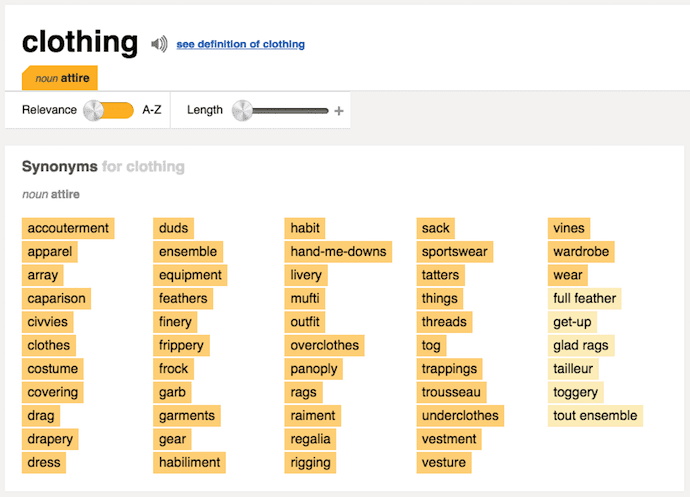
3. Create some sketches.
Now is the time to create some rough sketches. Allow your brand story and keywords to guide you and make some initial logo ideas.
Remember, these are your first drafts. The important thing is to get the ideas out of your head and onto the paper, so trust the process and just let the ideas flow. You’ll have the opportunity to refine your ideas later.
“The beauty of a first draft lies in its imperfections; it’s the starting point for refining ideas and finding the perfect balance.” – David Airey
Logo designer David Airey knows a thing or two about sketching. Embrace the imperfections of your first drafts and let your creativity flow!
As you’re sketching the concepts for your logo, keep these tips in mind:
- Keep the shape simple. You’re in good shape if you can sketch the most symbolic components in seven seconds or less.
- Avoid any popular clip-art artwork or generic symbols like a globe, star, or similar icons that people too quickly identify from other places.
- Be strategic about your use of color. Consider today’s color trends as well as popular colors in your industry. As a general rule, don’t choose more than three colors. Choose a color or group of colors that will make you stand out from your competition, but please, for the love of marketing, don’t use the whole rainbow!
4. Choose a sketch and refine it.
Now that you have some sketches, pick the one that speaks to you most and put on your thinking cap.
“Design is thinking made visual.” – Saul Bass
Make a deep effort to reflect on your brainstorming words and brand story and visualize your thoughts. Use your mental efforts to refine your logo sketch into a meaningful, deep, relatable design that ties back to your brand’s core values.
Easier said than done, but this is where the heavy lifting comes in.
5. Develop your logo’s layout on a free design platform.
If you’ve been working on paper until now, now is the time to bring your design to the computer and create a layout. Your logo layout is how individual elements of your logo are organized and positioned in relation to each other.
Here are some free tools you can use to scan your sketch and start creating a layout:
Proper alignment of your logo is the key here. Your logo doesn’t need to be perfectly symmetrical, but it should appear visually balanced.
“Whitespace is like air: it is necessary for design to breathe.” – Wojciech Zieliński
The whitespace between different elements of your logo is the unsung hero of your design and the secret you must uncover in this step of the process.
Strive for a crisp, balanced logo where everything feels like it’s in the right place. If your design looks great in black and white, then you know you have a well-balanced logo.
6. Choose your colors.
The color palette you choose for your logo says a lot about your brand.
For example, blue communicates trustworthiness and maturity, while red shows passion and excitement. Consider your brand story and the keywords you brainstormed earlier when choosing your logo colors.
“When you choose a new color palette, 60% of the palette should be dedicated to one color (usually, it’s a neutral color), another (complementary) color makes up 30% of the palette, and a third color (accent) is used for the remaining 10% of the design.” – Nick Babich
Product designer Nick Babich drops some wisdom about the three-color rule in design. You don’t need to choose multiple colors for your logo, but if you decide to go the multicolor route, keep everything harmonious by following this design principle.
7. Choose a font.
Now it’s time to combine text with imagery.
Consider the typeface this text will carry if your company name ever stands without your logo. If you decide on a wordmark or lettermark logo as opposed to a symbol, your font choice is even more crucial.
Believe it or not, your font choice can say a lot about your business. You can choose a font that’s either serif (with stems on each letter) or sans serif (no stems) — also known as classic or modern, respectively.

Stay away from generic fonts that come standard on every word processor. Some examples of generic fonts are Times New Roman, Lucida Handwriting, and Comic Sans. These fonts will only work against you and your company by making you less memorable.
“Display type is a visual voice. Without reading, it imparts its message.” – Laura Worthington
Designer and typography guru Laura Worthington hits the nail on the head regarding the importance of font selection. Your font choice goes beyond just conveying information as text; it is a crucial aspect of your design.
8. Ensure scalability.
Logos are meant to represent your company on multiple platforms — in print, on your website, on each of your social media business pages, and across the internet as your business grows.
You want a logo that can be blown up super large for a billboard or scaled down for screening onto the side of a pen.
Every part of your logo should be legible, regardless of the logo’s size.
9. Get feedback.
“There are three responses to a piece of design — yes, no, and WOW! Wow is the one to aim for.” – Milton Glaser
Once you feel your logo design is ready, consider sharing it with others and seeking constructive feedback.
Of course, you can seek input at any point in the process, but it is precious to get people’s reactions to your realized vision and reiterate from there.
Whew — still with us? We know this might seem a little overwhelming, but take it slow and don’t rush yourself.
It’s better to follow the process through to completion and end with a remarkable logo than to start over a few months later due to a design error or change of heart.
Once you’ve completed your logo, how can you tell if you scored a winner? Easy: Use our Logo Grader to assess the sustainability and effectiveness of your new logo.
With millions of logos worldwide, you may be surprised that they all fit into one of seven main categories.
Each logo type has its characteristics, strengths, and weaknesses, so choose the variety that best aligns with your brand values and goals when designing your logo.
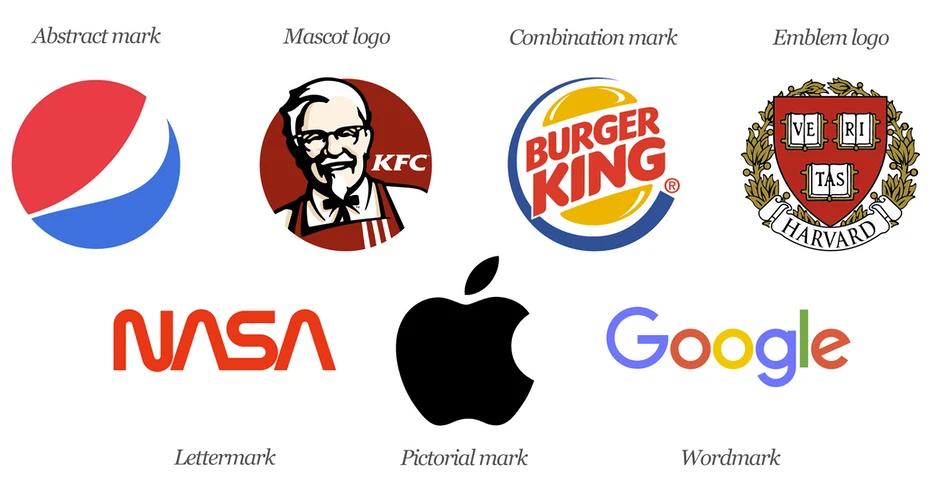
Emblems
An emblem is a logo incorporating text within a symbol for a cohesive image, often conveying formality and tradition. It is strong and impactful, yet challenging to separate for integration and may not reproduce well in small sizes.
Pictorial Marks (or Logo Symbols)
Pictorial marks, also known as logo symbols, are logo types that rely on a single image to represent a brand. These logos can be iconic and memorable and are effective at conveying a brand without text, yet may pose challenges in establishing brand recognition and connecting to the brand’s purpose without words.
Wordmarks (or Logotypes)
Wordmarks are text-based logos that use typography to turn the brand name into a logo, ideal for companies with unique names. They offer simplicity and integration ease, but may struggle to stand out or suit longer, less distinctive names.
Monogram Logos (or Lettermarks)
Monogram logos, also called lettermarks, use initials to create a concise logo suitable for companies with longer names. They are easy to remember and scale, but may require displaying the full brand name initially for recognition and could be confused with other brands if the initials are similar.
Abstract Logomarks
Abstract logos, such as the Pepsi logo, are unique representations of brands using geometric forms and colors instead of real-life images. They are inherently unique and capable of communicating complex ideas through simple shapes and colors but may be open to misinterpretation due to their abstract nature and unclear meaning for unestablished brands.
Mascot Logos
Mascot logos feature illustrated characters to personify a brand with a fun and friendly image, ideal for brands seeking a light-hearted and family-friendly appeal. They offer an inviting and controllable brand storytelling approach but may not suit serious or corporate brands, and their complex design can pose challenges for reproduction at smaller sizes.
Combination Marks
A combination mark integrates text with an icon, offering versatility by combining a brand name with a memorable symbol. This type of logo provides clarity in brand messaging but may become overly busy if not carefully designed and could face challenges in scaling down for smaller applications.
Logo Design Best Practices
1. Keep it simple.
Simplicity is key in logo design. Aim for a clean, uncluttered design that communicates your brand identity as straightforwardly as possible. The goal is for viewers to recognize and understand your logo instantly.

Take Nike’s logo, for example. Its simplicity makes it iconic. There’s a reason they haven’t updated it since 1995.
2. Prioritize versatility.
Your logo should be versatile enough to work across various backgrounds and colors. Test your logo against multiple backgrounds and mediums to ensure legibility and clarity in all possible scenarios.
That means you should have alternate color palettes and logo orientations to suit any situation.
3. Design for your audience.
Your logo design should be consistent with how you perceive your brand and how your customers already perceive it.
You must consider your target audience’s buyer persona by researching their demographics and interests. Only then can you serve their expectations and needs in your design.
4. Be original.
Standing out from the pack is essential. Today, almost every market is saturated with competition and options. The design of your logo is as vital to carving out your niche as creating a unique value proposition.
Avoid generic logo designs and cliché symbols that are easily spotted elsewhere. For example, globe-based logos are a dime a dozen:
5. Be timeless.
Your logo should be iconic and timeless. Easy enough, right? Epochal logos like Coca-Cola’s are as rare as they are significant, but that doesn’t mean you can’t aim for a timeless logo as well.

A timeless logo means that it will never go out of style.
One way to ensure that is to steer clear of today’s hottest design trends (which will go out of style sooner or later). Instead, opt for a simple, classic design that would be comfortable representing your brand for years to come.
Logo Design Tools
1. HubSpot Logo Maker
Get started with HubSpot’s Logo Maker
Our logo maker can assist you in designing and customizing the ideal logo for your brand, offering a wide range of professionally designed templates that eliminate the need to start from scratch. By simply providing your industry, company name, and slogan, the tool will offer personalized recommendations tailored to your needs.
2. Canva
Canva is an all-in-one, web-based graphic design tool that you can use to design anything you can think of, including logos. Anybody can use Canva’s intuitive drag-and-drop interface and extensive library of templates and design assets.
In my opinion, Canva is one of the most accessible logo generators, as I have been using the platform for years, making professional graphics without a formal degree or training in design. And my favorite aspect is that you can use pre-existing colorways to create a more visually appealing and aesthetic logo.
Best for: Beginner designers and small business owners who desire a hands-on approach to logo creation.
Pricing: Free plans are available. Canva Pro costs $14.99 monthly. Canva for Teams costs $9.99 monthly for up to three users.
3. Adobe Illustrator
Illustrator is the industry-leading, vector-based graphics software from Adobe, the maker of other popular tools like Photoshop, Lightroom, and InDesign.
Illustrator is a staple for many professional design groups and can be used to create professional logos and limitless other designs.
Illustrator is vector-based, meaning graphics are made of points, lines, shapes, and curves based on mathematical formulas rather than a set amount of pixels.
Accordingly, an Illustrator logo can be scaled up or down while maintaining image quality.
Best for: Experienced design professionals and agencies that require powerful features and ultimate customization and control.
Pricing: Plans start at $22.99 monthly.
4. Hatchful
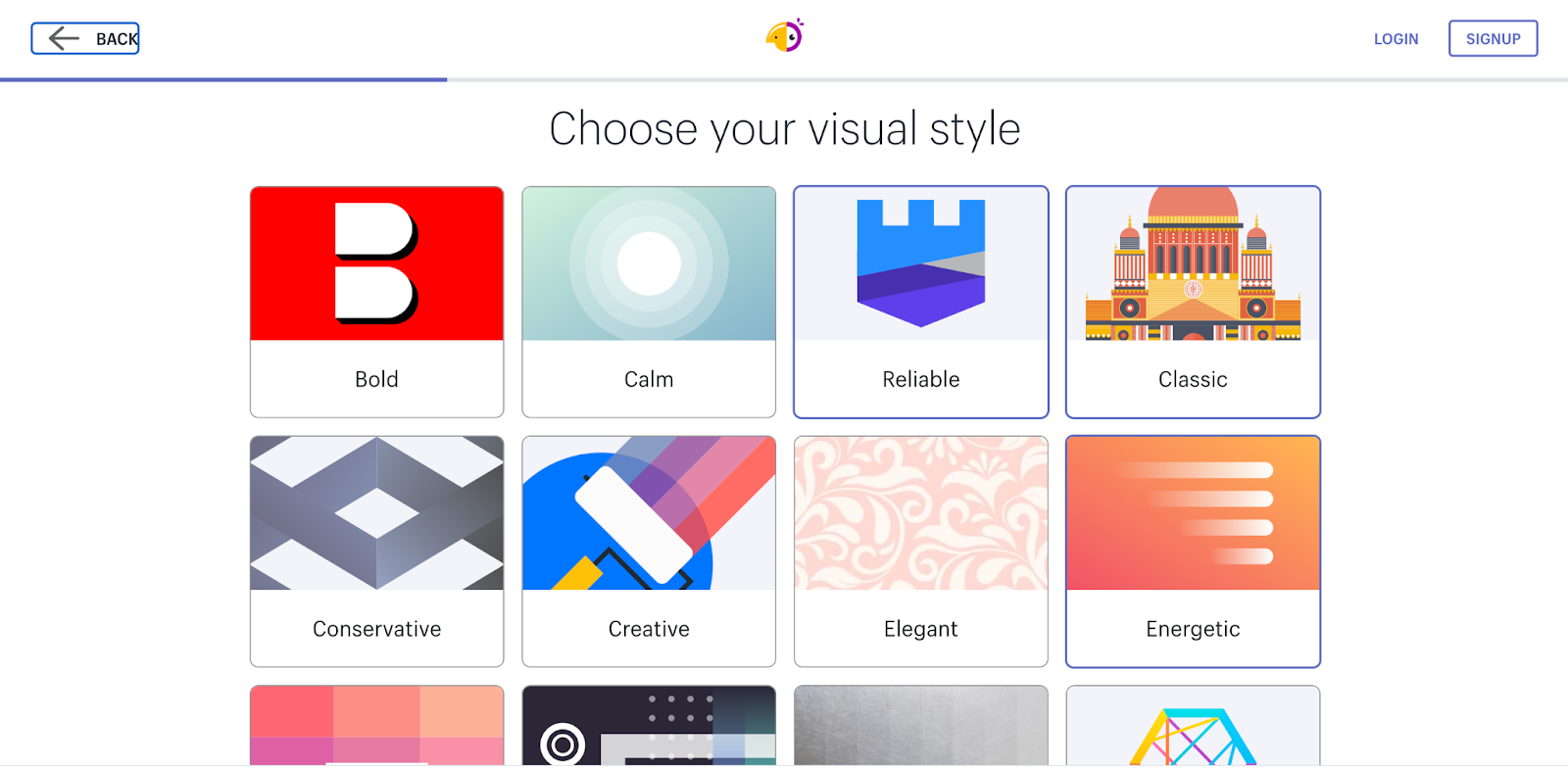
Hatchful is a fast and easy-to-use logo-maker tool from Shopify. The tool will ask you questions about your company’s industry, preferred visual style, brand name, and where you expect to use the logo (print, digital, etc.).
Using the provided information, Hatchful will automatically generate a slew of logo options, which you can select and further customize.
Best for: Entrepreneurs and small business owners looking to create a high-quality logo with minimal design effort quickly.
Pricing: Free.
5. Squarespace Logo Creator
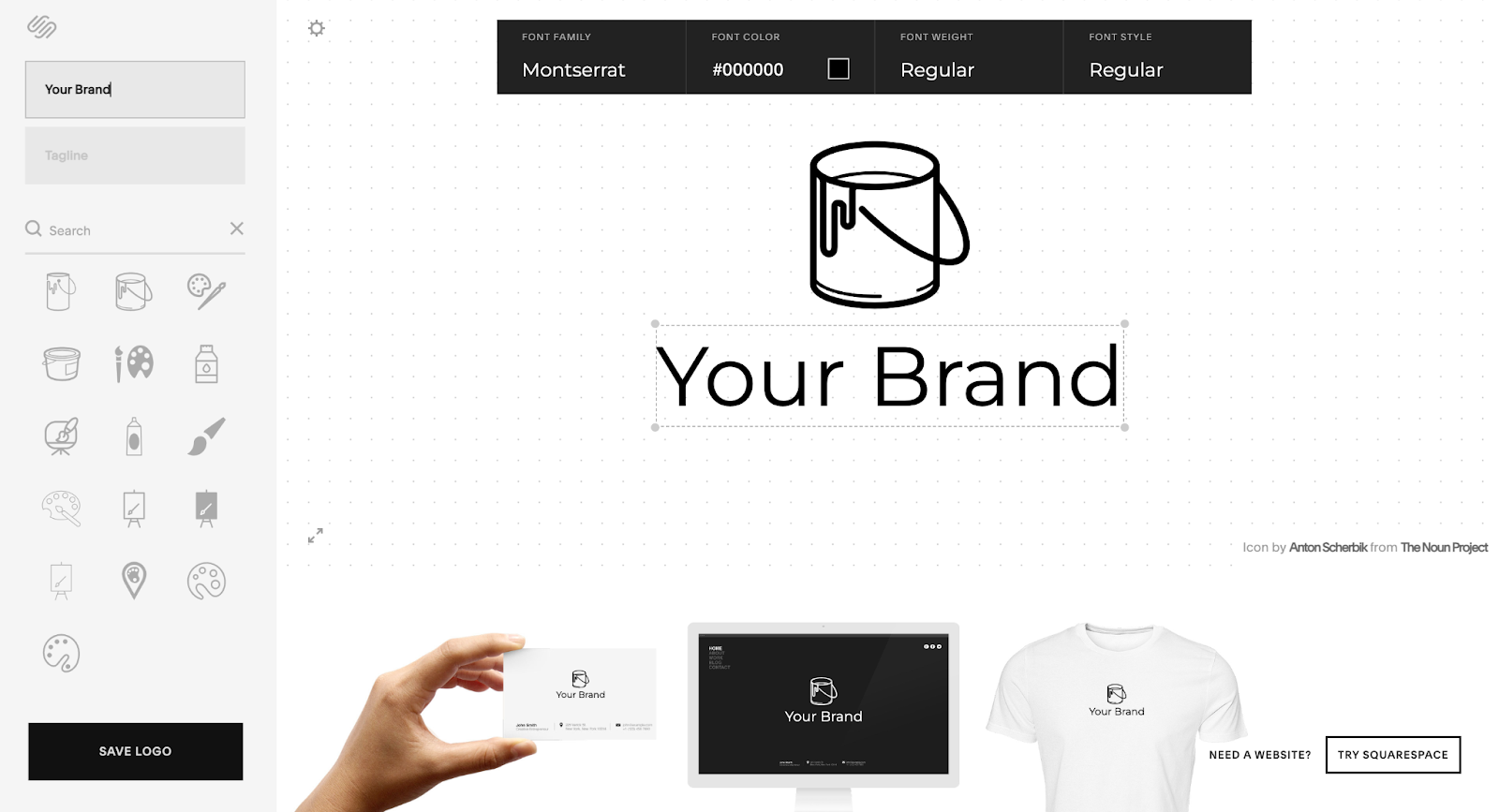
Squarespace’s logo creator tool lets you quickly generate a clean-looking logo for your business. The logos that this tool empowers you to create are consistent with the modern and minimal aesthetic that Squarespace is known for.
Input your business name, and Squarespace allows you to serve it up in a beautiful font alongside an icon of your choice. The tool has thousands of vectorized icons and a curated selection of high-quality fonts.
Best for: Entrepreneurs and small businesses looking to quickly create a clean, minimal logo.
Pricing: Free.
6. Looka
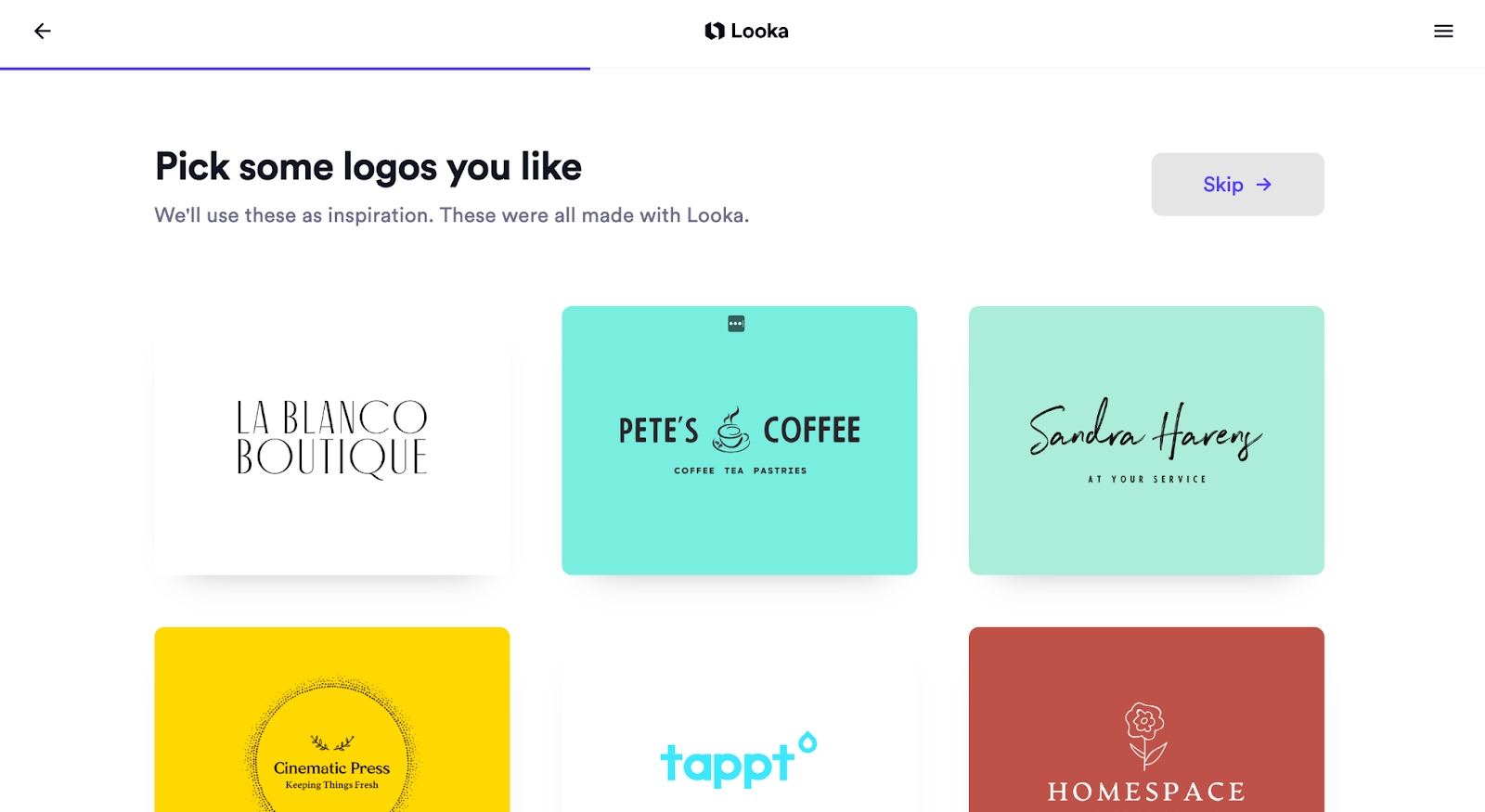
Anyone can design a logo using Looka’s AI-powered logo creation engine. Input your brand name and industry, select your favorite colors, and pick some example logos that speak to you.
Based on your input data, Looka will generate an AI-curated selection of logos. Choose one and customize it to your heart’s content.
Best for: Entrepreneurs and small business owners without design experience who won’t compromise on the quality of their logo.
Pricing: A basic logo package costs $20 for a one-time purchase. A premium logo package is a $65 one-time purchase
7. CorelDRAW

CorelDRAW is a fully loaded, desktop-based vector design program that runs on Windows and macOS.
CorelDRAW is an alternative to Adobe Illustrator that offers nearly all the same functionality and allows you to transform sketches and ideas into fully-fledged logos.
Since you can purchase CorelDRAW outright instead of as a subscription, it can be a more budget-friendly choice than Adobe.
Best for: Professionals and experienced designers who require a complete design toolkit.
Pricing: Plans cost $22.42 monthly or $549 for a one-time purchase.
8. Affinity Designer

Affinity Designer is another fully-featured desktop alternative to Adobe Illustrator that runs on macOS, Windows, and iPad.
It is considerably more budget-friendly than alternatives. It features a slick, dark UI, fast performance, and all the features a professional designer needs to create logos and other design assets.
Best for: Professional designers and agencies looking for a fully featured, budget-friendly alternative to Adobe.
Pricing: Affinity Designer is a $69.99 one-time payment.
Designing a Logo for Your Brand
Now that you know about the types of logos, the process for creating one, best practices, and some tools you can use, get started crafting the perfect logo for your brand.
Create a logo that captures your audience’s attention, communicates your brand values, and makes you stand out from the crowd.
Editor’s note: This article was originally published in October 2023 and has since been updated for comprehensiveness.